Global customer support sounds organized in strategy decks.
In reality, it often sounds chaotic. The operational problem most vendor management teams quietly fight every quarter. And it gets worse as outsourcing networks grow.
Enterprise support operations stretch across India, the Philippines, Latin America, Eastern Europe, and Africa. Multiple BPOs handle the same customer journey. However, customers still expect one consistent conversation every time they call.
That expectation collides with reality fast.
Early in any offshore scaling initiative, companies usually invest heavily in onboarding, QA calibration, and accent coaching. However, communication friction still leaks into calls. Customers hesitate. Agents repeat themselves. Handle times climb.
Consequently, more enterprises are exploring real-time accent harmonization as operational infrastructure instead of treating communication clarity as a training-only problem.
What Is Accent Harmonization in Offshore Vendor Management?
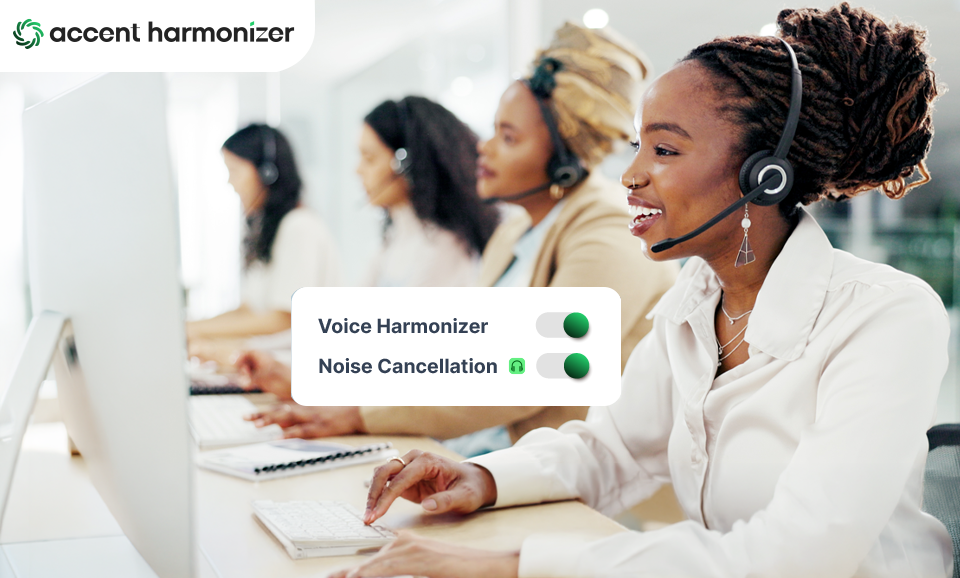
Accent harmonization uses real-time speech processing to make agent conversations easier for customers to understand without changing the agent’s natural speaking identity. Instead of forcing agents to “sound American” or imitate another region, the technology adjusts pronunciation clarity during the live call.
Traditional accent training depends heavily on coaching quality, repetition, and agent adaptability. Results vary dramatically across locations and hiring pools.
Real-time harmonization approaches the problem mechanically instead. The same phoneme-level tuning gets applied during every interaction, regardless of where the agent sits. As a result, customers experience fewer moments where comprehension breaks down.
The Real Problem with Multi-Vendor BPO Operations
Most offshore support environments are stitched together over years. This segmentation creates operational fragmentation.
Customers Experience Variability Immediately
Customers do not analyze workforce strategy. They react emotionally to the conversation they had with agents, impacting trust.
Specifically, communication friction usually shows up in four operational areas:
- Longer Average Handle Time (AHT)
- Lower First Call Resolution (FCR)
- Higher repeat call volume
- Escalation-heavy customer interactions
Why Accent Training Alone Stops Working at Scale
Most outsourcing contracts already include accent training requirements. However, they often measure process completion instead of customer comprehension. A vendor may pass every training audit while customers still struggle during live interactions.
Why Training Outcomes Become Unstable
Accent training outcomes vary because speech adaptation depends on several factors:
| Training Variable | Why Results Become Inconsistent |
|---|---|
| Regional speech patterns | Some pronunciation shifts are harder to retrain |
| Trainer quality | Coaching effectiveness differs across sites |
| Ramp timelines | Fast hiring cycles reduce reinforcement time |
| Agent turnover | High attrition resets communication progress |
| Call complexity | Technical support requires clearer articulation |
Consequently, vendor management teams end up trapped in endless audit cycles without fixing the actual customer experience problem.
How Accent Harmonization Changes Vendor Governance?
Accent harmonization changes vendor management because it removes one major source of distorted performance data. Once communication friction decreases across sites, performance comparisons become cleaner. If one vendor still underperforms, leadership can focus on actual operational problems instead of debating speech clarity.
Vendor Meetings Become More Actionable
Without communication distortion clouding the metrics, teams can isolate real operational failures faster.
For example:
- Weak onboarding programs
- Poor escalation handling
- Script adherence issues
- Coaching inconsistencies
- Knowledge gaps in complex workflows
As a result, vendor reviews spend less time arguing about symptoms and more time fixing operational weaknesses.
Why This Matters for Performance-Based Vendor Contracts?
Many enterprise outsourcing agreements rely on KPIs tied to customer outcomes. However, those metrics become unreliable when customers struggle to understand agents differently across regions. Accent translation and neutralization helps normalize those interactions. Consequently, vendors get evaluated more fairly on factors they can control.
| Traditional Governance vs Harmonized Voice Operations | |
|---|---|
| Traditional Vendor Governance | Harmonized Voice Operations |
| Heavy reliance on training audits | Focus on live call comprehension |
| Accent scoring during onboarding | Real-time speech clarity adjustment |
| Metrics distorted by communication gaps | Cleaner cross-site comparisons |
| Long stabilization periods | Faster operational ramp-up |
| Escalations tied to misunderstanding | Reduced repeat clarification moments |
Faster Vendor Ramp-Ups During Growth Periods
New vendor launches create operational chaos. Leadership wants capacity online immediately. QA teams rush calibrations. Customers absorb the mistakes. Communication friction usually spikes during this phase.
New agents are still adapting to pacing, terminology, and customer expectations. Consequently, customers often feel like support quality suddenly dropped overnight.
Accent harmonization helps reduce that instability. Agents become easier to understand earlier in the ramp cycle. That gives operations teams more room to stabilize performance without overwhelming QA and coaching teams.
For seasonal support environments, this becomes especially important. Nobody wants holiday call queues flooded with repeat contacts because customers abandoned the first interaction halfway through.
The Financial Impact of Communication Friction
Communication friction rarely appears as one catastrophic event. Instead, it leaks money slowly across the operation. Thus, calls run longer, repeat contacts rise and supervisors spend more time handling escalations. It causes customer frustration to increases silently.
Eventually, vendor costs drift upward without an obvious explanation.
| Where Communication Friction Usually Appears | |
|---|---|
| Operational Metric | What Communication Friction Causes |
| AHT | Longer explanations and repeated clarification |
| FCR | More callbacks due to misunderstanding |
| CSAT | Lower trust during interactions |
| QA Scores | Reviewers react to customer frustration |
| Escalation Rates | Customers lose patience faster |
According to McKinsey & Company, even small reductions in repeat contact volume can materially lower contact center operating costs at enterprise scale. Therefore, reducing comprehension friction affects both customer experience and operating margins simultaneously.
Why Voice Clarity Is Becoming Core CX Infrastructure
Ten years ago, communication clarity was treated mainly as a coaching problem. Modern support operations are too distributed, too fast-moving, and too dependent on rapid offshore hiring. Companies cannot realistically coach thousands of agents into identical speech patterns.
Accent harmonization does not erase regional identity. Instead, it reduces the moments where customers mentally disconnect because understanding suddenly requires extra effort.
Consequently, voice clarity is becoming part of the underlying infrastructure that keeps global support operations stable.
Accent Harmonizer for Enterprise Vendor Networks
Omind AI’s Accent Harmonizer around a practical operational problem: helping enterprises maintain understandable customer conversations across distributed offshore support environments.
The platform focuses on improving real-time voice clarity without forcing agents to abandon their natural speech identity. Instead of relying entirely on training cycles and audit-heavy governance, enterprises gain an additional operational layer designed to reduce communication friction directly during the live interaction.
Final Thoughts
Most offshore support problems do not begin with catastrophic operational failure. They begin with tiny moments of customer confusion repeated thousands of times per day.
Multiply that across global vendor networks, communication friction becomes an expensive operational problem hiding inside ordinary metrics. That is why more enterprises are starting to treat voice clarity as infrastructure instead of soft-skills coaching alone.
Stop treating communication friction as a training problem.
See how Accent Harmonizer can serve as critical infrastructure for your global vendor network. Schedule a Demo