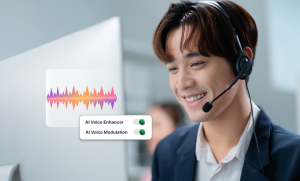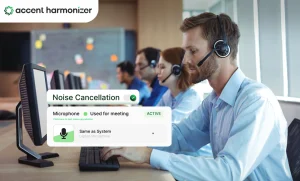

BPO agents can be fluent, highly trained, and technically proficient while customers still struggle with unfamiliar pronunciation patterns. These moments surface as clarification requests, repetition, slower conversations, and unnecessary escalations. The underlying operational bottleneck is not language proficiency; it is cross-accent intelligibility.
Accent translation for BPO is real-time speech technology designed to reduce this friction. It operates directly within the active voice path to adjust specific acoustic markers, ensuring speech is instantly clear. It is fundamentally distinct from language translation, as the underlying language and message remain entirely unchanged.
What Is Accent Translation for BPO?
Accent translation for BPO is real-time speech-processing technology that adjusts selected pronunciation and accent characteristics during live customer conversations, so speech is easier to understand while the underlying language and message remain unchanged.
The software operates inline during live speech, targeting specific phonetic variables that drive comprehension friction. It does not translate English into another language, nor does it alter the underlying vocabulary. Instead, it preserves speaker identity, tone, and conversational flow while smoothing phonetic markers for the listener.
| Voice & Speech Technology Breakdown | ||
|---|---|---|
| Technology | What It Changes | Primary Goal |
| Language translation | Language and words | Cross-language understanding |
| Accent translation | Pronunciation/accent characteristics | Cross-accent understanding |
| Noise cancellation | Environmental background audio | Cleaner audio signal |
| Accent training | Speaker behavior over time | Long-term speech development |
Vendor terminology varies across the market, so BPO procurement teams should evaluate what a platform modifies within the audio path rather than relying on category labels.
Why Accent Friction Becomes an Operational Problem in BPOs?
In distributed contact centers, cross-accent friction cascades through core operational metrics:
| Accent Friction & Escalation Cascade Diagram |
|---|
Step 1 Unfamiliar Accent → Step 2 Higher Listening Effort → Step 3 Clarification Request → Step 4 Agent Repetition → Step 5 Added Talk Time → Step 6 Customer Frustration → Impact Escalation |
Operations leaders notice specific operational signals when this friction is present:
- Frequent customer clarification phrases (“Could you repeat that?”)
- Customers asking agents to spell out standard names, dates, or numbers
- Agents artificially slowing their natural speaking pace to compensate
- Repeated verification of order, policy, or account details
- Avoidable transfer requests to onshore tier-2 agents
- Structural Average Handle Time (AHT) variance across customer geographies
Comprehension friction is driven by listener familiarity and phonetic variance, not by the intrinsic quality of an agent’s accent.
Where Accent Translation Creates the Most Value in BPO Operations?
Multiplied across millions of annual voice minutes, minor comprehension delays create substantial financial drag. Accent translation targets specific high-friction operational workflows:
- Offshore Customer Support: Global delivery teams in regions like India, the Philippines, or LATAM serving US, UK, or Australian markets where listener familiarity varies.
- Technical Support: Interactions involving complex serial numbers, alphanumeric error codes, software commands, or multi-step troubleshooting instructions where misheard letters create rework.
- Sales and Retention: High stakes call where customer hesitation during offer presentations or objection handling directly degrades conversion rates.
- BFSI and Regulated Services: Loan servicing, insurance claims, and banking environments where policy disclosures, dates, and financial amounts leave zero room for misunderstanding.
How Does Accent Translation Work During a Live BPO Call?
Live speech processing relies on dynamic acoustic adaptation executing within milliseconds.
- Capture live speech: The system intercepts raw agent audio from the microphone input within the active voice path.
- Analyze speech characteristics: Deep neural networks analyze incoming phonetic structures, pitch, cadence, and acoustic features affecting intelligibility.
- Adjust selected cues: The engine applies targeted modifications exclusively to the pronunciation markers that cause listener friction.
- Return processed speech in real time: Processed audio streams to the customer seamlessly.
| Real-Time Accent Harmonization Loop Workflow |
|---|
Input Agent Speech → Processing Speech Analysis → Execution Targeted Adjustment → Output Customer |
To preserve natural turn-taking and prevent agents and customers from talking over one another, processing must maintain ultra-low latency. Standard enterprise deployments require processing speeds under 200 milliseconds to avoid conversational lag.
Accent Translation vs. Accent Harmonization vs. Accent Neutralization
Understanding category terminology helps procurement teams select platforms aligned with operational goals.
| Speech & Accent Management Paradigms | ||
|---|---|---|
| Approach | Main Objective | Key Consideration |
| Accent translation | Broad market category for improving cross-accent understanding | Voice naturalness and system latency |
| Accent harmonization | Reduces speech friction while preserving voice identity and emotion | Speaker identity and cadence preservation |
| Accent neutralization | Standardizes region-specific pronunciation markers aggressively | Risk of robotic or synthetic output |
| Language translation | Converts semantic meaning between different languages | Completely separate operational use case |
In practice, vendors use these terms interchangeably. Enterprise buyers should focus on what the software modifies, what it preserves, and how it handles active call volume.
How Can Accent Translation Affect BPO Performance?
Modifying live audio streams changes how interactions progress, directly impacting key workforce management metrics:
- Average Handle Time (AHT): Removing repeat explanations and confirmation loops reduces unnecessary talk time.
- First-Call Resolution (FCR): Preventing misheard details ensures customer requests are accurately resolved during the initial contact.
- Customer Effort Score (CES): Reduces the cognitive strain placed on callers during complex technical or financial exchanges.
- Agent Pacing: Agents speak at a natural cadence without continuously self-monitoring their pronunciation.
- Workforce Deployment: Delivery leads can flexibly route agent pools across international accounts without geography-specific comprehension barriers.
| Speech & Accent Friction Signal Analysis | ||
|---|---|---|
| Friction Signal | Observable Call Behavior | Potential Metric Impact |
| Repetition loops | Clarification phrases (“Say that again?”) | Higher AHT |
| Misheard details | Inaccurate data entry / corrections | Lower FCR / Higher AHT |
| Listening fatigue | Mid-call customer frustration | Lower CSAT / Higher Escalations |
| Agent self-monitoring | Artificially slow or hesitant speech | Lower Occupancy / Pacing Drag |
What Should BPOs Measure Before Deploying Accent Translation?
BPOs must establish accurate operational baselines prior to software pilots. Evaluating real-time voice tools requires operational data rather than post-call listening tests.
Teams should benchmark:
- Baseline clarification phrase frequency via speech analytics
- Total call duration spent repeating details
- Transfer rates driven by customer comprehension complaints
- AHT variance between onshore and offshore delivery teams on identical queues
| Common Customer Repetition Phrases & Impact | ||
|---|---|---|
| Customer Trigger Phrase | Root Cause | Operational & CX Impact |
| “Could you repeat that?” | Phonetic mismatch and regional accent variance during live conversation | Increases Average Handle Time (AHT) by 15–30% due to repetition loops |
| “Can you spell that?” | Unclear pronunciation of key entities (names, alphanumeric IDs, emails) | Drives customer friction, cognitive fatigue, and data capture errors |
| “I didn’t understand.” | Severe listener cognitive strain or rapid cadence under cross-accent calls | Reduces First Call Resolution (FCR) and depresses CSAT scores |
Tracking the frequency of these specific acoustic signals before and after deployment provides clean data on whether comprehension friction has decreased.
How Should BPOs Evaluate Accent Translation Software?
Evaluating real-time voice infrastructure requires rigorous operational validation across performance, architecture, and security.
| Real-Time Voice Harmonization Evaluation Framework | |
|---|---|
| Criterion | What to Evaluate |
| Intelligibility | Does customer comprehension measurably increase on live calls? |
| Naturalness | Does the output retain human vocal nuances without sounding synthetic? |
| Voice Identity | Are the agent’s unique tone, pitch, and emotional cadence preserved? |
| Latency | Is end-to-end processing under 200ms to preserve natural conversation? |
| Telephony Integration | Does it deploy cleanly via virtual audio drivers across CCaaS environments? |
| Security & Privacy | Is voice data processed locally/in-memory without storing PII or raw audio? |
| Fail-Open Architecture | Does raw audio pass through uninterrupted if the processing layer drops? |
Platforms should always be tested on active agent-customer call corridors rather than pre-recorded vendor demonstration clips.
What Accent Translation Cannot Fix?
Accent translation addresses acoustic comprehension friction; it is not a cure-all for operational deficits.
Technology cannot resolve:
- Gaps in agent product knowledge or workflow compliance
- Weak active listening or poor conversational empathy
- Suboptimal call scripting and IVR routing logic
- Flawed escalation workflows
- Network latency, packet loss, or hardware-level audio distortion
- Genuine cross-language barriers requiring native translation
Accent translation removes a specific layer of communication friction, but it works alongside—not in place of—core BPO operational management.
Where Accent Harmonizer Fits in BPO Voice Operations?
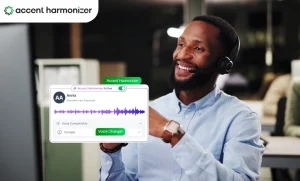
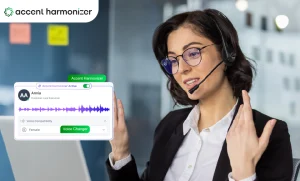
For operations teams targeting communication friction without sacrificing agent voice identity, Omind Accent Harmonizer provides real-time, zero-latency voice adaptation.
It is designed for enterprise contact centers and global BPOs. The platform operates directly within the telephony voice path. It applies targeted pronunciation adjustments to boost intelligibility while preserving the agent’s natural tone, emotional delivery, and vocal character.
Hear What Your Customers Hear
Evaluate the impact of live real-time speech processing on your operational metrics. Compare raw and harmonized agent audio across active BPO interaction profiles to analyze speech naturalness, latency, and conversational flow.