Customer-facing teams succeed or fail on one core factor: mutual understanding. When communication breaks down, even highly skilled agents struggle to deliver efficient, empathetic service. Harvard Business Review has documented how small communication breakdowns disproportionately impact customer satisfaction in service interactions. They arise from speech clarity challenges created by diverse accents, speaking patterns, and linguistic structures.
As companies expand across regions, customers increasingly interact with agents whose pronunciation differs from what they are accustomed to hearing. This difference is not a flaw, yet it can slow conversations, trigger repeated clarifications, and increase frustration on both sides. Over time, these micro-frictions compound into measurable operational problems.
AI accent reduction software has emerged to address this gap. Its purpose is not to remove accents or suppress identity, but to improve intelligibility in real time so conversations flow naturally. For modern customer-facing teams, this capability is becoming operationally critical rather than optional.
What Is AI Accent Reduction Software?
Automated accent reduction software is a speech-processing system designed to improve how spoken language during live conversations. It focuses on clarity, not conformity.
Instead of retraining agents or altering their voices, the speech accent reduction technology analyzes speech patterns as they occur and adjusts specific pronunciation elements that commonly lead to misunderstanding. These adjustments are subtle and selective, ensuring that the speaker’s tone, emotion, and vocal identity remain intact.
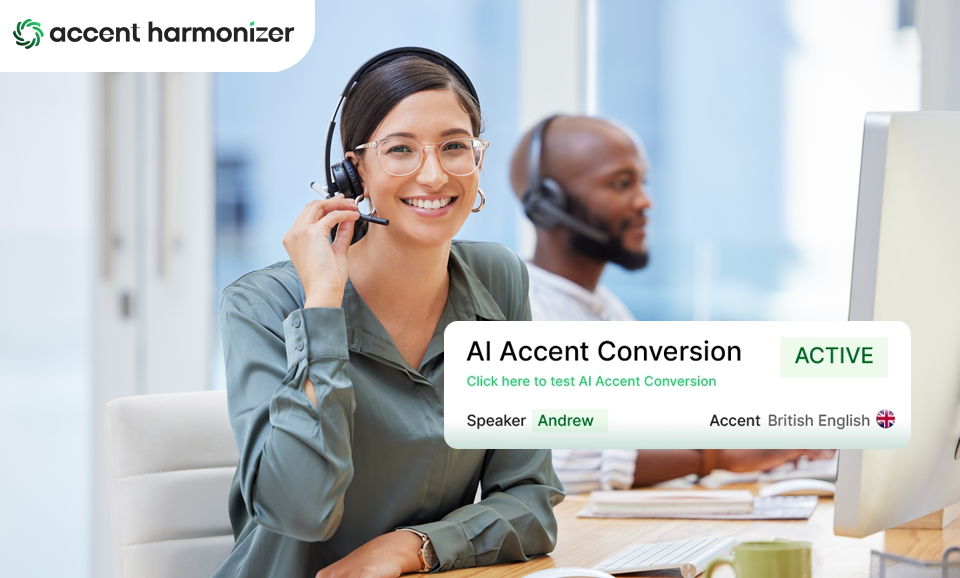
The software operates in real time, sitting between the agent’s microphone input and the customer’s audio output. Its objective is simple: reduce friction without changing meaning or personality.
This distinction is essential. Accent reduction in this context refers to harmonization of speech clarity, not elimination of cultural or regional characteristics.
How the Accent Harmonization Technology Works?
At a high level, AI accent harmonization follow a multi-step speech-processing pipeline.
First, incoming audio is captured and analyzed at the phonetic level. The system identifies pronunciation patterns that statistically correlate with reduced intelligibility for a broad listener base. These patterns may involve stress placement, vowel shaping, or consonant articulation.
Next, context-aware models determine whether an adjustment is appropriate. This step is critical, as language meaning and emotional tone must remain unchanged. Only the specific elements affecting comprehension are modified.
Finally, the optimized speech signal is delivered to the listener with extremely low latency, ensuring the conversation remains natural.
Importantly, technology does not translate language, rewrite sentences, or alter intent. It refines delivery, not content.
Why do Customer-facing Teams Struggle Without Speech Accent Reduction?
In high-volume service environments, even minor communication delays carry cost. When customers struggle to understand an agent, they ask for repetition. Agents slow down unnaturally to compensate and calls lengthen. It increases cognitive load for agents and often leads to frequest escalations.
These effects impact multiple performance indicators simultaneously:
- Average handle time increases
- First-call resolution decreases
- Quality assurance scores fluctuate
- Agent confidence declines
None of these outcomes reflect agent capability. They reflect friction in speech perception under real-world conditions such as background noise, time pressure, and emotional stress.
AI accent reduction software directly targets this root cause by reducing the need for constant conversational repair.
Operational Value Real-time Accent Reduction for Customer-facing Teams
Improved clarity produces downstream benefits across both customer experience and internal operations.
For customers, conversations feel smoother and less effortful. For agents, communication becomes less mentally taxing, allowing them to focus on problem-solving rather than self-monitoring speech.
Organizations typically associate speech clarity improvements with:
- More efficient call flows
- Lower escalation frequency
- More consistent QA evaluations
- Improved agent confidence and retention
While outcomes vary by use case, clarity improvements often influence multiple metrics at once rather than producing isolated gains.
Use Cases with the Highest Impact
AI accent reduction delivers the greatest value in environments where speech precision matters most.
Inbound support teams benefit due to high volume and limited call time. Technical support environments see gains because complex terminology amplifies mishearing risk. Global delivery centers rely on the technology to maintain consistent experience across regions.
It is also effective during onboarding, where new agents may struggle initially despite strong knowledge, and during seasonal surges when temporary staff must perform quickly.
In each scenario, clarity directly affects perceived competence.
Technology Versus Traditional Training
Accent training has long been the primary approach to addressing speech clarity. While valuable for personal development, it has practical limitations.
Training requires months of effort, produces inconsistent outcomes, and places heavy cognitive burden on agents. Results vary widely based on aptitude, coaching quality, and sustained practice.
AI accent harmonizer complements training by providing immediate, consistent support without requiring behavioral change.
| Accent Training vs AI Accent Reduction | ||
|---|---|---|
| Dimension | Accent Training | AI Accent Reduction |
| Time to impact | Long-term | Immediate |
| Scalability | Limited | High |
| Consistency | Variable | Uniform |
| Cognitive load | High | Minimal |
| Ongoing effort | Continuous | Passive |
For modern contact centers, technology addresses operational needs while training supports long-term growth.
How to Evaluate AI Accent Reduction Software?
Not all solutions offer the same capabilities. Evaluation should focus on measurable criteria.
From a technical standpoint, real-time speech clarity performance and low latency are non-negotiable. Voice preservation is equally critical; if agents sound artificial, trust erodes quickly.
Integration and readiness matter as well. Solutions should connect cleanly with existing telephony or VoIP infrastructure without forcing workflow changes.
Data handling and privacy policies must be explicit. Organizations should understand how audio is processed, whether recordings are stored, and how regulatory obligations are met.
Finally, reporting capabilities determine long-term value. Without visibility into performance impact, ROI remains speculative.
Conclusion
As customer expectations rise and global teams expand, speech clarity becomes foundational to service quality.
AI accent reduction software enables organizations to improve understanding immediately while preserving individuality, inclusion, and human connection.
To explore how real-time accent harmonization can support your customer-facing teams, request a live demonstration with Accent Harmonizer.