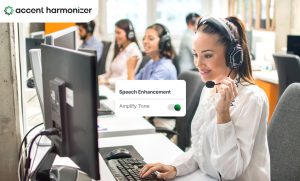

AI-powered voice harmonization has entered the contact center conversation with a lot of noise around it. Depending on who you ask, it is framed as accent removal, voice normalization, or even to fix communication challenges in global customer service.
That framing is the fastest way to misunderstand AI-powered voice harmonization.
Voice harmonization technology does not exist to change who someone is or how they sound at a fundamental level. It exists to reduce friction in how speech is received. When positioned honestly, AI voice harmonization is not transformative in a theatrical sense, it is corrective, selective, and intentionally limited.
This article draws a clear boundary between what AI-powered voice harmonization changes, and what it does not. That distinction matters, especially for enterprises trying to improve customer experience without chasing novelty.
What is AI-powered Voice Harmonization Technology?
AI-powered voice harmonization is a real-time speech processing approach that improves intelligibility without changing how a speaker sounds. Its purpose is narrow and practical: reduce the moments where listeners mishear, ask for repeats, or lose the thread of a conversation. The platform does not:
- generate new voice
- replace an accent with a “neutral” one
- translate language or rewrite meaning
Voice harmonization operates at the phonetic and prosodic level: specific sounds, timing, and stress patterns that are commonly misinterpreted across regions. In real interactions, most breakdowns come from these small variations rather than from an accent.
By adjusting only what consistently causes confusion and leaving everything else untouched, harmonization remains usable in real time. Systems that attempt to change too much tend to be overcorrect and sound processed.
How AI-powered Voice Harmonization Works?
This section explains how AI-powered voice harmonization works:
- Speech is captured in real time: The system processes live audio as it is spoken, not after the fact.
- Phoneme-level analysis is applied: Speech is broken down into sounds, timing, stress, and rhythm to identify where listeners commonly mishear.
- Only targeted adjustments are made: The system modifies specific acoustic elements that affect intelligibility, rather than reshaping the entire voice.
- Processing stays low latency: Effective voice harmonization operates fast enough that neither speaker nor listener perceives delay or interruption.
- Natural speech characteristics are preserved: Emotional inflection, vocal texture, and speaker identity are left untouched.
- The outcome is clarity, not transformation: Voice harmonization does not make speech sound different, it makes it easier to understand.
What AI-powered Voice Harmonization Actually Changes?
Here are some of the ways enterprise adoption of voice harmonization assists:
Clarity at the Interaction Level
Voice harmonization improves intelligibility during live conversations. Listeners ask for fewer repeats. Agents spend less time rephrasing. Conversations move forward without forcing speakers to slow down or modify how they talk. The system reduces friction, while maintaining speech natural and improves comprehension.
Voice harmonization does not remove accents. It reduces the effort required to understand them.
Operational Effects in Contact Centers
Voice harmonization lowers dependency on accent familiarity. Hiring decisions can prioritize capability over perceived “clarity.”
From an accessibility standpoint, the burden shifts away from the speaker. The system adapts to the listener instead of asking people to change how they speak.
Talent and Accessibility Implications
Voice harmonization lowers dependency on accent familiarity. Hiring decisions can prioritize capability over perceived “clarity.”
From an accessibility standpoint, the burden shifts away from the speaker. The system adapts to the listener instead of asking people to change how they speak.
Clarity should be a system responsibility, not a personal one.
What AI-powered Voice Harmonization Does Not Change?
In practice, the value of voice harmonization becomes clearer when its boundaries are explicit—what the technology is designed to improve, and what it deliberately leaves untouched.
- It Does Not Remove Identity: Voice harmonization does not erase regional or cultural markers. It preserves speaker identity while improving intelligibility. Any system that claims otherwise is not practicing voice harmonization, practicing replacement.
- It Does Not Improve Poor Communication: Clearer audio does not compensate for weak product knowledge, rigid scripting, or lack of empathy. Accent harmonizer platform improves how speech is heard, not what is being said.
- It Does Not Create a Universal “Ideal Voice”: There is no universal accent that works for every listener. Effective voice harmonization adapts to context and interaction patterns rather than enforcing a standardized voice model.
Voice Harmonization vs. Commonly Confused Technologies
Most confusion around voice harmonization comes from collapsing distinct technologies into a single category. The table below separates accent harmonizer with other voice technologies by intent, impact, and constraint.
| AI-Powered Voice Harmonization vs Other Approaches | ||||
|---|---|---|---|---|
| Aspect | Accent Neutralization | Voice Changer | Speech-to-Speech Translation | AI-Powered Voice Harmonization |
| Core objective | Suppress accent traits | Alter or mask the speaker’s identity | Convert spoken language into another language | Improve intelligibility while preserving the original voice |
| Unit of change | Identity-bearing features | Phoneme / pattern mapping | Entire language structure | Acoustic variance |
| Operation type | Suppression-based | Transformational | Translational | Constraint-based |
| Effect on identity | Reduced | Altered | Intentionally changed | Retained; only friction-causing acoustic elements are adjusted |
| Suitable for live speech | Limited | Risk-prone | No | Yes |
| Use case fit | Training or standardization environments | Entertainment, anonymity, effects | Cross-language communication | Live conversations where clarity matters without conformity |
| Key limitation | Does not fix content, intent, or communication skill | Risks loss of identity and authenticity | Breaks naturalness and trust | Introducing translation latency and semantic risk |
Where AI-powered Voice Harmonization Makes Sense?
AI-powered voice harmonization delivers the most value in environments where clarity matters more than conformity.
Common use cases include:
- Voice harmonization in customer experience teams
- Global contact centers with regionally diverse agents
- Cross-border internal communication
In contrast, already mono-regional teams or heavily scripted IVR environments may see limited gains. Voice harmonization is not a substitute for training, QA, or process design.
Clearer Frame for AI-powered Voice Harmonization
AI-powered voice harmonization improves how speech during conversation. Its value lies in voice clarity, preserving speaker’s identity, and supporting customer experience without distortion.
The platform does not guarantee a fix, or a replacement for human communication skills. It is a precision tool for reducing friction where it matters. The real question is not whether voice harmonization changes voices. It is whether it enables understanding without asking people to become someone else.
Evaluate voice harmonization under real contact center conditions. Schedule a demo of Accent Harmonizer by Omind and assess its impact on live calls.