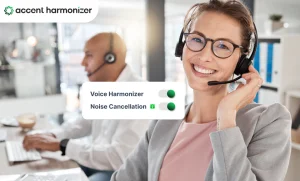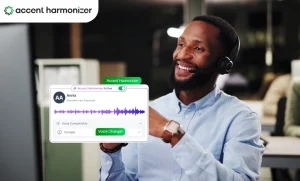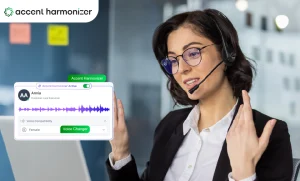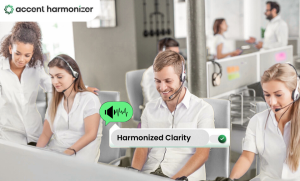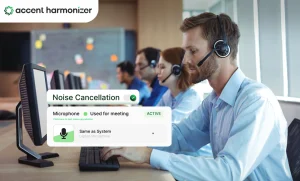

In global customer conversations, often accents create friction and make calls run longer. These communication errors make customers weary, causing deals to fall apart. Real-time accent harmonizer software addresses such problems at the system level. The AI pronunciation improvement software fixes conversation gaps during the live conversation itself. This guide breaks down what technology does, who needs it, and why it’s becoming essential infrastructure for call centers and BPOs worldwide.
What Is Real-Time Accent Harmonizer Software?
An AI pronunciation improvement software layer acts as a real-time communication bridge. It processes live speech during a call and transforms it for greater clarity in under a second.
Key Differences in Timing
The primary distinction lies in when the processing occurs. Most traditional tools operate outside the live interaction:
- Training Tools: These work before the call and often take weeks to show results.
- Post-Processing: These analyze data after the call for QA or coaching.
- Real-Time Harmonization: This happens during the call. It adapts phonetics and speech patterns instantly so the listener experiences natural communication.
Why Real-Time Technology Matters?
The performance gap between training and live-call behavior is a known challenge. Even well-trained agents may lose clarity under pressure or when fatigued.
Because AI pronunciation improvement software does not fatigue, it maintains high standards throughout a shift. It applies consistent enhancement to every call, ensuring that every customer interaction remains clear and professional.
Accent Translation vs Accent Neutralization vs Accent Conversion — What Do These Terms Mean?
These terms are often used interchangeably, but they describe meaningfully different things. It is important to understand the critical CX technology distinctions before choosing a solution:
| Demystifying Accent Processing Terminology | ||
|---|---|---|
| Term | What It Actually Means | Primary Use Case |
| Accent Translation |
| Global digital conversations |
| Accent Neutralization | Reducing strong regional phonetic deviations to improve baseline intelligibility. | Call centers, enterprise voice AI |
| Accent Conversion | Adapting speech toward a specific listener-familiar pattern in real time. | BPOs, global support teams |
When people search for ‘accent translation software,’ their intent is almost always clarity. Real-time accent harmonization addresses that intent directly without the risks of semantic drift often found in pure translation pipelines.
Why Pronunciation Training Fails in Live Customer Conversations?
Pronunciation training is a legitimate tool for long-term skill development However, many contact centers are adopting software instead of training programs because of structural limitations:
- Time to Proficiency: Most accent training programs take weeks or months to show measurable improvement — and even then, results vary significantly between agents.
- Regression Under Pressure: Agents who perform well in training often revert to natural speech patterns when handling difficult calls or high volumes.
- Scalability: Retraining hundreds or thousands of agents is a recurring cost with no ceiling, especially in BPO environments with high turnover.
This is the performance-versus-learning gap. Real-time AI operates at the infrastructure level, independent of individual agent performance, and significantly shortens ramp-up time for new agents.
How AI Pronunciation Improvement Software Beats Traditional Training?
Voice clarity and pronunciation accuracy are related but distinct concepts. Pronunciation accuracy focuses on whether a word is phonetically correct. In contrast, voice clarity determines if a listener understands a message without effort.
Modern AI pronunciation improvement software focuses on the latter to bridge communication gaps effectively.
How the Technology Works?
In practice, AI adjusts multiple speech dimensions simultaneously. The ultra-low latency voice AI ensures smoother interaction by addressing three core areas:
- Phonetic Mapping: It reduces sounds that may feel unfamiliar to the listener.
- Intonation Smoothing: The software adjusts patterns that signal a “foreign” tone, even when words are correct.
- Rhythm Normalization: It aligns speech pacing with native-listener expectations.
AI Accent Solutions for BPOs and Global Contact Centers
Business process outsourcing operations face a communication challenge. Friction in communication has measurable costs, often leading to hidden accent bias in CX.
Real-time accent harmonization is particularly valuable for BPOs because it requires no agent retraining, integrates directly with existing call infrastructure. The AI layer sits between input and output, invisible to both parties.
Sales teams face a different but related challenge: accent bias. Research consistently shows that unfamiliar accents makes it difficult for building trust in international markets. AI harmonization levels that playing field by adapting voice output to the listener’s familiarity baseline. It removes an invisible variable from every conversation.
Business Impact — From Voice Clarity to Revenue Outcomes
The business case for real-time accent harmonization is built on four KPIs that CX and operations leaders already track:
| The ROI of Voice Harmonization: Key Performance Indicators | |
|---|---|
| KPI | How Harmonization Moves the Needle |
| CSAT | Fewer miscommunications = higher satisfaction scores. |
| First Call Resolution (FCR) |
|
| Average Handle Time (AHT) | Reducing repetition reduces call length and total handle time. |
| Conversion Rate | Reduced accent bias improves sales call outcomes and overall trust. |
AI accent harmonization has a lower per-seat cost, faster time to impact, and consistent performance regardless of agent tenure or turnover. It’s a CX infrastructure investment, not a recurring training expense.
When Should You Use Accent Harmonization vs Training?
Use real-time accent harmonization when:
- you need consistent clarity across high call volumes,
- when turnover makes ongoing training economically unfeasible, or
- when your customer base spans multiple accent familiarity profiles simultaneously
Use pronunciation training when:
- you’re investing in long-term agent career development,
- building language proficiency programs, or
- supplementing harmonization for agents who want to improve independently
Ready to Eliminate Accent Barriers in Real Time?
Real-time accent harmonizer software isn’t about teaching agents to sound different. It’s about ensuring that every conversation — regardless of who’s speaking or who’s listening — lands with the clarity it deserves. Enterprise-ready, scalable, and deployable without disrupting existing workflows, it’s the infrastructure layer that modern global communication requires.
Book a live demo to see real-time accent harmonization in action across your call environment.