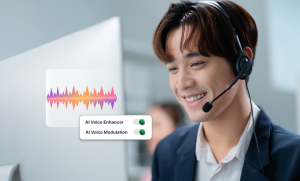

Accent issues don’t just affect how people sound — they affect how quickly they’re understood. In high-volume customer conversations, even small pronunciation mismatches create repetition, confusion, and measurable business cost. AI voice-accent changers promise to solve this, but most explanations blur together very different technologies, leaving buyers unsure of what works in real-time communication. This guide untangles the category, explains the underlying science, and gives you a clear framework for evaluating what matters.
What Is an AI Voice Accent Changer?
The term “AI voice accent changer” is an umbrella that covers at least three distinct technologies and conflating them leads to poor buying decisions. Understanding the differences is the first step to choosing the right solution.
- Real-time Accent Harmonization: This technology modifies a speaker’s accent live, during an active call, with latency low enough that neither party notices the processing. It’s the most technically demanding category and the most relevant for contact center and enterprise CX use cases.
- AI Voice Generation (Text-to-Speech with Accents): TTS systems synthesize voice output in a chosen accent from written text. These are used in IVR systems, voicebots, and content production. Because they don’t process live human speech, latency constraints are less critical — but they also can’t help a live agent in a real conversation.
- Voice Conversion (Post-Processing): Voice conversion tools transform a recorded audio file from one accent to another after the fact. This has legitimate uses in media production and training data generation, but it is fundamentally incompatible with real-time communication. Many vendors market voice conversion capabilities without making this constraint clear.
Why Accent Friction Breaks Conversations?
Accent friction is not a cosmetic issue — it’s a performance issue. When a listener encounters unfamiliar phoneme patterns, their brain must spend additional cognitive resources on decoding pronunciation before meaning can be processed. This is called listening load, and it directly degrades comprehension speed.
In practical terms, this plays out in predictable ways: numbers get misheard (“fifteen” vs. “fifty”), dates get confused, product names get distorted. Each instance triggers a repetition loop — the agent repeats, the customer re-processes, and average handle time (AHT) climbs. When those loops compound across thousands of daily calls, the operational cost becomes significant.
Research in cognitive linguistics consistently shows that even moderate accent unfamiliarity increases processing time and error rates for spoken numerals and proper nouns — precisely the categories most critical in financial services, healthcare, and sales calls. The business impact follows directly: higher AHT, lower first-contact resolution (FCR), and declining CSAT scores.
How AI Voice Accent Changers Actually Work ?
Real-Time Accent Harmonization
The processing pipeline runs as follows: audio is captured from the agent’s microphone, phoneme patterns are detected and compared against a target accent profile, adjustments are synthesized, and the modified audio is delivered to the caller — all within a sub-150ms window. Identity preservation is critical here: the agent’s voice, tone, and emotional register must remain intact. The only thing being adjusted is the phonetic surface layer.
AI Voice Generation (TTS with Accents)
TTS systems use pre-trained voice models fine-tuned to produce specific accent characteristics. Modern systems allow prompt-based generation, where accent, pace, and regional variation can be specified at runtime. Because the input is text rather than live audio, there are no hard latency constraints, and output quality can be very high.
Voice Conversion (Speech-to-Speech)
Voice conversion takes a recorded input audio file and outputs a transformed version in a different accent. The transformation is applied to the entire file after recording. Because processing happens offline, latency is irrelevant — but so is real-time utility. This architecture is well-suited to dataset augmentation, dubbing, and training simulations.
Accent Harmonization vs Neutralization vs Conversion: A Side-by-Side View
Buyers frequently encounter these three terms without a clear explanation of the trade-offs each approach involves. The following Accent Neutralization vs Accent Harmonization vs Accent conversion table below compares them across the dimensions that matter most in a deployment decision:
| Accent & Voice Processing Methods – Side-by-Side Comparison | ||||
|---|---|---|---|---|
| Criteria | Neutralization | Voice Conversion | Accent Training | Real-Time Harmonization |
| Speed | Fast | Post-processing only | Weeks of training | Sub-150ms live |
| Authenticity | Low — robotic | Medium | High | High — preserves voice |
| Scalability | High | Low | Low | High |
| Live Call Use | Limited | No | Yes | Yes |
Real-time harmonization outperforms on the dimensions that matter most for live CX: speed, authenticity, and live call compatibility. The trade-off is implementation complexity and the need for robust infrastructure.
Where AI Voice Accent Changers Deliver the Most Impact?
Not every use case carries the same risk profile for accent friction. The highest-value deployments share a common characteristic: conversations where a single misheard word can have serious downstream consequences.
BPO and Offshore CX
High call volume combined with accent unfamiliarity creates compounding AHT costs. Even a 10-second reduction in average time per call translates to significant capacity gains on a scale.
Financial Services
Numbers are the communication medium. Account numbers, transfer amounts, dates, and rates must be conveyed with zero ambiguity. Accent friction directly increases error rates in these exchanges.
Healthcare
Medication names, dosage instructions, and appointment details are safety critical. Miscommunication here isn’t just a CX failure — it’s a clinical risk.
Sales
Trust and comprehension are both prerequisites for conversion. Accent friction introduces cognitive load that competes with the persuasion task, reducing close rates.
Enterprise Collaboration
Global teams increasingly rely on voice for high-stakes discussions. AI voice accent changer in internal communications improves alignment and reduces the need for post-call clarification cycles.
What Most Buyers Get Wrong About AI Accent Changers?
Several systematic mistakes repeat buyer evaluations. Recognizing them in advance can save months of failed pilots:
- Mistaking TTS tools for real-time solutions: A vendor that excels at voicebot accent generation does not necessarily have real-time harmonization capability.
- Ignoring latency under real load: Optimising demo environments while production environments are not. Require load testing as a condition of any serious evaluation.
- Assuming “accent-neutral” is accent-agnostic: Accent coverage is specific. A system trained primarily on US-to-Indian English accent pairs may perform poorly on UK-to-Filipino or Australian-to-Eastern European pairs. Always validate the specific accent pairs relevant to your operations.
- Underestimating agent adoption barriers: Agents may resist the technology or behave differently when it’s active. Change management and framing are as important as the technology itself.
- Accepting demo performance as production reality: Require a pilot on real call samples in your actual environment before committing to a deployment.
How to Evaluate AI Voice Accent Changer Software?
A rigorous evaluation framework should cover these dimensions:
- Latency performance under realistic load (target: sub-150ms at P95)
- Voice identity preservation — does the agent still sound like themselves?
- Accent-pair coverage relevant to your specific geographies
- Integration compatibility with your existing CCaaS or PBX stack
- Data security and compliance posture (especially for healthcare and finance)
- QA and analytics integration — can you measure comprehension impact?
- Pilot structure — does the vendor support a real-call pilot, not just a demo?
What Happens After You Deploy AI Accent Transformation Software?
Successful deployment of AI accent transformation software follows a predictable trajectory. To ensure a smooth rollout, the process has two critical pillars: the data-driven pilot and the human-centric strategy.
1. The 2–4 Week Validation Sprint
A successful deployment starts with a controlled pilot on a subset of live calls. This phase establishes a performance baseline and stress-test the system against three key metrics:
- Technical Stability: Identifying latency spikes during peak call volumes.
- Comprehension Accuracy: Validating the software’s performance across “edge-case” accent pairs and diverse dialects.
- User Sentiment: Gauging initial agent satisfaction and ease of use.
2. Overcoming the “Change Management” Hurdle
The most sophisticated technology will fail if the workforce resists it.
- Enhancement, Not Replacement: Position the accent AI software for call center as a clarity enhancement tool.
- Comprehension over Correction: When agents view the technology to reduce listener effort, rather than a “correction” of their natural speech.
From Accent Changing to Clarity Infrastructure
The most strategically significant shift in this category is the move from thinking about accent technology as a feature to thinking about it as infrastructure. AI accent transformation infrastructure makes your CX stack to function correctly.
As real-time accent harmonization matures, it will converge with real-time translation, AI quality management systems, and omnichannel voice intelligence. The organizations that build clarity infrastructure now — rather than bolting on accent tools reactively — will have a compounding advantage in global CX scalability.
Ready to evaluate AI voice accent changing?
Book a live demo using real audio from your environment. It can help you to validate latency, voice preservation, and comprehension impact in conditions that reflect your actual operations.