Call centers have become highly metric-driven environments. Customer satisfaction (CSAT), average handle time (AHT), first call resolution (FCR), and quality assurance (QA) scores are closely monitored and frequently optimized. These indicators often shape staffing models, coaching priorities, and technology investments. Contact center audio quality can influence many of these outcomes often remains untracked.
While rarely treated as a formal CX metric, audio quality increasingly acts as an underlying factor that shapes how customers perceive conversations, how agents perform, and how accurately calls are evaluated. In modern contact centers—especially those operating at scale—this makes audio quality a hidden but consequential part of the customer experience.
What “Audio Quality” Means in a Contact Center Context?
Audio quality in contact centers is often misunderstood as a binary concept: either a call connects, or it does not. Unlike simple uptime, true audio quality is defined by four critical pillars:
- Speech Clarity: The sharpness and definition of the speaker’s voice.
- Signal Stability: The absence of jitter, packet loss, or “choppy” audio.
- Background Noise Levels: The suppression of ambient floor noise (chatter, fans, or static).
- Intelligibility: The ease with which a listener can decode meaning without excessive effort.
Cost of “Sub-Clinical” Audio Degradation
Even minor degradations—often invisible on standard IT dashboards—dramatically increase cognitive load for both agents and customers. When the brain has to “fill in the blanks” of a distorted signal, listener fatigue sets in, leading to:
- Increased Friction: Subtle misunderstandings that derail the emotional rapport of a call.
- Communication Breakdown: A disconnect between what is said and how it is interpreted.
- Operational Lag: Slower processing times as agents and customers ask for repetitions.
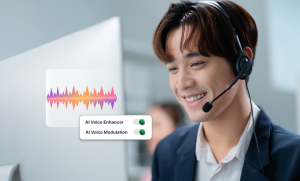
Managing this spectrum effectively requires moving beyond basic connectivity. Implementing vocal enhancers and AI voice modulation ensures that audio remains intelligible and consistent, regardless of the underlying network conditions or environment.
How Audio Quality Shapes Customer Perception?
Customer experience is not determined solely by what is said, but also by how it is heard. Voice-based interactions carry emotional cues, intent, and tone. When audio quality is compromised, these cues can be distorted or lost.
Customers may need to ask agents to repeat information, pause more frequently, or infer meaning based on partial understanding. These interruptions can affect the perceived smoothness of the interaction, often leading to increased customer effort and lower overall satisfaction scores. In some cases, frustration attributed to long call times or unclear explanations may originate from audio-related issues rather than agent capability.
Customers may subconsciously associate unclear audio with lower professionalism or reduced attentiveness, even when agents are engaged and compliant. As a result, audio quality can influence satisfaction indirectly, without appearing explicitly in post-call surveys.
Connection Between Audio Quality and QA Scores
Quality assurance programs are designed to evaluate agent performance, compliance, and adherence to defined standards. However, when audio quality is compromised, this assumption collapses, transforming QA from a performance tool into a governance risk.
The Masking of Compliance Markers
In regulated industries (Finance, Healthcare, Insurance), agents must recite specific disclosures or obtain verbal consent. Poor audio can mask these critical markers. During an audit, a perfectly compliant agent may be flagged for a “failure to disclose” simply because the recording was unintelligible, leading to false negatives in compliance reporting.
Sampling Trap and Systematic Bias
Most contact centers use sampling-based QA, reviewing only 1–2% of total calls. It creates blindspots during quality analysis. When “bad audio” calls are sampled, agents are often coached for “lack of empathy” or “poor communication,” when in reality, the hidden operational cost of technical friction is the true culprit.
Legal and Dispute Resolution Integrity
In the event of a customer dispute, the call recording is the primary evidence. If audio quality is degraded, the “verifiability” of the interaction is weakened. By treating audio quality as a first-class QA metric, organizations ensure that their “source of truth” remains defensible and accurate.
Audio Quality as an Operational and Compliance Consideration
Beyond customer perception, audio quality can have implications for operational risk. Many contact centers operate in regulated environments where disclosures, confirmations, and verbal consent play a critical role.
When audio quality is degraded, key statements may be misunderstood or partially captured. This can complicate post-call reviews, dispute resolution, or compliance verification.
While poor audio quality does not inherently cause compliance failures, it may increase review effort and ambiguity when interactions are scrutinized. In such contexts, audio quality functions are less like a soft CX factor and more like an operational variable that affects governance processes.
Why Traditional CX Metrics Mask Audio Issues?
Traditional CX metrics are lagging indicators—they tell you what happened, but rarely why it happened. Because metrics like CSAT and AHT are outcome-focused, they often misattribute audio-driven friction to agent performance or process failure.
Misalignment of KPIs
When audio quality is poor, it “pollutes” your standard metrics in ways that are hard to detect:
- CSAT (Customer Satisfaction): Reflects sentiment but doesn’t distinguish between a “bad agent” and a “bad connection.” A customer frustrated by repeating themselves will give a low score that blames the agent’s competence.
- AHT (Average Handle Time): Measures duration, not comprehension efficiency. Audio distortion adds “dead air” and repetitive clarifying questions, inflating AHT without a clear diagnostic reason.
- FCR (First Call Resolution): Focuses on the “fix,” but ignores the communication friction that makes the fix harder to achieve.
Why QA Fails to Catch the Signal?
Even granular Quality Assurance programs often miss the mark due to two systemic issues:
- Sampling Limits: Reviewing 1–2% of calls mean sporadic audio drops or “robotic” voice issues are likely to be missed.
- Subjectivity: Analysts often grade “Tone” or “Empathy” harshly when the agent’s voice was simply distorted by low-bandwidth signals.
Audio issues rarely appear as a line item on a dashboard. They surface as “unexplained” noise: elevated repeat calls, inconsistent coaching feedback, and high agent burnout. However, the business case is clear: addressing these underlying technical factors can directly improve CSAT and reduce AHT by removing the “hidden tax” on every conversation.
Emerging Approaches to Observing Audio Quality at Scale
Audio is no longer just “background infrastructure.” It is becoming a measurable data point. With the speech analytics market expected to reach $13.34 billion by 2032, contact centers are moving away from manual spot-checks toward automated, large-scale voice analysis.
How are Organizations Observing Quality at Scale?
Rather than hoping a QA analyst “catch” a bad connection, modern centers are using three emerging approaches:
- Voice Signal Analysis: Automatically detecting “robotic” voices, jitter, or background noise across 100% of calls.
- Transcription Health Monitoring: Using AI to flag were poor audio leads to “Inaudible” tags in transcripts major driver of lost data.
- Automated Clarity Benchmarking: Establishing a “baseline” for intelligibility so that sudden dips in signal quality trigger immediate alerts.
According to Gartner, Conversational AI is set to reduce agent labor costs by $80 billion by 2026. However, these savings depend entirely on the AI’s ability to “hear” clearly. By making audio quality visible, organizations ensure their AI and human agents have the high-fidelity input they need to succeed.
Accent and Intelligibility in Global Contact Centers
In global contact centers, linguistic diversity can introduce “intelligibility friction” in high-pressure service environments. Accent-based friction causes cognitive tax on the listener and agents.
Accent “Neutralization” to “Harmonization”
Traditional training programs focused on “accent neutralization,” which is often slow, costly, and can negatively impact agent confidence. Modern organizations are shifting toward real-time technology to solve this:
- Intelligibility Over Elimination: The goal is to ensure speech is instantly understood, reducing the need for customers to say, “Could you repeat that?”
- Preserving Identity: Unlike generic voice changers, harmonization preserves the agent’s natural tone and emotion while smoothing out phonetic friction.
- Reducing Ramp-Up Time: Technology allows agents to hit the floor faster, as they no longer need months of intensive linguistic training to be instantly intelligible to global callers.
Making Audio Quality Actionable with Accent Harmonizer
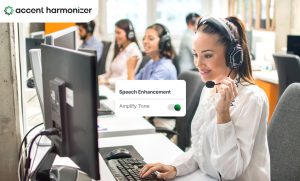
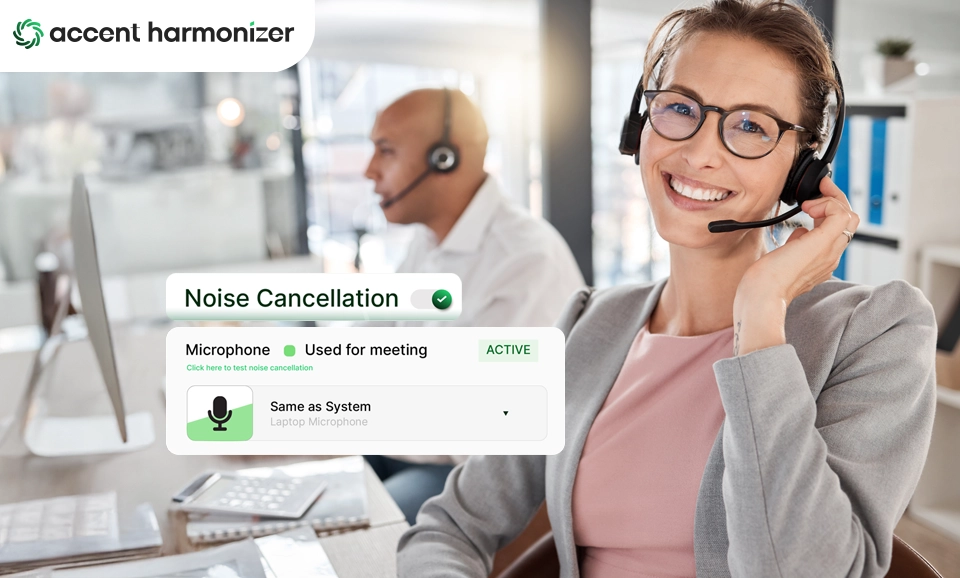
Solutions like Accent Harmonizer by Omind sit at the intersection of audio quality and CX. By applying real-time speech clarity enhancements, the software ensures that the “hidden metric” of audio quality is optimized automatically.
When you remove the barrier of accent-based misunderstanding, you are improving a call, strengthening agent confidence and ensuring your QA scores reflect the agent’s actual skill.
Reframing Audio Quality as a First-Class CX Signal
Audio quality can influence customer perception, agent performance evaluation, and operational confidence. Despite this, it is rarely tracked with the same rigor as other CX metrics.
Treating audio quality as a first-class signal does not require redefining CX frameworks. It requires acknowledging that voice interactions are shaped by more than scripts and sentiment alone. When audio conditions are consistently clear, other metrics become easier to interpret. Moreover, this clarity reduces the cognitive load on agents, allowing them to focus on empathy rather than repeating themselves.
As contact centers continue to scale across geographies and channels, the ability to observe and understand audio quality may become less optional and more foundational to reliable CX measurement.
Looking Ahead
Audio quality may not appear on most CX dashboards today, but its influence is already present across outcomes that leaders care about. Recognizing it as a contributing factor—rather than an invisible constant—can help organizations interpret their metrics more accurately.
As teams reassess how voice data is evaluated, some are beginning to explore tools and frameworks that focus on speech clarity and intelligibility. Accent Harmonizer by Omind represents one such approach worth examining within that broader context. Do you want to know more? Let’s set up a call to know more.