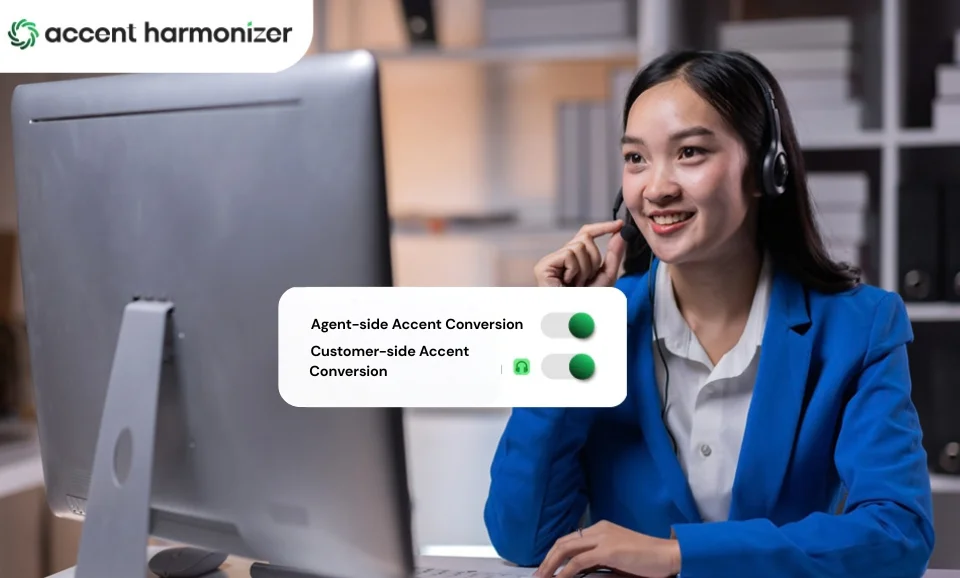
Accent conversion in contact centers is usually discussed in one direction: making the agent easier for the customer to understand. But a live call has another speech path. The agent also must understand customers whose pronunciation patterns, regional accents, and acoustic environments change from call to call.
In a live interaction, communication friction occurs across two distinct pathways:
| Bidirectional Voice Friction Points in Global Contact Centers | |
|---|---|
| Agent → Customer | Customer struggles to parse the agent’s pronunciation, resulting in repeated questions and elevated Average Handle Time (AHT). |
| Customer → Agent | Agent struggles to parse incoming customer speech, leading to incorrect log details and dropped First Call Resolution (FCR). |
A speech-processing system described as bidirectional should therefore be evaluated as two separate comprehension paths—not simply as a scaled-up version of agent-side accent conversion.
What Does Bidirectional Accent Conversion Mean in a Contact Center?
In a contact center, bidirectional means processing both live speech paths of an ongoing call between agent and customer.
| Real-Time Bidirectional Voice & Accent Processing Architecture |
|---|
Source / Receiver Agent ➜ Accent Processing ➜ ⬅ Accent Processing ⬅ End User Customer |
To evaluate these systems, operations leaders must distinguish between the specific directional components:
Agent-Side or Speaker-Side Conversion
The agent’s outbound audio stream is processed in real time before reaching the PSTN or VoIP endpoint. The customer hears modified pronunciation patterns designed to improve clarity while preserving the agent’s underlying vocal identity, pitch, and emotional cadence.
Customer-side or Listener-side Conversion
The incoming customer audio stream is processed before reaching the agent’s headset. The agent hears modified audio designed to harmonize unfamiliar accents, distinct speech rhythms, or regional pronunciations. This capability operates on live voice streams and is distinct from automated speech recognition (ASR), real-time transcription, language translation, or basic noise suppression.
Bidirectional Integration
A system is bidirectional only when it can address both speech paths simultaneously within the same live conversation. AI accent conversion tools use speaker-side and listener-side processing.
Customer-side Processing
“Customer-side processing” refers strictly to whose speech is being transformed (the customer’s), not the physical location where the code executes. Processing for both directions typically occurs at the media gateway, virtual audio driver, or edge endpoint within the contact center architecture.
Agent-side and Customer-side Conversion Solve Different Problems
Deploying accent processing requires recognizing that outbound and inbound voice streams operate under completely different operational variables.
| Speech Direction & Operational Impact Analysis | |||
|---|---|---|---|
| Direction | Speech Processed | Primary Listener | Core Operational Problem |
| Agent-Side | Agent Speech | Customer | Can customers understand the agent consistently without repeated clarification? |
| Customer-Side | Customer Speech | Agent | Can agents understand varied, unpredictable customer speech without strain or delay? |
| Bidirectional | Both Streams | Both Parties | Does measurable, two-way comprehension friction exist across the interaction? |
Known vs. Variable Speaker Populations
Agent-side conversion operates on a highly predictable speaker population. Contact center operations maintain detailed profiles on their workforce:
- Known geographic delivery centers and native language backgrounds
- Standardized hardware, headset profiles, and workstation configurations
- Controlled acoustic environments and predictable queue assignments
Customer-side conversion faces the opposite condition. The incoming caller population changes on every call. An agent handling an inbound queue may successively speak with callers from different geographic regions or dialects.
Because incoming caller speech varies unpredictably, strong performance on agent-side conversion does not guarantee equal performance on incoming customer speech. The two directional streams should never share identical evaluation criteria or performance thresholds. If agents experience severe processing strain when listening to unfamiliar caller dialects, refer to strategies for managing agent cognitive load to assess operational impact.
Do You Need Both Directions?
More processing is not automatically better processing. Applying voice transformation to audio streams where no measurable comprehension failure exists adds needless architectural complexity and system overhead. Operations should select directional capabilities based on empirical conversation evidence rather than global delivery stereotypes.
| Diagnose Call Breakdown Evidence |
|---|
Customer asks agent to repeat info 🢃 Deploy OutboundAgent-side Processing Agent asks customer to repeat info 🢃 Deploy InboundCustomer-side Processing Clarification fails in BOTH directions 🢃 EvaluateBidirectional Deployment |
Agent-side Only Is Sufficient When
Call audits show that conversational breakdown is driven by the customer asking the agent to repeat critical information. Common indicators include:
- Customers request re-clarification of agent names, policy terms, or alphanumeric codes.
- Customers ask the agent to slow down or spell out standard words.
- Spikes in time while agents re-explain basic process steps.
Customer-Side Only Is Justified When
The operational failure is driven by the agent struggling to understand incoming caller speech, even when line quality is clear. Indicators include:
- Agents frequently ask callers to repeat account numbers, names, or addresses.
- Unusual post-caller statements pause while the agent attempts to process what was said.
- Logging errors caused by misheard customer details during verification steps.
Note: Before attributing agent comprehension failures to accent friction, eliminate acoustic background noise as a root cause. Ensure your infrastructure isolates ambient sound by reviewing noise cancellation vs accent harmonization differences.
Bidirectional Processing Is Relevant When
Interaction analysis demonstrates that clarification requests, speech repetitions, and phonetic errors occur symmetrically across both sides of the call.
What Should Buyers Evaluate in a Bidirectional System?
Evaluating a bidirectional system requires looking beyond top-level feature claims. Leaders should evaluate both directional processing paths against eight core operational criteria:
| Real-Time Voice & Accent Processing Technical Evaluation Criteria | ||
|---|---|---|
| Evaluation Criterion | Operational Impact | Target Technical Standard |
| Independent Direction Control |
| Administrators can enable agent-side, customer-side, or bidirectional processing independently per queue, campaign, or tier. |
| Direction-Specific Accent Coverage |
| Vendor models are validated against the specific agent source accents and the full spectrum of incoming customer dialects. |
| Meaning & Intent Preservation | Pronunciation adjustments must not alter critical semantic meaning, numbers, or tone. | Speech modification alters target phonetic markers without warping proper nouns, numerical digits, or emotional inflection. |
| Direction-Specific Latency | Processing two live audio streams sequentially can introduce conversational latency. | Added processing delay stays within strict conversational bounds without introducing talk-over or disruption. For details on latency thresholds, see our guide on contact center latency. |
| System Fallback Behavior | Real-time audio engines must not create a single point of failure for live calls. | If processing fails, the system gracefully degrades to raw, un-harmonized audio without dropping the line or alerting the caller. |
| Granular Queue & Routing Control | Different business lines carry distinct compliance and speech profile requirements. | Control allows rule-based toggles by geography, BPO partner, queue type, or customer tier. |
| Recording & QA Compliance | Supervisors and AI QA tools may evaluate audio signals different from what was heard live. | Architecture specifies whether raw, processed, or dual-track streams are fed to call recorders and QA engines (such as Omind AI QMS). |
| Deployment Architecture | Running dual-stream real-time voice models alters endpoint CPU and network bandwidth demands. | System performance and memory footprints are validated under full enterprise load without degrading desktop software. |
Build the Pilot Around Direction-specific Failure Cases
In a typical contact center, many calls progress smoothly without severe accent barriers. Sampling them at random dilutes performance data and masks operational impact. To evaluate bidirectional conversion, construct targeted test sets built around verified communication breakdowns.
1. Construct the Direction-Specific Failure Sets
Isolate historical call samples using speech analytics or manual call tagging:
- Outbound Failure Set: Calls where customers repeatedly say “What?”, “Repeat that,” or ask the agent to spell basic terms.
- Inbound Failure Set: Calls where agents repeatedly ask customers to restate account numbers, street names, or core requests.
2. Test Under Four Controlled Conditions
Run the test sets through the processing engine across four isolated environments:
- Baseline: Original, unprocessed dual-stream audio.
- Agent-side Only: Outbound stream processed; inbound stream raw.
- Customer-side Only: Inbound stream processed; outbound stream raw.
- Bidirectional: Both inbound and outbound streams processed simultaneously.
3. Measure Direct Conversation Outcomes First
Evaluate immediate communication metrics before analyzing high-level KPIs:
- Frequency of exact repetition requests per call
- Transcription/understanding accuracy for names, numbers, and codes
- Measured conversational turn-taking delay and overlap instances
- Panellist-rated speech naturalness and intelligibility scores
Evaluate the metrics such as Average Handle Time (AHT) and First Contact Resolution (FCR), and CSAT only after direct communication improvements are proven.
Buy the Direction You Can Prove You Need
Bidirectional accent conversion is an architectural choice, not a single feature checkbox. Agent-side and customer-side processing address different listening problems, operate on different input distributions, and require separate operational justification.
If call audits reveal that comprehension failures occur primarily in one direction, deploy processing for that direction first. If conversation logs prove that friction occurs on both sides of the exchange, pilot a bidirectional implementation with independent stream controls. Enterprise procurement should be driven by measured conversation evidence.
Validate Your Contact Center’s Speech Directionality
Unsure whether your contact center suffers from outbound agent clarity issues, incoming customer dialect barriers, or two-way conversational friction? Don’t pay for dual-stream processing overhead until you prove you need it.