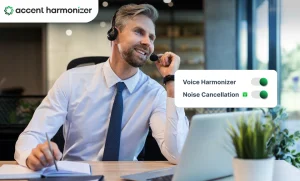

Global contact centers face a hidden compliance risk: miscommunication caused by accent differences. When customers misunderstand disclosures, authentication steps, or policy explanations, even fully compliant agents can appear non-compliant in call center environments. Compliance auditing with smart technologies bridges this gap by ensuring that critical disclosures are not just spoken but clearly understood and verified in real-time.
What Is Call Center Compliance Auditing?
Call center compliance auditing is the systematic process of reviewing agent interactions to ensure adherence to regulatory requirements, company policies, and industry standards. Unlike quality monitoring — which focuses on customer satisfaction and service delivery — regulatory compliance monitoring specifically tracks whether mandatory disclosures were made, authentication protocols were followed, and data protection rules were upheld.
Industries such as financial services, healthcare, and telecommunications face strict obligations. A missed disclosure, a skipped verification step, or a mishandled data request can trigger significant regulatory consequences. The challenge is that compliance failures don’t always stem from agent negligence — they often result from communication breakdowns that are entirely invisible in a standard QA review.
Key compliance risk areas: Missed financial disclosures · Incorrect authentication steps · Data protection violations · Misunderstood policy explanations
Why Do Compliance Failures Still Happen in Modern Call Centers?
Despite advances in QA tooling, most enterprise contact centers still review only 1–5% of calls. That coverage gap creates a significant blind spot. Beyond the volume problem, several structural weaknesses compound the risk:
| Limitations of Traditional Manual QA | |
|---|---|
| 1–5% QA Coverage | Only 1–5% of calls are reviewed in typical manual QA programs → 95–99% of interactions go completely unevaluated, leaving massive blind spots for compliance, coaching, and quality risks. |
| Days–Weeks Feedback Delay | Average delay of days to weeks before agents receive coaching feedback → repeated errors, missed improvement opportunities, and ongoing poor performance across thousands of calls. |
| Varies 40%+ Scorer Agreement | Inter-rater reliability often varies by 40% or more between reviewers → inconsistent scoring, subjective bias, and unreliable quality measurement across the team. |
| Rarely Done Clarity Audits | Clarity and phonetic intelligibility audits are rarely performed systematically → accent friction, miscommunication, and unnecessary repeat calls go undetected. |
Delayed coaching means agents receive feedback long after the interaction, reducing its effectiveness. Subjective scoring means different QA evaluators interpret the same call differently. And critically, almost no auditing framework accounts for whether the customer understood what the agent said — a gap that creates compounding compliance exposure over time.
The Hidden Compliance Risk: Accent and Communication Clarity
Accent differences are a real and underreported source of compliance risk in global contact centers. When a customer mishears a financial disclosure, misunderstands an authentication prompt, or cannot follow a policy explanation, the interaction may be technically compliant on paper — but functionally non-compliant in practice.
“We see offshore teams deliver accurate disclosures, but customers still report confusion. The words were spoken. The understanding wasn’t transferred.”
— Global CX Leader
The operational consequences are measurable: longer call durations, repeated explanations, frustrated customers, and elevated escalation rates. In regulated industries, repeated comprehension failures during disclosures represent a significant audit risk — even when recordings show agents following the correct script.
AI Accent Harmonizer: A New Layer in Compliance and Quality Monitoring
AI accent harmonization technology processes spoken audio in real time to improve phonetic clarity between speakers. Unlike accent neutralization — which attempts to eliminate accent characteristics entirely — accent harmonization preserves the natural voice and identity of the speaker while adapting phonetic patterns to improve comprehension for the listener.
The distinction matters. Accent neutralization is often impractical, agent-stressful, and culturally reductive. Accent harmonization is a technology-layer solution that operates transparently, requiring no behavioral change from agents.
Real-time audio pipeline: Agent speech → AI processing → Accent harmonization → Clear delivery to customer
How AI Improves Call Center Compliance Auditing?
AI voice technology doesn’t operate in isolation — it integrates into a broader compliance monitoring workflow. Here is how a modern AI-driven compliance pipeline functions end to end:
- Audio capture— Every interaction is recorded at the telephony or VoIP layer.
- Speech transcription— AI converts audio to high-accuracy text, with clarity-enhanced audio producing more reliable transcriptions.
- Accent harmonization layer— Real-time or post-call processing improves phonetic clarity, reducing transcription noise.
- NLP compliance rule detection— Natural language processing checks transcripts for mandatory disclosures, authentication steps, and prohibited language.
- QA scoring and coaching— Automated scores surface high-risk calls for human review and feed targeted coaching workflows.
Because clearer audio produces cleaner transcripts, the accent harmonization layer materially improves the accuracy of downstream NLP compliance detection — reducing false negatives in disclosure monitoring.
AI Accent Harmonizer vs Traditional Accent Training
Enterprises have historically addressed accent-related communication challenges through agent training programs. The comparison with AI-driven harmonization reveals significant operational differences:
| Comparison of Accent Improvement Methods | |||
|---|---|---|---|
| Method | Speed | Scalability | Agent Experience |
| Accent training | Slow (months) | Limited | Often stressful |
| Speech coaching | Moderate | Limited, manual | Labor-intensive |
| AI accent harmonization | Real-time | Enterprise scale | Seamless, invisible |
The scalability gap is especially significant in large BPO operations, where traditional training cannot keep pace with agent volume, turnover, or the diversity of linguistic backgrounds across global delivery centers.
Key Metrics to Track in AI-Driven Compliance Auditing
Implementing AI-powered compliance monitoring requires a clear measurement framework. The following metrics connect directly to technology’s impact:
- Compliance detection rate
- Disclosure completion accuracy
- CSAT improvement
- First-call resolution rate
- Conversation clarity score
- Repeat-explanation rate
The conversation clarity score measures how often customers request repetition or indicate confusion — is a particularly strong leading indicator of both compliance risk and CSAT decline.
Conclusion
Cross-accent communication technology is now a foundational layer in global CX operations. As regulatory expectations around consumer comprehension continue to evolve, the ability to demonstrate not just that disclosures were made, but that they were made clearly, will become a new standard in compliance auditing.
See AI Accent Harmonizer in action
Explore how real-time voice harmonization improves clarity and reduces compliance risk across global contact center operations.