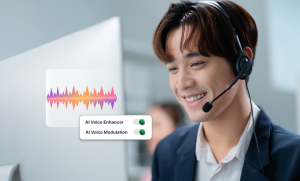
Global conversations don’t fail because people lack knowledge, they fail because they aren’t understood the first time. In contact centers and offshore teams, accent friction quietly increases handle time, frustrates customers, and erodes revenue. While training focuses on the agent, modern voice harmonizer software focuses on the audio signal itself.
Enterprise-based voice harmonizer software solves this at the source: by fixing how conversations are heard in real time, not just how they’re logged afterward.
What Is Enterprise Voice Harmonizer Software?
Voice harmonizer software is a real-time AI layer that adjusts speech during live conversations to improve phonetic clarity between speakers. Unlike noise-cancellation tools that filter background sound, or speech-to-text engines that transcribe what was said, voice harmonization operates on the spoken signal itself—adapting pronunciation patterns so both parties hear and understand each other more naturally.
Think of it as a ‘speech clarity layer’ inside your CX technology stack. It sits between the speaker and the listener, making invisible micro-adjustments that reduce accent friction without altering voice identity, tone, or emotional register. The caller still sounds like themselves—just clearer.
“In enterprise CX, automation can handle volume. But clarity handles trust. When customers can’t understand their agent—or vice versa—no amount of workflow optimization recovers the moment.” — CX Operations Leader, Global BPO
How Cross-Accent Communication Breaks in Live Calls
Most contact center leaders understand that miscommunication hurts metrics. Fewer understand exactly where and how it breaks down. There are three core failure points:
- Phonetic mismatch: Different accent patterns cause the brain to work harder to decode words, under stress or in noisy environments.
- Listening fatigue: When a listener must concentrate intensely to parse speech, cognitive load increases. Customers disengage faster, and agents lose confidence.
- Repetition loops: Misunderstood words trigger requests to repeat, which extends calls, frustrates both parties, and directly inflates Average Handle Time (AHT).
The cascading metric impact is direct and measurable:
| Communication Failure Points & Their KPI Impact | |
|---|---|
| Communication Failure Point | KPI Impact |
| Phonetic mismatch → repetition loops | ↑ Average Handle Time (AHT) by 20–35% |
| Miscommunication → wrong issue resolution | ↓ First Call Resolution (FCR) |
| Listening fatigue → disengaged customer | ↓ CSAT scores |
| Accent friction → loss of trust | ↓ Conversion rates on sales calls |
The cost isn’t abstract. Every repetition loop adds seconds to a call. Across thousands of daily interactions, clarity gaps translate into real operational and revenue loss.
Accent Neutralization vs. Accent Translation vs. Voice Harmonization
These three terms are often conflated, but they represent fundamentally different approaches—with very different outcomes for enterprise deployments:
| Accent Management Approaches – Enterprise Comparison | |||
|---|---|---|---|
| Approach | How It Works | Limitations | Enterprise Fit |
| Accent Neutralization | Training agents to suppress native accent patterns | Slow, inconsistent, degrades agent confidence | Low scalability |
| Accent Translation | Converts one accent to another in post-processing | Often sounds unnatural; too late for live calls | Risky for CX |
| Voice Harmonization | Real-time AI phoneme-level adaptation during calls | Requires advanced AI infrastructure | Best fit for live CX |
Accent neutralization asks agents to change themselves—a slow, confidence-eroding process that rarely achieves consistency at scale. Accent translation applies post-processing that arrives too late for a live conversation and often strips natural warmth from the voice. Voice harmonization is the only approach built for real-time live call environments, adapting dynamically to each unique speaker-listener pairing without human intervention.
How Real-Time Accent Harmonization Works?
Effective voice harmonization operates through a five-stage pipeline, all executed with sub-100ms latency to preserve natural conversation flow:
- Input capture: The agent’s live voice is captured at the audio layer before transmission.
- Phoneme-level analysis: AI models decode the acoustic phoneme patterns specific to the speaker’s accent in real time.
- Adaptive adjustment: The system maps those patterns to listener-optimal equivalents, adjusting only what’s needed for clarity.
- Identity preservation: Tone, pitch, emotion, and speaking cadence are held constant—the agent’s voice remains their own.
- Clarity output: The adjusted audio is transmitted to the listener with no perceptible delay.
Critically, this is not voice cloning, nor post-call enhancement. It is a real-time process that affects only the phonetic clarity layer—not the personality, professionalism, or humanity of the conversation.
Business Impact: How Voice Clarity Directly Improves CX Metrics
Voice harmonization’s business case is built on direct metric causality—not correlation. Here is how clarity improvements flow through operational KPIs:
- Reduced AHT: Eliminating repetition loops removes the single most common driver of extended call duration. Early deployments have shown 15–25% reductions in handle time on cross-accent call segments.
- Improved FCR: When agents and customers understand each other correctly the first time, issue resolution doesn’t require call-backs or escalations.
- Higher CSAT: Customers who feel understood report significantly higher satisfaction scores—clarity is experienced as care.
- Increased conversion rates: On sales calls, accent friction introduces hesitation. When prospects can clearly hear value propositions, close rates improve.
Contact centers that reduce clarity-related repetition by even 10% can recover thousands of agent hours per month that can be reinvested in complex, high-value interactions.
Why do BPOs and Global Enterprises Need Voice Harmonization?
Business process outsourcing has long relied on accent neutralization training as the primary solution to cross-accent communication challenges. This model is increasingly unsustainable for three structural reasons:
- Hiring pool compression: Accent bias in hiring—whether explicit or unconscious—artificially narrows the available talent pool. Enterprises operating in the Philippines, LATAM, India, and Eastern Europe are excluding highly capable agents based on phonetic characteristics unrelated to job performance.
- Training inefficiency: Traditional accent neutralization programs take 4–8 weeks, yield inconsistent results, and require continuous reinforcement. The ROI is difficult to justify when attrition rates remain high.
- CX standardization at scale: As enterprises expand globally, maintaining a consistent clarity baseline across regions, languages, and agent cohorts becomes operationally impossible without AI infrastructure.
Voice harmonization reframes the problem entirely: instead of changing agents, it changes how agents are heard—making accent an engineering challenge rather than a hiring filter or a training burden.
Real-Time vs. Training vs. Post-Processing: What Actually Works on Live Calls
The intervention timing question is decisive for live CX environments:
- Pre-call training: Effective overtime for agents who can invest weeks in phonetic coaching—but are inconsistent under pressure and unavailable on day one.
- Post-call processing: Useful for quality analysis and transcription but has zero impact on the live conversation already completed.
- Real-time harmonization: The only approach that intervenes now clarity matters—during the call, on the first exchange, before a customer asks for a repeat.
Live conversations require live solutions. No amount of retrospective improvement changes what the customer experienced at that moment.
What to Look for in Enterprise Voice Harmonizer Software?
When evaluating solutions, use this framework to separate genuine enterprise capability from surface-level demos:
- Real-time processing with sub-100ms latency (anything higher creates perceptible conversation lag)
- Identity preservation — the agent’s voice, tone, and emotional cues must remain intact
- Native integration with CCaaS and UCaaS platforms (Genesys, Five9, Avaya, Zoom, Teams)
- Scalability across concurrent agents without quality degradation
- Multi-language and multi-accent coverage aligned to your operational footprint
- Transparent latency benchmarks and clarity improvement metrics from real deployments
Ask every vendor for deployment case data — not just demo recordings. The difference between a compelling proof of concept and enterprise-grade software is performance consistency under real call volume.
How Do Enterprises Deploy Voice Harmonization?
Successful deployments follow a structured three-phase model:
- Phase 1 — Targeted Pilot (Weeks 1–4): Deploy with a defined agent cohort on high-volume cross-accent call segments. Establish pre-intervention baselines for AHT, FCR, and CSAT. Measure clarity improvement and agent confidence scores.
- Phase 2 — Measurement and Calibration (Weeks 5–8): Analyze pilot data. Calibrate harmonization parameters for regional accent profiles. Identify any integration adjustments needed with existing CRM and CCaaS tooling.
- Phase 3 — Regional Rollout (Weeks 9–16): Expand across agent populations by region. Establish ongoing monitoring dashboards tracking clarity-to-metric causality. Begin building the data foundation for continuous model improvement.
The integration layer is typically the longest lead item. Organizations with standardized CCaaS infrastructure see the fastest time-to-value.
The Future of AI Voice Clarity: Beyond Harmonization
AI accent solutions for BPO exists as foundation of a broader evolution in how AI understands and adapts human communication:
- Emotion-aware harmonization: Systems that detect speaker stress or frustration and adjust clarity parameters dynamically to de-escalate tense conversations.
- Context-aware adaptation: AI that understands the subject matter of a call — medical, legal, financial — and prioritizes precision in domain-specific terminology.
- Cross-channel voice consistency: Harmonization applied uniformly across voice, video, and asynchronous audio so customers experience the same clarity regardless of channel.
Organizations that invest in voice clarity infrastructure today are not just solving a current operational problem. They are building the AI-native communication stack that will define enterprise CX in the next decade.
Hear the Difference in Real-time
Schedule a live demo and experience accent harmonization on an actual call — not a recording. See exactly how voice clarity transforms conversations before you commit to a deployment.