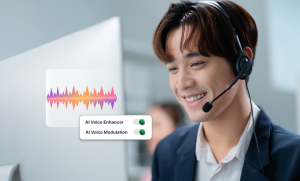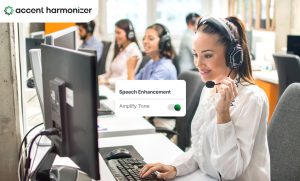

Noise cancelling software is often treated as a universal fix for poor call quality in enterprise environments. Remove background noise, and the problem should disappear—at least in theory.
In practice, enterprises discover something else: even after noise is filtered out, conversations still break down. Speech Clarity Challenges In Enterprise Contact Centers such as customers asking agents to repeat themselves or resolution times stretch.
For contact centers, noise cancellation is only one component of a much broader speech intelligibility challenge.
Why “Noise Cancellation” Is an Incomplete Enterprise Requirement?
Noise cancelling software is designed to suppress unwanted background sounds: keyboard clicks, ambient office noise, cross-talk, or environmental hum. This capability is useful, and in many cases necessary.
But enterprise voice interactions fail for reasons that go well beyond background noise.
Common contributors include:
- Accent variability across global teams
- Inconsistent microphone and headset quality
- Softphone compression artifacts
- Real-time processing constraints that limit aggressive filtering
In these environments, removing noise may make calls quieter but not necessarily more understandable. This is where the audio quality has become a hidden CX metric. It pushes enterprise requirement from noise reduction to speech clarity.
“Audio clarity issues in enterprise calls are not always caused by background noise. In many cases, misunderstanding persists even in quiet environments.”
How Enterprise Audio Environments Differ from Consumer Use Cases?
Many noise cancelling tools are built with consumer or creator workflows in mind: recorded audio, meetings, podcasts, or post-production cleanup. These tools assume:
- Controlled hardware
- Predictable environments
- Non-real-time processing
Enterprise contact centers operate under very different conditions.
Calls are:
- Fully real-time, with strict latency tolerance
- Routed through telephony stacks and softphones
- Handled by agents using varied equipment
- Conducted across regions, accents, and speech patterns
In this context, over-aggressive noise suppression can degrade intelligibility. Filters that work well for meetings or recordings may distort live speech when applied at scale.
This distinction explains why enterprises searching for noise cancelling software for call centers often continue to report clarity issues even after deploying noise filters.
Noise Suppression vs. Speech Clarity Systems
Noise suppression and speech clarity are related, but they are not the same thing. Here is the difference between noise cancellation and accent harmonization:
| Noise Suppression vs Speech Clarity Systems | ||
|---|---|---|
| Aspect | Noise Suppression | Speech Clarity Systems |
| Primary goal | Remove background sound | Improve intelligibility |
| Processing | Often single layer | Multi-layer |
| Accent handling | Accent-agnostic | Accent-aware |
| Use case | Meetings, recordings | Live enterprise calls |
| Risk | Over-filtering | Balance preservation |
Speech clarity systems take a broader view. Instead of focusing solely on what to remove, they consider how speech is perceived by the listener across accents, dialects, and speaking styles.
This is where accent-aware processing becomes relevant, particularly in global contact center environments.
Why Call Centers Need More Than Noise Cancelling Software?
Call centers need far more than basic noise-cancelling software to deliver exceptional operations. They require advanced AI-driven speech clarity and real-time accent harmonization to bridge accent gaps, minimize miscommunication, and drive higher CSAT scores—all while preserving the agent’s unique voice and identity.
Modern contact centers demand smarter audio technology because:
- A call can be noise-free yet still unclear due to pronunciation, articulation, or audio artifacts.
- Accent variability compounds clarity issues, especially in global, multilingual teams serving diverse customers.
- Repetition from misunderstandings inflates handle time, heightens agent fatigue, and erodes customer satisfaction.
In practice, enterprises find that noise cancellation solves only part of the problem. Without addressing accent-related intelligibility and real-time speech consistency, clarity gaps remain.
This is why many organizations move beyond standalone noise filters and begin evaluating speech clarity systems that combine noise suppression with accent-aware processing.
What Enterprises Should Evaluate Instead of “Best Noise Cancelling Tools”
Rather than asking which noise cancelling software is “best,” enterprise buyers benefit from evaluating systems against operational criteria that reflect real call environments.
Key considerations include:
- Real-Time Processing Latency: Enterprise calls cannot tolerate noticeable delays. Any speech enhancement layer must operate within tight latency thresholds.
- Accent Variability Handling: Global teams introduce wide pronunciation and rhythm differences. Systems that are accent-agnostic may unintentionally reduce intelligibility.
- Tone and Pitch Preservation: Over-filtering can flatten natural speech, making voices sound artificial or muffled.
- Compatibility with Call Center Infrastructure: Solutions must integrate cleanly with existing telephony, softphones, and recording systems.
- Compliance and Recording Integrity: Speech processing should not compromise audit trails or regulatory requirements.
Accent Harmonizer systems are often referenced in this context as examples of platforms designed to address speech clarity at the system level. It combines noise suppression with accent-aware modulation rather than treating them as isolated problems.
Where Accent Harmonization Fits in Enterprise Speech Clarity?
Accent harmonization is frequently misunderstood as accent replacement or translation. In enterprise speech clarity systems, it serves a different role.
Rather than changing an agent’s identity or voice, accent harmonization focuses on:
- Improving phonetic consistency
- Reducing listener strain
- Preserving the agent’s natural tone and intent
When combined with noise suppression, accent-aware processing helps ensure that speech remains intelligible even under less-than-ideal conditions.
“Accent-related clarity challenges are linguistic and perceptual, not acoustic. Treating them as noise problems often leads to incomplete solutions.”
The Enterprise Outcome: Fewer Repeats, Clearer Conversations
When enterprises evaluate noise cancelling software through the lens of speech clarity, the focus shifts from audio cleanup to communication effectiveness.
Operationally, this translates to:
- Fewer “Can you repeat that?” moments
- Reduced conversational friction
- More consistent understanding across regions and accents
These outcomes are not the result of silence alone, but of clarity achieved through layered speech processing.
Final Takeaway: Don’t Buy Silence—Buy Clarity
Noise cancelling software is a necessary foundation for enterprise voice environments, but it is not a complete solution.
For contact centers and other high-volume voice operations, clarity depends on:
- Real-time processing
- Accent-aware speech handling
- Careful balance between noise reduction and natural speech preservation
Enterprises that move beyond generic noise cancellation, toward AI-based accent harmonization technologies are better positioned to address the real causes of communication breakdown. The platform supports clearer conversations and clarity.
“For global contact centers, evaluating communication clarity requires looking beyond isolated features and toward how speech is actually perceived in live conversations.”
See How Accent Harmonization Works in Live Enterprise Call Conditions
Explore how enterprises evaluate accent clarity beyond noise cancellation.