
A customer does not consciously think, “That phoneme was mispronounced.” They simply lose confidence when they ask an agent to repeat an account number three times on a single call. Comprehension failure is invisible — until it shows up in your AHT, your CSAT, and your churn. When customers ask you to repeat yourself three times, the problem isn’t knowledge — it’s phonemes
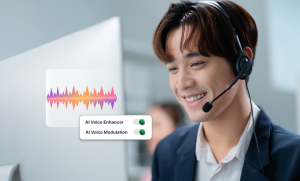
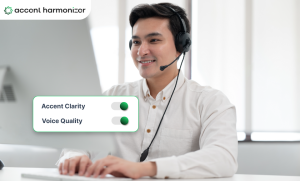
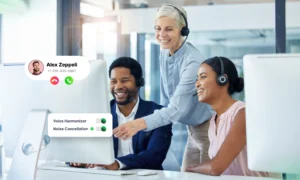
In global contact centers, communication friction creates cognitive load and impacts customers experience. Real-time phoneme adjustment software enables them to handle cross-accent gaps. Instead of retraining agents or flattening their voices, AI adapts speech during live conversations and improves audio clarity.
What Phoneme Adjustment Means?
A phoneme is the smallest unit of sound in spoken language. The difference between a customer hearing “fourteenth” and “fortieth” — two numbers that produce radically different outcomes in a billing call — comes down to a handful of phoneme substitutions. These are not errors of grammar or vocabulary. They are differences in how sounds are physically shaped by regional speech patterns.
Real-time phoneme adjustment software intercepts audio at the phoneme level, identifies where a listener is likely to experience a comprehension gap, and synthesizes a clarified version — all within the latency constraints of a live conversation.
| “Harmonization vs. Neutralization Accent neutralization attempts to remove regional speech characteristics entirely — often producing robotic output and stripping agents of the warmth that builds customer trust. Harmonization adapts specific phonemes that create comprehension gaps, leaving everything else alone. The distinction matters both ethically and in business outcomes. ” |
Adapts specific phonemes that create comprehension gaps, leaving everything else alone. The distinction matters both ethically and in business outcomes.
How It Works in A Live Call?
The processing pipeline operates in six stages, each optimized for low-latency throughput:
- Audio capture— the agent’s voice stream is isolated at the telephony layer
- Phoneme recognition— a speech model identifies the phonetic sequence in real time
- Listener expectation modeling— the system maps local phoneme patterns to the customer’s expected speech norms
- Targeted harmonization— only the phonemes likely to cause comprehension failure are adjusted
- Low-latency synthesis— the clarified audio is resynthesized without adding conversational delay
- Customer-side delivery— the customer hears a natural voice with improved phoneme alignment
The hardest engineering constraint is timing. Conversational speech is not tolerant of delay. Humans detect desynchronization at roughly 150 milliseconds, and any processing that pushes beyond that threshold creates an uncanny, uncomfortable interaction. Enterprise-grade systems target sub-80ms end-to-end latency. That constraint drives every architectural decision in the stack.
Where Comprehension Failure Costs Money?
Most contact center leaders know that repeat clarifications extend handle time. Fewer have modeled what those costs are at scale. Consider a 5% comprehension failure rate across 10,000 daily calls. If each failure adds 90 seconds of handling time — one extra clarification loop — that is 12,500 minutes of incremental labor daily, before accounting for escalations, repeat contacts, or dropped calls.
Comprehension friction compounds across call types. The operational model for each of these is different, but the root cause is the same: the customer’s brain is working harder than it should to decode speech, and at some point, it gives up.
| “ The customer is not evaluating your agent’s knowledge. They are evaluating how much effort it costs them to understand. ” |
Listening effort also degrades emotional outcomes independently of whether the customer ultimately gets the right answer. A customer who works hard to understand a correct resolution still reports lower satisfaction than one who understood effortlessly — even when the outcomes are identical. That asymmetry is why speech clarity is a strategic variable, not just an operational one.
Harmonization Versus the Alternatives
Enterprises evaluating speech AI typically compare four categories. The differences are significant.
| Accent Solutions Comparison | ||||
|---|---|---|---|---|
| Approach | Preserves Identity? | Real-time? | Sounds Natural? | Enterprise Scalable? |
| Accent training programs | ✓ | ✗ | ✓ | ✗ |
| Accent neutralization software | ✗ | ~ | ✗ | ~ |
| Voice conversion / cloning | ✗ | ~ | ~ | ~ |
| Phoneme harmonization | ✓ | ✓ | ✓ | ✓ |
Accent neutralization is phasing out by procurement teams due to its limitations. Removing regional identity from a voice degrades the warmth and expressiveness that customers respond to in service interactions. It also produces speech that sounds processed, which erodes confidence in different ways than accent friction does.
Harmonization’s technical advantage is that it operates at the feature level rather than the signal level. Rather than transforming the entire audio stream, it identifies and modifies the specific phoneme sequences that create comprehension gaps, leaving the surrounding audio — the prosody, the rhythm, the emotional coloring — unchanged.
What Enterprises Should Evaluate Before Choosing a Vendor?
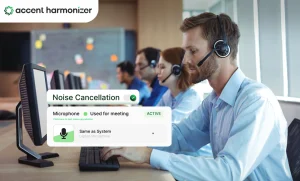
Procurement teams often evaluate accent AI on demo quality alone, which is the wrong test. Demo audio is clean, single-speaker, and controlled. Real contact center audio is not. The questions that matter are operational, not acoustic.
| 10 Critical Questions to Ask AI Voice Harmonization Vendors | |
|---|---|
| 1. | What is the average end-to-end processing latency under production load? |
| 2. | How does the system handle overlapping speech — agent and customer talking simultaneously? |
| 3. | Does harmonization degrade in noisy or low-bandwidth environments? |
| 4. | Can the system operate across multilingual conversations without retraining? |
| 5. | What is the packet-loss fallback behavior? |
| 6. | How is agent vocal identity preserved during synthesis? |
| 7. | What QA metrics does the vendor use to measure harmonization accuracy? |
| 8. | How does the system integrate with existing CCaaS infrastructure? |
| 9. | Is the harmonization model adaptive to new regional phoneme patterns? |
| 10. | What is the data residency model for audio processing? |
The red flags that signal weak infrastructure are usually audible: timing drift between speech and synthesis, emotional flattening where the agent sounds slightly detached, and pronunciation instability on proper nouns and product names. These are signs that the system is processing at the signal level rather than the phoneme level, and that naturalness has been sacrificed for simplicity.
The Direction the Category Is Heading
Real-time phoneme adjustment is the current state of the technology. The next horizon is conversational clarity infrastructure — systems that manage not just phoneme alignment but pacing, rhythm, interruption handling, and emotional register in real time.
Multilingual accent harmonization system works across language-pair combinations, not just within a single language, opens new possibilities for BPO operations that service customers across multiple regions from the same agent pool. Adaptive models that learn from QA feedback and update phoneme mapping continuously are already in development at several enterprise vendors.
The differentiation question for procurement teams is no longer whether to invest in speech clarity AI, but which vendor has built infrastructure that performs under the conditions that exist in enterprise contact centers — not in demos.
Evaluate your contact center’s communication friction
See how phoneme-level harmonization performs in live call environments.