
Forty seconds.
That’s roughly how long it takes for a customer’s confidence to drop when they’re asked to repeat the same account number three times on a support call.
The word isn’t wrong. The accent isn’t wrong. The decode is wrong — and that’s precisely the gap in real time voice accent correction AI is engineered to close.
Contact centers treating this problem with the wrong tools such as accent training programs or hiring new agents. Consequently, a millisecond-level fix applied at the phoneme level can preserve the speaker’s natural voice entirely. It sharpens the signal the listener needs to catch the first time.
In this post, you’ll learn exactly how technology works under the hood, where live calls break down, how accent correction compares to traditional alternatives, and much more.
What is Real Time Voice Accent Correction AI?
The term “accent correction” is a misnomer that makes a lot of people uncomfortable. Technology doesn’t correct accents in the sense of declaring one way of speaking superior to another. Instead, it optimizes intelligibility at the listener’s end. The advance tools ensure specific words, numbers, or names are decoded correctly the first time.
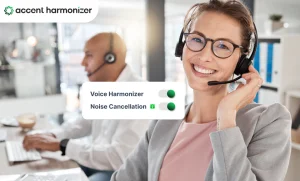
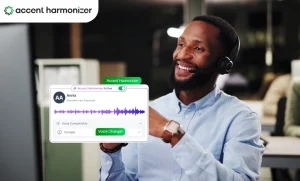
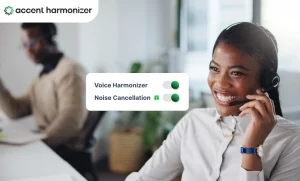
Accent harmonization operates at the phoneme level. It selectively adjusts the acoustic features of high-risk tokens (names, digits, instruction words) without flattening the speaker’s natural voice or cadence. The speaker still sounds like they were, just sounds clearer.
Why Do Live Calls Fail Without Voice Accent Correction AI?
Not all words carry equal risk in a conversation. “Hello” rarely causes a misunderstanding. Dates, dosages, addresses, instruction verbs are high-stakes tokens, and trigger repetition loops when they land wrong.
Several factors compound the risk simultaneously in live-call environments:
- Regional accent variation,
- Speaking pace under pressure,
- Background noise on either end, or
- Cognitive load that accumulates as a call extends
When all four converge the probability of a failed decode on a critical token spike significantly.
The result: repetition, escalation, longer average handle times, and a customer whose confidence in the interaction has quietly dropped.
The Mechanics of Voice Accent Correction AI
A real-time accent correction pipeline runs in five stages, each of which must complete well within the threshold where delay becomes perceptible (roughly 150–200 milliseconds):
- Audio capture— Raw microphone input is streamed in near-real-time frames.
- Phonetic feature extraction— The system analyzes the acoustic signature of incoming speech, mapping it against phoneme models.
- Intelligibility risk detection – It identifies tokens with elevated misperception probability given the current listener context.
- Selective phoneme adjustment— Only the flagged tokens are modified. Prosody, rhythm, and overall voice character are preserved.
- Audio reconstruction— Modified audio is synthesized and delivered to the listener’s channel, indistinguishably integrated with the original stream.
Comparing Training vs. Voice Accent Correction AI
Organizations typically weigh three approaches to accent-related communication friction. The comparison is instructive:
| Accent Improvement Comparison: Training vs. AI Solutions | ||||
|---|---|---|---|---|
| Approach | Time to Impact | Scalability | Consistency | Cost Profile |
| Accent training programs | Months | Low | Variable | High, ongoing expenses per agent |
| Accent-based hiring filters | Immediate | Limited | High | Very high + legal exposure |
| Real-time AI correction (Accent Harmonizer) | Immediate | High | Consistent | Scalable, per-use |
The training approach is slow and yields uneven results — the gap between the agent who practices daily and the one who doesn’t create inconsistency at scale. The hiring filter approach is both operationally limiting and ethically untenable. Real-time AI correction is the only approach that’s simultaneously immediate, scalable, and decoupled from individual performance variation.
Ethical Standards for Implementing Voice AI
Accent correction AI offers a solution, but it comes with a massive ethical responsibility. If used incorrectly, it risks stripping away agent identity. The real challenge here is intelligibility. The goal shouldn’t be to make every agent sound the same, but to ensure the speaker’s intended meaning arrives intact at the listener’s ear, regardless of regional variations.
Deploying It in Practice
Implementation follows a predictable sequence for most organizations
- Identify Your High-Leverage Starting Points: Don’t try to boil the ocean by applying AI to every call at once. Start where clarity matters most—specifically, interactions involving high repetition and critical data exchange.
- Account Verification: Where accuracy in spelling and numbers is non-negotiable.
- Prescription/Medical Confirmations: Where a single misheard syllable can have serious consequences.
- Technical Support: Where complex instructions require absolute precision.
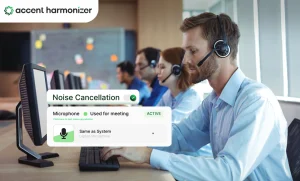
- Connect to Your Existing Infrastructure: Modern accent correction tools are designed to be “plug-and-play” with your current tech stack. Most major VoIP (Voice over IP) or CCaaS (Contact Center as a Service) platforms have available API hooks or middleware integrations.
- Run a Focused Pilot: Before scaling across the entire organization, select a small, diverse cohort of agents.
- The Goal: Gather qualitative feedback on the user experience.
- Strategy: Measure “before and after” metrics immediately. This data will be your primary tool for securing stakeholder buy-in during the full rollout.
- Prioritize the “Organizational Work”: Technical integration is rarely the obstacle; the human element is where deployments succeed or stall. To ensure a smooth transition, you must align your internal teams:
- Communication: Be crystal clear with agents about what the system does (improves clarity) and what it doesn’t do (monitor or change their personality).
- QA Alignment: Update your Quality Assurance frameworks. If an agent’s voice is being adjusted for clarity, QA needs to know so they can score the interaction fairly.
- Feedback Loops: Establish a direct line for agents to report “glitches” or instances where the AI feels intrusive.
What comes next
The near-term trajectory of this space points toward systems that real-time modeling of the person on the other end of the call and adjustment tuned to their perceptual patterns. Combined with advances in noise cancellation, speaker separation, and multilingual clarity, the end state is a phone call where information transfer succeeds regardless of the acoustic conditions on either side.
The question for operators isn’t whether this technology works. It’s whether the cost of not deploying it — in handle time, in customer confidence, in agent experience — is one they can continue to absorb.
Precision in Every Call
Don’t let accent become communication barriers. Experience the future of contact center clarity.