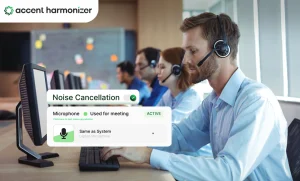

Most BPO leaders believe they have an automation problem. After years of investing in IVRs, chatbots, and AI voice agents, many are still watching handle times climb and CSAT scores stagnate. The assumption is that more automation is the answer.
The real problem is a communication breakdown happening inside live calls — in the exact seconds when a customer hears words they don’t fully understand, and neither party realizes it yet.
Voice transformation AI was built to fix that moment. The platform does not replace agents nor automate conversations. To fix the point where human communication silently fails.
What Is Voice Transformation AI for BPO? (And What It Is Not)
Voice Transformation AI is a real-time enhancement layer that sits between the agent and the customer. The platform surgically adjusts phoneme clarity and consonant sharpness. Listener perceives the speech as “easier to understand,” while the agent’s unique voice identity and emotional tone remain 100% intact.
The Critical Distinctions
To understand the value, you must understand where the boundaries lie:
- It is NOT a Voice AI Agent: It empowers humans. While AI agents handle “low-complexity” tasks, Transformation AI is built for the high-stakes, emotional conversations that require a human touch.
- It is NOT “Accent Neutralization”: Older neutralization tech is often inconsistent and can sound “uncanny.” Voice Transformation is a precision tool that focuses on intelligibility rather than just “softening” an accent.
- It is NOT Text-to-Speech (TTS): It does not generate a synthetic voice from scratch. It takes the agent’s life, organic emotional prosody and simply removes the “linguistic friction” that causes miscommunication.
| Voice Technologies Compared: Automation vs Human Enhancement | |||
|---|---|---|---|
| Technology | Action | Impact on Identity | Primary Use Case |
| Voice AI Agents | Replaces Human | None (Synthetic) | Tier-1 Automation |
| TTS Synthesis | Generates Voice | None (Synthetic) | Screen Readers / Bots |
| Voice Transformation | Enhances Human | Preserved (Natural) | Complex BPO Calls |
Where does BPO Conversations Actually Break Down?
Communication failure often comes up with phonetics. When we analyze call data across offshore and nearshore operations, breakdowns cluster into three specific “friction points” that destroy margins and CSAT.
1. The Verification Loop (The “Opening” Friction)
During identity verification, agents read back reference numbers, codes, or names.
- The Breakdown: Customers mishear a single digit or letter.
- The Cost: A 45-second verification stretches to 90 seconds. AHT (Average Handle Time) doubles because the sounds didn’t “land” the first time.
2. The Cognitive Load Gap (The “Mid-Call” Friction)
When a customer must work hard to “decode” unfamiliar phoneme patterns, their working memory fills up.
- The Breakdown: The customer enters “Passive Listening” mode. They nod and say “yes” just to end the effort of the conversation.
- The Cost: The call looks successful on a transcript, but the customer hangs up without understanding the solution. This leads to First Contact Resolution (FCR) failure.
3. The False Confirmation (The “Closing” Friction)
At the end of the call, the agent summarizes the next steps.
- The Breakdown: The same cognitive fatigue from mid-call causes the customer to accept a summary they only half-understand.
- The Cost: These “false confirmations” manifest later as repeat contacts, avoidable escalations, or customer churn.
The Cumulative Impact
For a contact center processing 50,000 calls per month, this communication friction creates a massive “invisible” tax. While we have built a detailed AI Accent Harmonizer ROI Model to help leaders calculate these specific losses, the impact usually manifests in three key areas:
| How Accent Friction Impacts Core Contact Center Metrics? | |
|---|---|
| Metric | The Friction Impact |
| AHT | Inflates due to “repeat-confirm” loops. |
| FCR | Drops because agreements aren’t fully internalized. Often, slashing repeat calls is simply a matter of improving phonetic landing. |
| CSAT | Reflects the frustration of effortful listening rather than agent helpfulness. |
Voice Transformation AI Works in Real-time Inside a Live Call
Understanding Voice Transformation requires looking under the hood of a live call. Unlike traditional “voice changers” that mask identity, this is a precision-engineered speech harmonization pipeline. It functions as a transparent infrastructure layer between the agent’s headset and the customer’s ear.
4-Step Pipeline for Real-Time Architecture
To remain imperceptible, the system must process, adjust, and re-stream audio in a fraction of a second.
- Audio Capture: High-fidelity audio is captured at the agent’s edge, typically via a browser-based dialer or softphone.
- Phoneme Detection: The AI identifies individual phonemes (the smallest units of sound). It distinguishes between “clarity-critical” sounds and those that define personality.
- Selective Adjustment: The engine performs surgical adjustments. It corrects specific consonant clusters or vowel elongations that typically cause “listener fatigue” or misinterpretation in cross-cultural interactions.
- The Output Stream: The harmonized audio is reconstructed and injected into the CX stack, reaching the customer in sub-200ms.
What Changes (and What Doesn’t)
The goal of Voice Transformation is clarity, not “cloning.” To maintain the human element of the BPO experience, the AI follows a strict protocol of what to modify:
- What gets modified: Consonants, syllable stress patterns, and clarity-critical vowel sound that contribute to heavy “linguistic friction.”
- What stays untouched: The agent’s voice identity, their emotional resonance, and their natural tone. The customer hears the person, without the phonetic barriers that lead to “What did you say?” moments.
Why 200ms is the Essential Number?
In professional telephony, timing is everything. If the processing delay is too long, the conversation becomes disjointed, leading to “double-talking.”
- <200ms (The Target): This is the threshold for Imperceptible Latency. At this speed, the transformation is indistinguishable from a standard digital phone line.
- 400ms (The Danger Zone): At this level, the delay becomes Disruptive. It causes unnatural pauses in the conversation flow and destroys the agent’s ability to mirror the customer’s pace.
Voice Transformation vs Voice AI Agents: The Strategic Difference
For BPO leaders, a critical distinction exists between voice AI Agents and voice transformation.
Voice AI Agents
- Best for: High-volume, low-complexity tasks.
- The Goal: Headcount reduction.
- The Use Case: Predictable interactions like password resets, balance inquiries, and appointment scheduling.
- The Trade-off: While efficient, they lack nuance. Robotic response patterns are acceptable here because the customer’s priority is speed, not empathy.
Voice Transformation
- Best for: High-stakes, complex conversations.
- The Goal: Human empowerment and clarity.
- The Use Case: Complaints, sales, technical support, and collections.
- The Value: In interactions, voice transformation removes the “accent barrier” or miscommunication risks, making offshore or multilingual human agents more commercially viable.
The Decision Matrix: When to Automate vs. When to Transform
| Choosing the Right Voice Technology by Call Type | ||
|---|---|---|
| If the call is… | Use this technology… | Because… |
| Predictable & Simple | Voice AI Agents | It preserves margins on routine Tier-1 volume. |
| Unpredictable & Emotional | Voice Transformation | It protects the customer relationship during “make or break” moments. |
Why Do Traditional Solutions Fail at Scale?
BPO operations have tried to solve the communication clarity problem through four conventional approaches. Each has structural limitations that prevent it from working at scale.
- Accent training programs are the most common intervention. They are also the slowest and least consistent. Training cycles typically run 60–90 days. Retention varies dramatically by agent. There is no mechanism for ensuring consistent application under call pressure.
- Hiring filters — selecting only agents with accent profiles perceived as “neutral” are expensive, legally sensitive, and increasingly untenable as BPO labor markets tighten. They also fail to account for the fact that intelligibility is a two-sided problem: listener familiarity, audio quality, and cognitive load matter as much as accent.
- Script optimization addresses content but not delivery. A perfectly written script read with unclear consonants or over-compressed audio still fails the customer.
- Noise cancellation removes background interference but does not address phoneme clarity in the agent’s speech itself. A call can have excellent background noise suppression and still produce systematic misunderstanding.
How to Evaluate AI Tools for Agent Voice Clarity for BPO?
For operations in active vendor evaluation, the following checklist filters out solutions that cannot perform in production:
- Latency is Under 200ms End-to-End: Request benchmark data on actual telephony integrations, not lab conditions.
- Voice Identity Preservation Scoring: The vendor should be able to demonstrate, with audio samples, that agent voice identity is retained after transformation.
- Over-processing Detection: Systems without feedback mechanisms for over-modification produce unnatural speech that customers find unsettling — the uncanny valley effect applied to voice.
- A/B testing capability: You need to be able to measure the impact of AI tools for agent voice clarity on your specific operations with your specific agent’s population and customer base.
- Accent-pair Optimization: Generic models perform below specialized models tuned for your specific origin-destination accent pairs.
The Future of BPO Is AI-Augmented Communication
Voice AI for customer service automation represents one answer to that question: infrastructure that makes human conversation reliably intelligible at scale, regardless of agent location, accent background, or audio environment. It is not a feature added to a contact center platform. It is a foundational layer for any BPO operation running multilingual or offshore teams that cannot afford to lose customers to communication friction.
The operations that treat communication clarity as a technical infrastructure problem — solvable at the system level rather than through individual agent training cycles — will outperform those still trying to hire, train, and script their way to consistent intelligibility.
Want to see how real-time voice transformation performs on your actual call data? Request a live call demo for a clarity analysis.