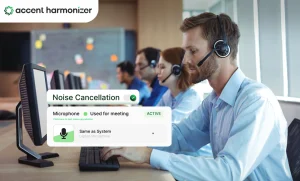

Most people hear the phrase accent correction AI and assume the technology is designed to change how someone sounds. That is not entirely accurate. Modern accent correction AI is increasingly being evaluated by contact centers, BPOs, and customer service organizations because it addresses a different problem: comprehension breakdowns during live conversations.
When customers repeatedly ask agents to repeat themselves, the issue is often not language fluency. Instead, the issue is how speech characteristics are perceived and processed by listeners in real time. This distinction matters because organizations are not typically trying to change agent identity. Consequently, they are trying to reduce misunderstandings that increase call duration, customer effort, and operational costs.
What Most People Think Accent Correction AI Does?
Many people assume accent correction AI removes accents entirely, trains pronunciation, or teaches language skills. Historically, accent reduction programs, speech coaching, and pronunciation training all focused on changing the speaker.
Because these legacy methods required months of behavioral change, buyers assume software works the same way. However, modern systems increasingly focus on improving listener comprehension instead of forcing agents to abandon their native speech patterns.
What Is Corrected During Live Conversations?
Modern accent correction AI does not necessarily correct the speaker. Instead, it corrects specific speech characteristics that create comprehension friction during real-time interactions.
- Pronunciation Variations: Phoneme differences and regional pronunciation patterns can cause immediate confusion. Software identifies these specific phonetic deviations and aligns them with the listener’s expected sound profiles.
- Speech Rhythm and Timing: Pacing, cadence, and conversational flow heavily influence speech perception. For instance, syllable-timed speakers may sound too rapid to stress-timed listeners, so the AI dynamically adjusts this rhythm.
- Intelligibility Gaps: Understanding under time pressure is difficult for anxious customers. Therefore, technology bridges the gap between what the agent says and what the listener’s brain can quickly process.
- Cross-accent Communication Challenges: Global support teams and offshore contact centers frequently manage multinational customer interactions. The software smooths out the acoustic mismatches that naturally occur across different geographies.
Why Contact Centers Are Evaluating Accent Correction AI?
Understanding how real-time accent modification adjusts speech during live calls helps operations teams set clear expectations for audio quality. When communication fails, operational metrics suffer. Specifically, teams run into three common triggers during live customer calls.
| Workflow Stage | Friction Mechanism & Breakdown | Omind Solution Intervention |
|---|---|---|
| 1. Repetition Loop |
| Real-time, low-latency accent modification converts delivery instantly into native regional variants without changing tone or delaying speech delivery. |
| 2. Increased Handling Time |
| Stripping out micro-frictions keeps AHT tight and uninflated, preserving standard conversational pacing and protecting regional agent stamina. |
| 3. Supervisor Escalation |
| Real-time call monitoring surfaces early friction signals automatically, allowing immediate course correction before an expensive manager handoff becomes mandatory. |
- Repetition Loops: Phrases like “Could you repeat that?” or “I didn’t catch that” stall progress.
- Longer Call Durations: Repetition leads to clarification, which quickly drives up additional handling time.
- Escalation Pressure: Customer frustration triggers supervisor involvement, which erodes operational confidence.
Most organizations are evaluating accent correction AI to reduce these conversational inefficiencies rather than alter human voices.
How Accent Correction AI Works in Real Time?
To understand this technology, you must look at the real-world digital signal processing occurring on every call.
| Phase | Technical Mechanism | Operational Goal |
|---|---|---|
| 1. Analysis | Speech signal analysis, phonetic modeling, and acoustic breakdown of real-time incoming audio layers. | Detect problematic phonemes instantly to target cross-accent friction before it impacts listener comprehension. |
| 2. Adaptation | Real-time speech adaptation algorithms coupled with precise, localized pronunciation adjustments. | Corrects acoustic characteristics dynamically, bridging the geographical pronunciation distance between agents and customers. |
| 3. Delivery | True speaker voice preservation paired with sub-100ms enterprise latency management. | Outputs clear, natural audio within seamless, unperceived delay boundaries to protect conversational rhythm. |
Why Traditional Accent Improvement Programs Struggle to Scale?
Traditional coaching depends heavily on lengthy training cycles and consistent reinforcement. For instance, agents must study pronunciation guides, practice variations, and receive manual feedback over several weeks.
Unfortunately, coaching dependence creates inconsistent outcomes across large global support teams. This article does not seek to compare software to human training, but organizations must recognize that digital speech adaptation scales instantly, whereas human behavior requires continuous, expensive maintenance.
The Operational Impact of Accent Correction AI
Deploying real-time speech correction yields direct, measurable improvements across standard contact center operations.
- Reduced Clarification Requests: Fewer repeat explanations mean smoother interactions. When customers grasp the information on the first attempt, call friction drops.
- Lower Average Handling Time Pressure: By eliminating repetition loops, agents resolve issues faster. Consequently, the center achieves better throughput without rushing the customer.
- Improved Customer Understanding: Communication clarity directly influences customer satisfaction. When listeners understand instructions easily, compliance and trust increase.
- More Consistent Global Service Delivery: Multinational support environments often struggle with variance across regions. AI standardizes clarity across all offshore operations.
Where Accent Correction AI Fits into Existing Contact Center Infrastructure?
Enterprise buyers must look beyond software functionality and focus on deployment realities.
| Deployment Scenario: Strong Fit | Deployment Scenario: Less Relevant |
|---|---|
Offshore Support Operations
| Low-Volume Voice Operations
|
Global Contact Centers
| Non-Customer-Facing Teams
|
Conclusion
Most discussions about accent correction AI focus on changing how people sound. However, that framing misses the broader operational challenge many enterprises are trying to solve.
Modern real time accent harmonizer software addresses comprehension friction during live conversations. It adapts speech characteristics in real time while preserving the speaker’s identity. For organizations managing large-scale voice operations, the question is often not whether accents should be corrected, but whether communication barriers can be reduced without retraining agents or disrupting existing infrastructure.
Optimize Your Voice Infrastructure Clarity
Are communication friction points driving up your average handling times? Contact our enterprise architecture team to learn how integrating a real-time speech layer can stabilize your global service delivery.