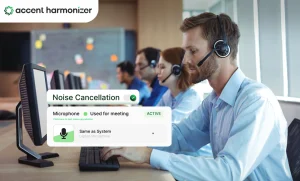

A customer does not measure conversational quality in milliseconds. They measure it in frustration. When voice AI pauses too long, clips speech, or forces repetition, trust breaks instantly. The issue worsens in offshore BPO environments were network instability and conversational pressure strain communication. Solving this requires deep voice clarity infrastructure for offshore teams to prevent baseline spikes. Therefore, modern contact centers are discovering that raw speed alone is not enough. The true challenge is maintaining consistent operational flow under real-world call conditions. If your system suffers from high real time speech latency, voice BPO performance degrades.
Why Real-time Speech Latency Became a Critical BPO Infrastructure Problem?
Customer service calls are emotionally escalated, multilingual, and highly fast-paced. When a customer encounters voice AI lag, it sets conversational fatigue. The delay triggers awkward clarification loops. Consequently, the customer loses confidence in the system before the agent can even offer a solution.
| How Delay Escalates During Live Customer Calls? | |||
|---|---|---|---|
| Operational Workflow Sequence | |||
Step 1 400ms Transmission Lag ⏱ Initial delay causes a faint, almost imperceptible pause on the line. | Step 2 Agent & Customer Collide 🗣 Both speakers jump into the silence simultaneously. Simultaneous cross-talk occurs. | Step 3 Audio Clipping & Distortion 🚫 Voice activation clipping removes critical consonants. Context is lost entirely. | Step 4 Frustrated Repetition 📈 Repetitions inflate call. 15-second AHT inflation per cross-accent exchange. |
Customers notice structural instability long before they identify the actual millisecond delay. This cognitive processing delay breaks the natural rhythm of human speech. Therefore, maintaining conversational continuity matters far more than chasing raw speed benchmarks.
If you want to protect your customer relationships, you must look beyond standard connection metrics. See how real-time Accent Harmonizer preserves conversational flow during global support interactions.
What Actually Causes Speech Latency in BPO Voice Systems?
To solve conversational delays, you must first understand the technical infrastructure. Many contact centers deploy voice applications without analyzing the underlying network layers.
| “ Traditional STT → LLM → TTS Pipelines ” |
Traditional voice AI applications rely following architecture:
- First, the Speech-to-Text (STT) engine converts the audio into text.
- Next, the Large Language Model (LLM) processes text to generate a response.
- Finally, the Text-to-Speech (TTS) engine synthesizes that text back into audio.
Hidden Delay Sources Most Contact Centers Ignore
Beyond software processing, the physical network introduces severe data degradation. Enterprise voice traffic frequently suffers from packet loss and jitters. Audio buffering mechanisms try to solve these errors, but they add noticeable delay.
Why Offshore BPO Environments Amplify Latency
Cross-region telecom routing requires data to travel thousands of miles through multiple international carriers. Because local internet reliability varies, cross-accent communication AI often struggles with dropped packets. Consequently, your real time speech latency voice BPO metrics spike due to local network limitations.
| Latency Stack Breakdown | ||
|---|---|---|
| Infrastructure Layer | Primary Cause of Delay | Operational Impact |
| Core Application | Sequential STT/TTS processing | High baseline lag |
| Network Layer | Jitter and packet buffering | Choppy, broken words |
| Telecom Routing | International SIP trunk hopping | Voice overlaps and echoes |
Evaluating these infrastructure layers helps prevent unexpected system failures. Evaluate whether your current voice infrastructure introduces hidden conversational delays.
Low Latency vs Conversational Stability: The Metric Most Vendors Ignore
Many software vendors promote incredibly low response times during ideal product demonstrations. However, raw speed does not guarantee a successful customer conversation.
Why 500ms Can Still Feel Terrible?
A consistent delay is manageable, but jitter inconsistency destroys conversational pacing. If your system delivers data at variable speeds, speech overlap occurs. The variance causes awkward pauses and sudden audio bursts. Therefore, a fast connection with high jitter feels worse than a slightly slower, stable connection.
Jitter Variance → CSAT Impact
↓
80ms Jitter → Noticeable drop
↓
150ms+ Jitter → Sharp Exponential Decline
Even with baseline latency under 300ms, high jitter significantly degrades perceived conversation quality.
Human Conversation Depends on Predictable Timing
Natural human conversation requires precise, predictable timing. When people speak, they rely on subconscious cues to take turns. AI speech enhancement call center systems must preserve these timing patterns. Without emotional synchronization, the interaction feels robotic and frustrating.
How Real-time Accent Harmonization Reduces Communication Friction?
Speech delay worsens when listeners struggle to understand the speaker’s accent. Deploying an AI voice intelligibility solution addresses both real-time raw stream processing speed and audio comprehension.Speech clarity software must address both network speed and audio comprehension.
Accent Friction Is a Comprehension Problem
When a customer encounters an unfamiliar accent, cognitive fatigue increases. The listener must expend extra mental energy to decode each word. It highlights why eliminating cognitive load and agent communication barriers functions as a structural operational goal. Consequently, minor voice AI delays become far more noticeable when comprehension is strained.
What Real-time Accent Harmonization Expressly Does?
Unlike legacy tools, modern software provides real-time accent localization through phonetic smoothing. This process aligns pronunciation patterns instantaneously without changing the agent’s actual voice identity.
Accent Harmonization vs Accent Neutralization
Traditional neutralization tools completely wipe away an agent’s cultural identity. This approach often results in an unnatural, robotic voice output. In contrast, real-time accent conversion tools preserve personal identity while optimizing speech intelligibility. This preservation maintains emotional authenticity during difficult service calls.
Clearer speech directly reduces the need for conversational repair cycles. Because customers understand words instantly, hesitation drops. Improve customer comprehension without changing how agents naturally sound by exploring Accent Harmonizer.
What Enterprises Should Evaluate in Real-time Voice AI Platforms?
Procuring the wrong technology can permanently damage your communication stack. Use these specific criteria during your technical vendor evaluations.
Critical Technical Questions to Ask Vendors
- What is your actual end-to-end processing latency under peak load conditions?
- Can you provide your P95 performance metrics rather than average P50 benchmarks?
- How does the platform handle high concurrency during sudden traffic spikes?
- What architectural mechanisms do you use for instant interruption management?
Infrastructure and Security Requirements
Your chosen platform must offer native SIP compatibility and explicit CCaaS integration. Additionally, look for WebRTC support to handle browser-based audio streams efficiently. To minimize transit delay, ensure the platform uses edge inference capabilities.
Common Failure Modes in Real-Time Voice AI Systems
Enterprise systems must remain resilient when production conditions degrade. Understanding potential failure modes helps your team prepare effective mitigation strategies.
- Latency Spikes Under Call Volume: During unexpected traffic peaks, cloud servers can experience computational exhaustion. It causes processing times to double instantly, disrupting ongoing customer conversations.
- Audio Clipping and Overlapping Speech: If a system cannot handle fast turn-taking, it clips the start of sentences. This defect forces both the customer and the agent to speak simultaneously, destroying the flow of the interaction.
- Silence Detection and Hallucination Failures: Poorly tuned voice systems often make natural pauses for the end of a sentence. Consequently, the AI interrupts the customer prematurely. In worst case scenarios, legacy engines hallucinate voice responses out of background noise.
The Future of BPO Communication Sounds Different
The next generation of contact center architecture belongs to real-time multimodal audio platforms. Moving forward, offshore scaling will depend entirely on AI-assisted communication clarity.
By upgrading to a real-time voice fluency solution, enterprises can eliminate geographical communication barriers. The future of global customer support is clearer, faster, and far more operationally stable.
Improve Conversational Stability Across Global Contact Centers
Reduce communication friction, improve speech clarity, and maintain real-time conversational flow with AI-powered Accent Harmonizer technology designed for enterprise BPO environments.