
A customer can hear an agent perfectly and still struggle to understand them. If your call center has already addressed packet loss, latency, headset quality, and background noise but customers still ask agents to repeat names, numbers, instructions, or product details, you may no longer have a conventional audio-quality problem.
You may have a speech-comprehension problem.
A call center voice clarity solution addresses that layer of the conversation: how easily customers can understand live agent speech after the underlying audio signal is already healthy.
For offshore BPOs and global contact centers, this distinction can affect Average Handle Time (AHT), escalation rates, agent capacity, and the economics of serving customers across different speech patterns.
The first step is to know whether voice clarity software is the right intervention.
When Does a Call Center Need a Voice Clarity Solution?
A voice clarity solution becomes relevant when several conditions appear together:
- network and CCaaS performance are stable;
- recorded calls sound technically clean;
- background noise is already controlled;
- customers still request repetition;
- agents frequently must rephrase otherwise correct information;
- clarification loops contribute to longer conversations;
- or comprehension problems appear disproportionately in particular offshore or cross-accent interactions.
That is a very different scenario from robotic audio, packet loss, jitter, or loud background noise. If the customer cannot hear the signal correctly, troubleshoot the signal.
If the customer hears the signal correctly but struggles to interpret the speech, investigate call center voice quality issues.
Call Center Voice Clarity vs Call Center Voice Quality
These terms are often used interchangeably. However, voice quality describes whether the audio reaches the customer cleanly. On the other hand, voice clarity describes whether the customer can understand the spoken message easily.
| Contact Center Voice & Network Troubleshooting | ||
|---|---|---|
| Problem | What the Customer Experiences | Primary Area to Investigate |
| Packet Loss | Missing or distorted speech | Network |
| Jitter | Choppy audio | Network |
| Latency | Delay and talk-over | Network / Processing |
| Background Noise | Office chatter, traffic, keyboard noise | Acoustic Environment |
| Low / Inconsistent Volume | Agent is difficult to hear | Endpoint / Audio Processing |
| Phonetic Mismatch | Customer hears the agent clearly but struggles to understand specific speech | Speech Clarity / Accent Harmonization |
They continue buying better headsets, adjusting network settings, or increasing agent coaching even though none of those interventions directly address the failure occurring in the conversation.
Why Speech Clarity Matters in Contact Centers?
Speech clarity is not merely a matter of whether a call “sounds good.” It affects what happens immediately after the agent speaks. A normal interaction should look like this:
| Real-Time Communication Loop |
|---|
Step 1 Agent Explains → Step 2 Customer Understands → Step 3 Conversation Continues |
A comprehension failure looks like this:
| Phonetic Repetition Friction Loop |
|---|
Step 1 Agent Explains → Step 2 Customer Asks for Repetition → Step 3 Agent Repeats → Step 4 Customer Confirms Partial Info → Step 5 Agent Rephrases → Step 6 Customer Verifies → Resolution Conversation Continues |
The customer may not even submit a formal complaint. But the contact center has consumed additional paid seconds without resolving any additional customer need. Across high call volumes, that becomes an operational problem.
How Speech Clarity Can Affect AHT?
Average Handle Time is influenced by many variables:
- CRM navigation;
- hold time;
- authentication;
- agent knowledge;
- transfers;
- after-call work;
- system performance;
- and customer complexity.
Speech comprehension is another one. When customers repeatedly ask:
- “Can you say that again?”
- “Did you say fifteen or fifty?”
- “Can you spell that?”
- “Sorry, I didn’t catch the last part.”
- “Can you explain that one more time?”
The agent is effectively performing the same work twice. It creates conversational repair time.
The problem becomes especially expensive when the repeated information involves:
- payment amounts;
- addresses;
- account details;
- policy terms;
- product specifications;
- troubleshooting instructions;
- or next steps.
These are high-information moments where misunderstanding can trigger additional confirmation or escalation. Contact centers evaluating AHT reduction through voice clarity should therefore measure repetition and clarification separately from general handle time.
What Does Call Center Voice Clarity Software Actually Do?
“Voice enhancement” is a broad category. Different tools modify different parts of the voice stack. A useful way to separate them is by the problem each technology is designed to solve.
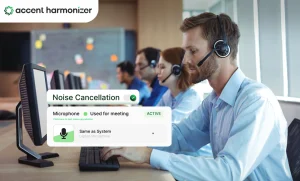
Noise Cancellation
Noise cancellation reduces unwanted environmental sound. It can help remove:
- office chatter;
- keyboard noise;
- traffic;
- fans;
- household sounds;
- and other background interferences
Noise cancellation and accent harmonization does not necessarily change how the listener interprets the agent’s pronunciation or speech patterns.
Audio Enhancement
Audio enhancement improves properties of the signal itself. Depending on the product, this may include:
- volume normalization;
- equalization;
- noise reduction;
- signal cleanup;
- or other processing intended to make speech sound cleaner.
Again, a cleaner signal does not automatically guarantee easier comprehension.
Speech Clarity and Accent Harmonization
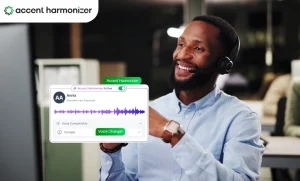
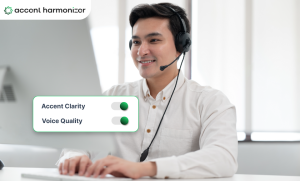
Speech clarity software operates closer to the spoken content itself. Accent Harmonizer by Omind AI, adjusts selected speech patterns in real time to make live agent speech easier for the listener to understand.
The objective is not to replace the agent’s voice. It is to reduce comprehension friction while preserving:
- individual voice identity;
- tone;
- emotional inflection;
- and natural conversational delivery.
This makes it fundamentally different from a novelty voice changer or synthetic voice replacement tool.
How Accent Harmonizer Works During a Live Call?
The deployment model is intentionally simple.
| Real-Time Audio Routing Architecture |
|---|
Step 1 Agent Voice → Step 2 Virtual Audio Device → Step 3 Existing CCaaS Platform → End Point Customer |
Accent Harmonizer operates as a Virtual Audio Device at the endpoint. From the perspective of systems, the processed audio behaves like input from a standard audio device. Telephony integration and voice harmonization deployment does not require the contact center to rebuild its voice-routing architecture merely to add speech processing.
The product is designed to avoid:
- SIP trunk rewrites;
- CCaaS routing changes;
- new physical voice hardware;
- and agent behavior modification.
Does Real-Time Voice Clarity Software Add Latency?
Every additional processing layer must be evaluated for its effect on live turn-taking. Accent Harmonizer operates at sub-200ms processing speed, designed to remain within the natural conversational buffer rather than introduce obvious telephony lag.
But enterprise teams should not accept a latency number without testing the product inside their own environment.
A sensible pilot should include:
- normal support calls;
- rapid back-and-forth conversations;
- double-talk;
- different endpoint hardware;
- representative agent workloads;
- and the CCaaS configuration used in production.
The buying question is not simply: “What is the vendor’s latency number?” Real-time voice processing and contact center latency claims “Does the complete live conversation still feel natural under our operating conditions?”
How Is Call Center Voice Enhancement Different from Accent Training?
Traditional accent training attempts to change agent behavior. Agents may receive coaching around:
- pronunciation;
- pacing;
- articulation;
- stress patterns;
- and conversational delivery.
Training can be appropriate when the problem is a broader communication or agent-skill issue. But it has an operational limitation. The improvement depends on the individual agent learning, retaining, and consistently applying the behavior.
For high-volume BPO operations, that means results can vary across:
- trainers;
- cohorts;
- locations;
- agent tenure;
- and individual learning curves.
A real-time voice clarity layer tackles a different job. When talking about accent harmonization vs accent training, instead of requiring the agent to consciously alter how they speak on every call, processing happens during the live conversation.
When a Voice Clarity Solution Is the Wrong Fix?
Accent harmonization is not the correct intervention when the root cause is:
- Packet Loss: If words are disappearing because packets are not reaching the customer, fix the network.
- Jitter: If audio is arriving unevenly and sounding choppy, investigate the voice transport path.
- Excessive Network Latency: If customers and agents continually speak over one another because of delayed transmission, diagnose the network or processing chain.
- Broken or Poorly Configured Headsets: If the microphone produces unusable audio, solve the endpoint problem.
- Background Noise Alone: If the customer primarily hears office chatter, traffic, or environmental noise, use noise suppression or improve the agent environment.
- Weak Agent Knowledge: If the agent is giving incorrect answers or cannot explain the product, speech software is irrelevant.
- Poor Call-Control Skills: If agents interrupt customers, fail to probe, or struggle to structure conversations, coaching remains the appropriate intervention.
How to Tell Whether Speech Clarity Is Actually Causing the Problem
Before deploying anything, sample real calls. Do not rely only on complaints saying, “audio quality.” Tag the exact point where the interaction breaks down. Useful categories include:
- network distortion;
- background noise;
- customer didn’t hear the agent;
- customer heard but misunderstood;
- agent repeated voluntarily;
- customer explicitly requested repetition;
- agent had to spell a word or name;
- agent paraphrased the same information;
- customer asked for confirmation;
- supervisor escalation followed misunderstanding.
Then ask whether the pattern clusters around:
- agents;
- specific call-center locations;
- customer markets;
- particular words or phonemes;
- numbers or transactional information;
- or certain stages of the call.
How to Evaluate an AI Voice Clarity Software Pilot?
A product demonstration proves that technology can run. It does not prove that it will produce economic value inside your operation. A useful pilot should answer four questions.
1. Does Comprehension Improve?
Measure indicators such as:
- customer repetition requests;
- agent restatements;
- clarification loops;
- and call-review observations.
2. Does the Improvement Affect Operations?
Track:
- AHT;
- transfer rate;
- escalation rate;
- repeat contacts where measurable;
- and agent capacity.
Do not attribute every change in these metrics to the voice technology. Control for other variables whenever possible.
3. Does Technology Affect Conversation Quality?
Evaluate:
- latency;
- naturalness;
- turn-taking;
- voice identity;
- emotional delivery;
- and comfort agent.
The product should not solve one form of friction by introducing another.
4. Can IT Deploy and Reverse It Cleanly?
Test:
- installation;
- endpoint requirements;
- CCaaS compatibility;
- rollback;
- failure behavior;
- administration;
- and support processes.
A pilot should de-risk the architecture as well as prove the user experience.
What Should Enterprise Buyers Ask for a Voice Clarity Vendor?
Before approving the deployment, put these questions in front of the vendor.
| Enterprise Technical Procurement & Deployment Checklist | |
|---|---|
| Evaluation Domain | Critical Procurement Questions & Verification Criteria |
| Architecture |
|
| Latency & Performance |
|
| Voice Authenticity |
|
| Security & Privacy |
Deployment Note: Solutions like Accent Harmonizer by Omind are engineered to retain zero PII or raw audio data, though security teams must formally audit socket endpoints during procurement. |
| Measurement & Pilot Validation |
|
How to Build the Business Case for Speech Clarity
Avoid starting with a broad claim such as: “Better voice clarity improves customer experience.” That is too vague to fund. Start with an observable operating problem. For example: Customers frequently request repetition during offshore support calls.
Then trace the mechanism:
| Accent Friction to Staffing Inflation |
|---|
Trigger Repetition → Latency Add Additional Conversational Seconds → Metric Degradation Higher AHT → Efficiency Loss Lower Interactions / Paid Hour → Cost Impact Greater Staffing Requirement |
Now calculate the opportunity using your own operation’s numbers.
Measure:
- calls per month;
- percentage containing avoidable clarification;
- average clarification time;
- loaded agent cost;
- impact on capacity;
- and escalation frequency.
This produces a much stronger business case than applying an unverified industry-average improvement percentage.
What Makes Accent Harmonizer Different from a Voice Changer?
The term “AI voice software” creates understandable skepticism. Some tools create a new synthetic voice; others replace speech entirely. Accent Harmonizer is intended for live human-to-human enterprise conversations. The goal is to preserve the agent’s identity while modifying selected speech patterns that can contribute to listener comprehension problems.
What should remain intact:
- the person’s voice identity;
- emotional expression;
- conversational intent;
- and natural personality.
What changes:
- selected speech characteristics associated with intelligibility for the target listener.
Should Your Contact Center Invest in Voice Clarity Software?
Consider testing a call center voice clarity solution when:
- audio infrastructure is healthy;
- customers still request frequent repetition;
- offshore or cross-accent calls show measurable comprehension friction;
- AHT contains significant clarification time;
- training has not fully addressed the problem;
- or scaling training across large agent populations is operationally difficult.
Hold off when:
- the voice network is unstable;
- endpoint quality is poor;
- noise is the dominant complaint;
- you have not analyzed real calls to identify the failure;
- or your actual problem is agent knowledge or call control.
From Clear Audio to Clear Understanding
The contact-center voice stack has several independent failure points. Network engineering solves transmission problems. Headsets and noise suppression solve acoustic problems. Training solves many behavioral communication problems.
A call center voice clarity solution is relevant when those layers are functioning, but the customer still struggles to understand otherwise correct agent speech.
Accent Harmonizer adds a real-time speech-processing layer to existing contact-center environments, designed to reduce comprehension friction without asking agents to change how they naturally speak or forcing IT teams to rebuild the voice stack.
The business case is not “make voices sound better.” It reduces conversational repair work that happens when customers hear the agent but do not understand the message the first time.
If that pattern exists inside your operation, measure it first, then test whether removing it changes the economics of the call.