Healthcare BPO operations handle some of the most consequential voice interactions in the outsourcing industry. A misheard medication name, an incorrectly recorded date of birth, or a policy number repeated three times does not merely extend call duration. It creates clinical risk, compliance exposure, and patient frustration that erodes trust in the provider brand.
The stakes are higher here than in most verticals. Agents working healthcare accounts manage prior authorizations, claims status inquiries, appointment scheduling, prescription refill coordination, and benefits verification. Each of these processes involves high-information-density exchanges where a single phonetic misunderstanding can cascade into downstream errors.
Traditional accent training programs in healthcare BPOs face two structural problems. First, the medical terminology itself is complex, and accent variation compounds the difficulty of parsing unfamiliar clinical terms over a phone line. Second, training cycles are long and costly, often running eight to twelve weeks before agents reach proficiency, and attrition erases much of that investment within the first year.
How Accent Harmonization Works in Healthcare Call Environments?
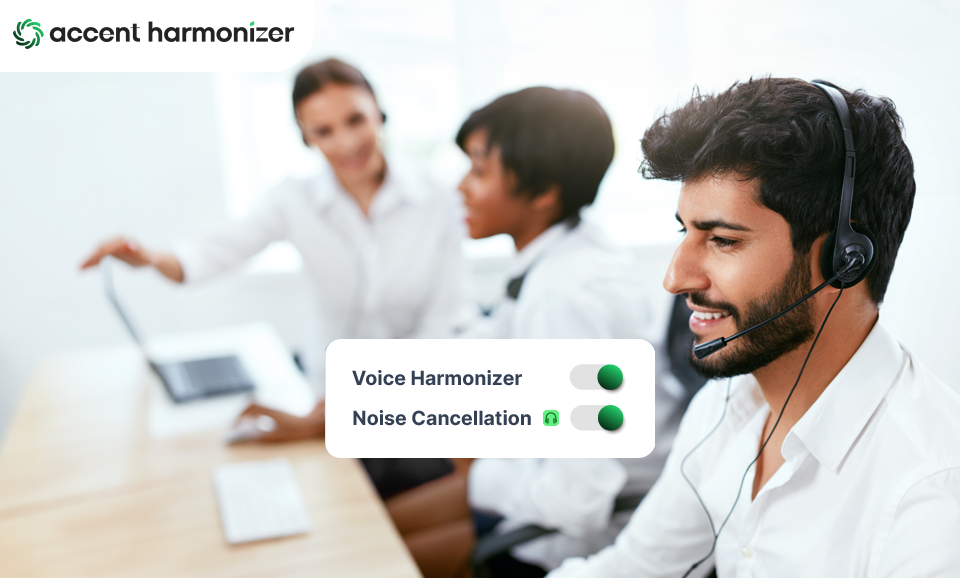
Real-time accent harmonization technology addresses these challenges at the audio stream level, not through behavioral modification. The system processes the agent’s live speech, identifies phoneme patterns most likely to cause comprehension friction for the listener, and applies targeted adjustments. The agent’s natural voice, tone, and emotional register remain intact. Only the specific sound patterns that create misunderstanding are refined.
For healthcare BPOs, this is especially valuable during high-risk moments in a call. Consider a benefits verification call where an agent needs to communicate a prior authorization number, a provider NPI, and specific coverage terms. Each of these data points contains alphanumeric sequences where a single misheard character triggers rework. Accent harmonization reduces the probability of these mishearing events by improving the clarity of consonant clusters and vowel positioning that vary most across regional accents.
The technology operates bidirectionally. It can clarify both the agent’s speech for the patient and the patient’s speech for the agent. This matters in healthcare contexts where callers include elderly patients, individuals with hearing difficulties, and non-native English speakers navigating complex insurance terminology.
“In healthcare, a ‘B’ sounding like a ‘D’ isn’t just a typo — it’s a potential HIPAA violation or a medication error. Real-time harmonization removes that cognitive load from the agent, allowing them to focus on patient empathy rather than phonetics.”
— Operations Leader, Healthcare BPO
Operational Impact on Key Healthcare BPO Metrics
The measurable impact of accent harmonization on healthcare BPO operations shows up across several interconnected KPIs. Average Handle Time (AHT) decreases because agents spend less time repeating information and re-verifying data points. Research from contact center deployments indicates that approximately 20 percent of calls contain avoidable repetition cycles, each averaging 30 seconds or more.
First Call Resolution (FCR) improves because patients correctly understand next steps, reducing callback rates. In healthcare, a failed FCR often means a patient misses a follow-up appointment, delays a prescription refill, or fails to complete a required pre-authorization, all of which have clinical and financial consequences.
Customer Satisfaction (CSAT) scores benefit from reduced frustration. While general CSAT is a goal for all, the specific application of voice clarity in reducing churn in telecom contact centers is where the ROI is most visible. Patients who feel heard and understood on the first attempt report significantly higher satisfaction. For healthcare BPOs where client contracts often tie compensation to CSAT benchmarks, this directly affects revenue retention.
| Traditional Training vs Accent Harmonizer: Key Outcomes | ||
|---|---|---|
| Metric | Traditional Training (Manual) | Accent Harmonizer (AI-Driven) |
| Onboarding Time | 8–12 Weeks | 1–2 Days (Immediate) |
| AHT Impact | Minimal/Variable | 8–12% Reduction |
| FCR Improvement | Dependent on Soft Skills | 10–15% Improvement |
| Scalability | Low (Trainer-dependent) | Infinite (Instant deployment) |
Compliance outcomes also improve. When mandatory disclosures such as HIPAA notices, cost-sharing explanations, and appeal rights are delivered clearly, the risk of a compliance gap caused by miscommunication decreases. Quality assurance teams reviewing recorded calls find fewer instances where technically compliant language was delivered but not effectively communicated.
Integration Without Disruption
One of the practical advantages of accent harmonization for healthcare BPOs is that it deploys as a voice-layer solution within the existing telephony stack. There is no need to overhaul the CCaaS platform, modify IVR logic, or retrain agents on new workflows. The technology sits beneath the existing quality assurance, speech analytics, and compliance monitoring tools, and improves the performance of those downstream systems by providing cleaner audio input.
For healthcare operations running on platforms like Five9, Genesys, NICE, or Avaya, accent harmonization integrates through the audio stream without requiring API-level changes or extended IT projects. Deployment timelines measured in days, not months, make it feasible to roll out across large agent populations without disrupting active healthcare campaigns.
The Case for Voice Clarity as Healthcare CX Infrastructure
Healthcare BPOs that have adopted real-time accent harmonization report measurable improvements within the first 30 days of deployment. AHT reductions of 8 to 12 percent, FCR improvements of 10 to 15 percent, and quality compliance score increases of up to 30 percent have been documented across production environments.
For operations leaders evaluating voice clarity technology, the relevant question is no longer whether accent-related miscommunication affects healthcare outcomes. The evidence is clear that it does. The question is whether the organization’s current approach can scale fast enough to match workforce growth and client expectations.
Real-time accent harmonization provides an infrastructure-level solution that works from day one, across every agent, on every call. In a vertical where communication errors carry clinical, regulatory, and financial consequences, that capability is quickly moving from competitive advantage to operational necessity.
Accent Harmonizer by Omind delivers AI-powered, real-time voice clarity designed for the specific demands of healthcare BPO environments. To explore how it integrates into your existing operations, schedule a demo today.