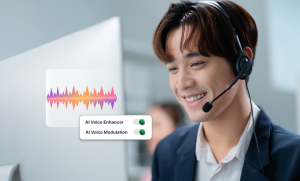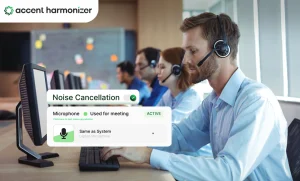

A contact center adds Accent Translation because it wants agents to be easier to understand without losing their natural vocal identity. But once real-time speech processing enters a live customer conversation, IT, enterprise architects, and security leaders need to evaluate what happens to that audio stream.
Before approving deployment, enterprise technical due diligence requires clear answers to four primary questions:
- Where is the voice processed?
- What data leaves the endpoint?
- What remains after the call ends?
- What other systems touch the conversation?
Evaluating accent translation security requires tracing the live voice path from the agent headset to the telephony infrastructure rather than relying on high-level marketing assurances.
Where Does Accent Translation Process the Voice?
Evaluating the architecture of a real-time speech layer begins with the physical execution boundary. In a standard enterprise deployment, the conversation flows through a defined sequence:
| Voice Signal Processing Flow |
|---|
Agent → Accent Harmonizer Engine → CCaaS & Telephony Environment → Customer |
Accent Harmonizer by Omind AI (powered by Sanas) provides real-time processing and on-device deployment. Processing audio locally on the agent’s workstation limits the unnecessary transmission of raw, unencrypted speech across external networks before it reaches the softphone.
On-Device Processing
On-device processing executes voice modification locally on the endpoint desktop CPU, but it does not make the application fully offline.
Conversation audio and voice samples are processed locally on the user’s device. However, the client application requires network connectivity for specific tasks. These external communications include:
- User authentication and access verification
- License key activation and validation
- Centralized policy updates from management portals
- Operational telemetry and health logging
What Data Remains After the Conversation?
Data retention policies represent the primary privacy boundary for contact center buyers. In the documented desktop/on-device Accent Translation configuration, Sanas states that live conversation data and voice samples are processed locally in real time and are not recorded or stored.
However, call audio is not the only data class generated within the application environment. Enterprise security teams must evaluate each data class independently:
| Enterprise Data Class Evaluation Framework |
|---|
Live Conversation Audio
Authentication & Account Data
Licensing & Access Information
Operational Telemetry
Administrative Configuration
|
While live call audio is not retained by the on-device engine, administrative and telemetry data cross the endpoint to maintain system governance. Separately, vendor data processing agreements (DPAs) may account for optional model-refinement or diagnostic workflows under specific contractual terms. Enterprise procurement should explicitly confirm whether any optional model-improvement programs apply to their specific tenant configuration.
Does Preserving the Agent’s Voice Require Storing the Voice?
Accent Harmonizer preserves the speaker’s natural voice, tone, and emotion while modifying accent characteristics for listener clarity. This raises an essential technical question: Does preserving vocal identity require persistent voice storage?
Voice preservation during live harmonization is not automatically the same as voice cloning or voiceprint storage. Real-time neural speech harmonization modifies audio during the sub-200 millisecond processing window without creating or retaining the data.
Accent Translation Is Only One Part of the Call’s Security Boundary
Accent Translation layers directly onto existing telephony and contact center infrastructure via a virtual audio device model, avoiding the need to redesign core routing or CRM workflows. Because the processing engine acts as a virtual microphone layer on the endpoint, security teams must look beyond the tool itself to evaluate full conversation security.
Consider the end-to-end operational call path:
| End-to-End Operational Call Path |
|---|
Headset → Accent Harmonizer → Softphone → Telephony Gateway → Call Recording → Speech Analytics → CRM |
Product-level privacy is distinct from end-to-end call privacy. Even when the Accent Translation engine executes with zero audio retention on the desktop, downstream systems within the contact center stack continue to operate under their own retention policies:
- The CCaaS platform may capture and store raw or harmonized call audio for compliance.
- Speech analytics tools may generate and retain text transcripts containing customer context.
- CRM systems store interaction metadata, notes, and case records attached to the customer profile.
If inbound Accent Translation is enabled alongside outbound processing, the data-flow map must also account for incoming customer audio. A zero-retention processing layer does not automatically make the entire contact center ecosystem zero-retention.
What Should Enterprise Security Teams Verify?
When conducting commercial technical due diligence, security and compliance teams should screen these key operational areas:
| Vendor Security & Compliance Verification | |
|---|---|
| Verification Area | What to Request from Vendor |
| Processing Location | Deployment architecture diagrams confirming where live audio workloads execute (endpoint vs. cloud). |
| Audio Retention | Technical documentation verifying whether live call audio, buffer caches, or voice samples are retained post-call. |
| Non-Audio Data | Data classification schedules covering telemetry, authentication tokens, system logs, and administrative data. |
| Connected Systems | End-to-end voice and data-flow maps covering integrations with CCaaS, call recording, QA, and CRM platforms. |
| Administrative Control | Documentation on Role-Based Access Control (RBAC), Single Sign-On (SSO) support, and centralized configuration auditing. |
| Security Assurance | Formal third-party audit reports, Data Processing Agreements (DPAs), subprocessor lists, and Trust Center documentation. |
To establish a clear compliance posture, enterprise buyers should use a three-layer validation framework:
- Product Documentation: Evaluates how the architecture is designed to operate.
- Security & Trust Artifacts: Validates organizational controls and third-party audit attestations.
- Contract, DPA, & SOW: Establishes the legally binding data handling parameters for the customer’s actual deployment.
Validate the Architecture in Your Actual Contact Center
Vendor documentation and trust portals establish the expected baseline architecture. A controlled technical pilot verifies how those controls execute inside your specific operating environment.
During pilot technical validation, test the live voice path across the full stack:
- Verify local endpoint resource consumption and network bandwidth under load.
- Trace audio routing from the headset through the virtual audio device into the softphone.
- Confirm CCaaS recording quality, transcript accuracy, and downstream QA ingestion.
- Audit network traffic to confirm that audio data does not cross unapproved external boundaries.
- Test administrative RBAC controls, deployment policies, and automatic fallback behavior if network connectivity drops.
Secure Accent Translation Starts with Knowing the Voice Path
Deploying real-time speech technology in enterprise contact centers requires balancing three core outcomes:
- Clarity: Customers understand agents on the first exchange.
- Authenticity: Agents retain their natural vocal identity and tone.
- Controlled Data Exposure: Security teams maintain precise visibility over live speech processing.
Accent translation security is not established by a single compliance badge or an “on-device” marketing label. It is established by tracing the complete voice path: verifying where live speech is processed, isolating what data remains post-call, mapping connected downstream systems, and confirming that vendor documentation aligns with your production environment.
Ready to Audit Your Live Voice Processing Security?
Deploying real-time speech AI doesn’t mean compromising on enterprise data governance or compliance standards.
Book our enterprise voice processing to get a complete demo.