
Contact center leaders evaluating Sanas accent translation usually start with a clear, impressive audio demo. Real-time speech transformation sounds crisp, agent identity remains intact, and the core capability is obvious.
Evaluating the technology as production voice infrastructure requires answering harder operational questions:
- Will processing hold up across thousands of concurrent agent sessions?
- How does the system handle diverse source accents across global delivery sites?
- Will legacy desktop hardware, VDI environments, and mixed headsets degrade real-time performance?
- Does real-time processing introduce conversational latency on live telephony routes?
- Will the deployment measurably reduce handle time, customer repetition, and supervisor escalations?
Evaluating Sanas accent translation requires moving past polished media samples and testing for production reliability, workforce compatibility, and clear operational ROI.
What Sanas Accent Translation Does?
Sanas accent translation processes incoming agent speech in real time, modifying selected phonetic and accent characteristics to match a target profile while preserving the speaker’s voice identity.
Three operational boundaries clarify the technology’s actual scope:
- It is not language translation. Both speaker and listener converse in the same language.
- It is not traditional accent training. Agents do not need to adjust their natural speech patterns.
- It is a real-time speech-processing engine applied directly to the agent’s audio stream.
Will Sanas-like Accent Translation Cover Your Agent Accent Mix?
A common question from IT and procurement teams is whether speech-processing technology supports all accents. In practice, generic model coverage is not the same as actual workforce coverage.
Vendor documentation highlights broad source-accent categories and target-accent profiles. However, real-time performance varies across regional dialects, speaker-level cadence, volume, and phrasing. An accent model that performs predictably for one demographic may struggle with minor regional variations or non-standard phrasing from another.
If your delivery footprint relies on operations in the Southeast Asia, your evaluation cohort must mirror that exact geographical and acoustic distribution. Relying on a small, hand-picked sample of test agents introduces sampling bias that masks model limitations.
Your actual workforce distribution must dictate your evaluation cohort. Evaluating real-time speech transformation platforms requires moving beyond pre-recorded demos; consult our 8 factors to compare in accent harmonization software to test operational risks under live conditions.
What a Sanas Accent Translation Demo Does—and Does Not—Prove?
Vendor demo audio serves a purpose: it proves that the underlying transformation algorithm is audible, that speaker identity can be preserved, and that output speech sounds natural under ideal conditions.
However, curated audio samples fail to reflect live contact center reality.
| Real-Time Voice Processing Proof: Demo vs. Production Reality | |
|---|---|
| What a Demo Proves | What a Demo Does NOT Prove |
| Audible speech transformation | Endpoint CPU and memory footprint under load |
| Baseline naturalness of transformed voice | Stability across 8-hour agent shifts |
| Voice identity retention | Telephony audio stability under high network jitter |
| Absence of processing artifacts in quiet environments | Intelligibility during background noise, crosstalk, and interruptions |
| Basic algorithm viability | Reductions in Average Handle Time (AHT) or repeat calls |
Audio quality is a product metric. Reduced interaction friction is a business metric. Evaluation begins when speech processing leaves controlled environments and operates under live queue conditions.
Three Production Tests Before Rollout
Before committing capital to enterprise rollout, put the processing engine through three production-grade stress tests.
Test 1: Your Actual Endpoints
Avoid testing exclusively on high-performance supervisor workstations or pristine cloud environments. Run tests on standard agent infrastructure:
- Legacy desktop hardware and low-spec thin clients
- Virtual Desktop Infrastructure (VDI) environments
- Standard USB, analog, or mixed enterprise headsets
Monitor local CPU utilization, memory consumption, audio-driver compatibility, hot-swapping behavior when headsets are unplugged mid-call, and continuous process stability across long shifts.
Test 2: Your Actual Call Audio
Assess the model against real-world voice traffic rather than scripted sentences. Expose the system to challenging live scenarios:
- High floor noise (competing agent chatter, air conditioning rumble)
- Rapid speech, sudden interruptions, and overlapping dialogue
- Alphanumeric strings, complex account numbers, and unusual proper nouns
- Multilingual code-switching or regional colloquialisms
- High-stress, emotionally charged customer interactions
The objective is to verify that speech output remains intelligible and natural when call dynamics become unpredictable.
Test 3: Your Actual Failure Modes
Evaluate how the application handles system-level disruptions:
- What occurs if local processing crashes or memory leaks develop?
- Can the agent instantly bypass processing via a physical or software toggle?
- How does the system respond when default audio input devices change mid-call?
- What is the measured round-trip latency under full production server loads?
Never accept “real-time” as a blanket benchmark. Measure conversational behavior directly on live lines. Watch for talk-over, awkward conversational pauses, delayed responses, and streaming audio distortion.
Also before rollout, security architects must verify what data leaves the agent endpoint during real-time speech processing. A viable platform must fail gracefully without dropping or corrupting the customer call.
Measure the Conversation, Not Just the Audio
To establish a clear deployment business case, separate technical vendor benchmarks from enterprise operating metrics.
Technical & Vendor Metrics
- Speech intelligibility scores (e.g., MOS, STOI)
- Perceptual voice naturalness and speaker similarity
- Processing latency (milliseconds)
- System uptime and processing error rates
Buyer Operating Metrics
- Customer repetition rate (clarification requests per call)
- Average Handle Time Reduction
- First Contact Resolution (FCR)
- Supervisor escalation frequency
- Customer Satisfaction (CSAT) and Net Promoter Score (NPS)
Technical metrics confirm that the software functions as designed. Operating metrics establish whether the solution delivers return on investment.
A transformation engine can pass technical listening tests while failing to impact call duration if customers continue asking agents to repeat information. Conversely, minor improvements in acoustic clarity can yield significant cost savings if they systematically eliminate repeated explanations across millions of annual queue minutes.
Measure the conversation, not just the waveform.
What Sanas Documentation Won’t Tell You About Your Rollout?
Vendor product documentation focuses on architectural features and benchmark performance. Enterprise Execution presents specific operational realities:
- Vendor benchmarks your environment: Controlled lab results do not account for legacy workstations, custom softphones, local network constraints, or specific customer demographics.
- Model coverage workforce coverage: Supporting a broad language or accent group does not guarantee equal acoustic performance across every individual agent.
- Demo quality queue economics: Clearer output audio must directly reduce handle times, repeat calls, or supervisor transfers to justify license costs.
- Supported architecture deployment readiness: Compatibility with a virtual environment or softphone provider does not address local IT ownership, automated software distribution, rollback protocols, or agent change management.
Operationalizing speech technology requires evaluating how the software integrates into existing daily contact center workflows.
Where Accent Harmonizer Fits in a Sanas-Powered Deployment?
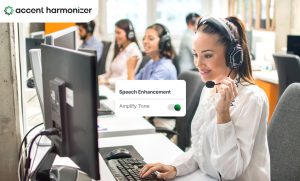
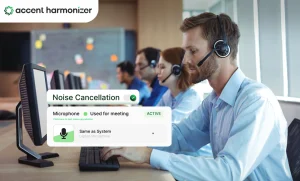
Accent Harmonizer by Omind AI incorporates Sanas accent translation into a complete enterprise deployment and operations management framework.
While Sanas delivers core real-time speech transformation algorithms, Accent Harmonizer provides the management, integration, and reporting infrastructure required by enterprise contact centers:
- Deployment & Endpoint Management: Simplified software packaging, automated agent endpoint distribution, and resource optimization across mixed VDI and desktop fleets.
- Telephony & Workflow Integration: Native alignment with existing CCaaS, CTI, and softphone routing architectures to prevent latency accumulation.
- Operational Analytics: Real-time visibility into usage rates, endpoint stability, and correlated conversation metrics (AHT, repetition rates, and handling costs).
- Change Management & Agent Experience: Streamlined onboarding controls, agent bypass capabilities, and operational governance models that ease workforce adoption.
This combined approach pairs real-time speech transformation with the deployment, management, and analytical infrastructure needed to secure measurable operational returns.
Production Evidence Beats Demo Quality
A successful demo confirms that speech modification software works under ideal conditions. Establishing an enterprise deployment case requires validating performance across live agent cohorts, actual endpoints, varied acoustic environments, and bottom-line contact center metrics.
A clear procurement evaluation follows a defined path: technical validation endpoint reliability operational metric tracking economic value recovery.
Next Steps
Evaluate Accent Harmonizer by Omind AI on a live production cohort. Measure comprehension, customer repetition, handle times, and processing stability across representative source accents, headsets, endpoints, and live telephony routes.
Explore our contact center solutions to learn more.