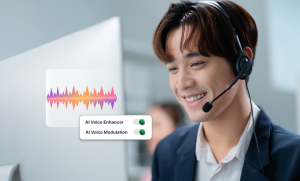

Global call centers don’t lose customers because agents lack empathy or product knowledge. They lose them when customers struggle to understand what’s being said—despite crystal-clear audio and well-trained agents. Most AI voice tools improve sound quality, but without real-time accent harmonization, comprehension friction still remains. The distinction matters more than most CX leaders realize, and it’s quietly costing contact centers in AHT, CSAT, and first-call resolution.
Why “Clear Audio” Isn’t Enough in Global Call Centers?
There is a common misconception in CX leadership that voice quality and linguistic intelligibility are the same problem. Audio quality has become a hidden cx metric and often overlooked until performance plateaus.
Signal vs. Syntax Paradox
Modern noise-cancellation and audio-enhancement tools (like Krisp or hardware-level DSP) have effectively “solved” the signal problem. They eliminate static, normalize decibels, and suppress background chatter.
However, High-Fidelity Audio ≠ High-Fidelity Comprehension.
Even in a silent digital environment, communication breakdowns persist. The issue is the phonemic friction between the speaker and the listener. Real-time noise cancelling software often solves the wrong problem.
Understanding Cognitive Load
When an agent’s speech patterns—vowel elongation, unconventional syllable stress, or non-native prosody—deviate from the listener’s internalized linguistic model, it triggers Increased Cognitive Load.
Studies in Scientific Reports (2024) demonstrate that even ‘clear speech’ can elevate cognitive load if it doesn’t align with the listener’s expectations. This confirms that the burden of comprehension is a neurobiological cost, not just a matter of ‘bad’ audio
- The Decoding Tax: The customer’s brain diverts processing energy away from the content of the message to decoding the sounds.
- The Latency of Logic: This micro-delay in processing leads to slower response times, frequent requests for repetition (“Can you say that again?”), and a measurable rise in customer frustration.
- The Trust Erosion: High cognitive load is subconsciously associated with effort. Reducing this customer effort is the new frontier of global CX.
Moving Toward Linguistic Legibility
Enterprises that have already deployed world-class noise cancellation often hit a performance ceiling. They are now searching for linguistic clarity.
| Audio Quality & Linguistic Clarity Solutions | ||
|---|---|---|
| Feature | Technical Solution | Customer Experience Outcome |
| Audio Quality | Noise Suppression / Gain Control | “I can hear the agent’s voice clearly.” |
| Linguistic Clarity | Real-time Accent Harmonization | “I understand the agent’s meaning immediately.” |
Expert Insight
High-quality CX isn’t defined by how “clean” the audio sounds; it’s defined by how little effort the customer has to exert to understand the resolution. What global enterprises need is legibility—speech that is immediately accessible to the listener, regardless of the agent’s regional background.
Accent Neutralization vs. Accent Translation vs. Accent Harmonization
While often used interchangeably in marketing, these three technical approaches offer vastly different outcomes for agent identity and customer experience.
Accent Neutralization
Attempts to force a speaker’s regional accent toward a perceived “standard” (e.g., General American).
- The Tech: Modifies phonemes and cadence to fit a target profile.
- The Downside: Frequently erases the speaker’s identity, resulting in a “robotic” or uncanny valley effect. By stripping regional features, it often removes the emotional texture and presence of the agent.
Accent Translation
Real-time mapping of the speaker’s accent onto a specific target regional accent.
- The Tech: Complex, high-latency re-encoding of speech patterns.
- The Downside: High risk of “moving target” syndrome. An agent translated to one specific region may sound jarring or unfamiliar to customers in another, creating new layers of friction.
Accent Harmonization
Focuses on the listener’s comprehension rather than changing the speaker’s identity.
- The Tech: Analyzes potential friction points in real-time and makes precise, minimal adjustments to improve legibility.
- The Benefit: Preserves the agent’s timbre, pitch, and emotional tone. The agent sounds like themselves; the customer simply understands them better.
| Neutralization vs Translation vs Harmonization | |||
|---|---|---|---|
| Feature | Neutralization | Translation | Harmonization |
| Primary Goal | Conformity | Substitution | Comprehension |
| Agent Identity | Erased/Flattened | Replaced | Preserved |
| Output Quality | Often Robotic | High Latency Risk | Natural & Human |
| CX Impact | Low Trust/Processed | Region-Specific | Universal Legibility |
This distinction is not semantic. It has direct implications for agent trust, CX authenticity, and customer-side perception of the interaction.
How Do Real-time Accent Harmonization Actually Works?
Accent Harmonization sits directly in the live audio pipeline as linguistic middleware. Instead of changing just the sound, the technology manages the AI-driven recognition of accent patterns.
Phonemic Analysis
The system runs a continuous scan for vowel quality and word stress. The goal is to identify points of mismatch, not “errors.” It adjusts only what affects comprehension, leaving pitch and emotional tone untouched. This is why harmonization is architecturally distinct from generic voice changers.
Selective Adaptation
The system adjusts only what affects comprehension—specific phonemic outputs like a softened vowel or a clarified terminal consonant. Everything else is left alone: pitch, timbre, cadence, emotional tone. The customer shouldn’t perceive any processing. The conversation should simply be easier to follow.
Latency
Live calls have a hard latency budget: under 150 milliseconds before delay becomes perceptible and disrupts conversational rhythm. That constraint makes post-processing architectures unworkable. Harmonization executes inside the live audio stream—between microphone and earpiece—because that’s the only place it can work.
Latency, Tone, and Pitch
Tone and pitch carry emotional information. When an AI system compresses dynamic range or strips pitch variation, it doesn’t just change how the agent sounds—it changes how the customer reads the interaction. Flat or processed voices register as untrustworthy, regardless of what’s being said.
Post-processing architectures have a structural problem: they require buffering. Processing a full utterance before delivery introduces delay, and systems that try to compensate by working in short windows create a different problem—discontinuities in the audio stream that produce unnatural cadence breaks. The speech sounds segmented.
Real-time harmonization sidesteps this by operating directly on the live stream. Because it modifies only the phonemic elements affecting comprehension—not the broader acoustic envelope—tone and pitch are never touched. The latency footprint stays within the 150ms budget. The voice stays intact.
Where Accent Harmonization Fits in the Call Center Stack?
Understanding harmonization as infrastructure rather than a feature is essential. It sits between the agent’s mic and the customer’s earpiece.
- Coaching tools fail because they add cognitive load to the agent.
- Post-processing layers fail because they introduce buffering delays.
Because it operates at the audio level, it shortens ramp-up time for new agents and works across platforms.
Measuring Effectiveness Before Full Rollout
Accent harmonization is measurable. Three metrics give you a direct read on comprehension friction—not proxies for it:
- Repeat request rate — how often customers ask agents to repeat themselves
- AHT variance by cohort — segmented by agent accent profile and customer region, not blended across the operation
- First-contact resolution — segmented by the same accent pairings
Collect these pre- and post-harmonization. The delta is your signal.
On pilot design: Test across a representative spread of accent pairings, not just the highest-friction ones. Measuring only worst-case scenarios inflates apparent impact. Also run agent perception check agents who feel their voice is being processed will work around the system. A functioning harmonization layer should be imperceptible to the agent. If it isn’t, that’s a product problem, not a training problem.
One thing to avoid: Synthetic accent testing in controlled environments. It doesn’t replicate live call variability. The data it produces isn’t reliable enough to make a deployment decision on.
Why Generic AI Voice Tools Still Leave a Gap for Global BPOs
Although solving noise cancellation and adding voice enhancement, comprehension gaps in global BPO operations persist anyway.
The problem is linguistic, not acoustic. A customer who hears the agent perfectly clearly can still struggle to process what they’re hearing. Phonemic mismatch or unfamiliar stress patterns create cognitive load that no noise suppression removes. Hearing and understanding are different processes.
At BPO scale, that distinction compounds. A contact center running thousands of calls per hour across multiple agent geographies and customer regions is generating comprehension friction continuously. The downstream effects—AHT inflation, repeat contacts, escalation rate creep—are real but diffuse enough that they rarely get attributed to the right cause. Which is why they persist.
Conclusion
For years, global enterprises have treated “accent” as a training problem, something to be coached away or “neutralized” at the cost of the agent’s identity. We now know this is a biological and operational miscalculation.
The friction in global service interaction is caused by cognitive load. When you force a customer’s brain to spend its energy decoding phonemes instead of solving problems, you lose money. You lose it in Average Handle Times, eroded brand trust, and agent burnout.