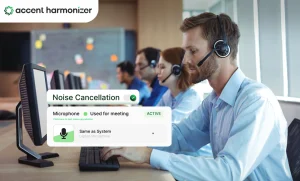

Global contact center operations face an underlying operational reality: customer conversations often fail even when agents provide the exact, technically correct solution.
This issue is rarely a lack of agent capability, process knowledge, or intent. Instead, it is driven by communication friction. The natural variations in speech patterns, regional accents, listening expectations, and phrasing collide during live customer interactions create silent barriers.
Organizations searching for AI speech clarity software for offshore agents are typically attempting to solve this broader communication clarity problem. However, evaluating these tools requires looking beyond how speech can be altered. Enterprise leaders must evaluate how communication AI improves actual understanding between humans without adding latency, degrading voice naturalness, or creating operational complexity.
What Happens When Communication Friction Occur?
When communication friction occurs, the operational consequences scale rapidly across the enterprise:
| Operational & Financial Impact of Speech Communication Friction | |
|---|---|
| Communication Issue | Direct Operational & Business Impact |
| Frequent Repetition Demands |
|
| Misunderstood Technical Information |
|
| Conversational Strain & Confusion |
|
| Inconsistent Speech Clarity |
|
Why Are Contact Centers Searching for AI Language Neutralization Software?
The search for language neutralization software is driven by fundamental shifts in how global customer support is delivered and managed.
| Global Support Realities vs. Operational Friction Path | |
|---|---|
Global Reality A Distributed BPO Teams Operating across global hubs Global Reality B High Customer Expectations Demanding fast, effortless clarity ↓ Convergence Point Operational Communication Friction ↓ Downstream Impact Metric Degradation
Downstream Impact Quality Management Gaps
|
| Friction Layer | Root Operational Cause | Target Solution Architecture |
|---|---|---|
| Metric Degradation |
| Deploy Omind Accent Harmonizer at the local client layer for real-time sub-150ms voice clarity. |
| Quality Management Gaps |
| Implement Omind AI QMS for 100% automated call coverage and data-triggered coaching. |
Global Support Requires Consistent Communication
Enterprises and Business Process Outsourcers (BPOs) increasingly rely on geographically distributed teams to deliver 24/7 coverage and scale workforce operations. While agents are highly trained, customers expect effortless understanding regardless of where a call is answered. Balancing regional talent distribution with consistent global delivery remains a primary operational challenge.
Communication Barriers Create Operational Inefficiency
Unclear interactions directly degrade key contact center performance metrics:
- Higher Average Handling Time (AHT): Minutes are lost when agents must repeatedly clarify terms, spell out phrases, or slow down their natural pacing to compensate for comprehension gaps.
- Lower First Contact Resolution (FCR): Minor misunderstandings during a call often result in follow-up inquiries, higher ticket volumes, and increased operational costs.
- Quality Management Friction: Traditional Quality Assurance (QA) processes struggle to evaluate communication barriers objectively. Coaching becomes reactive and manual, addressing issues long after the customer interaction has closed.
Manual Communication Training Does Not Scale
Traditional accent and speech training programs require weeks of onboarding, ongoing classroom instruction, and continuous manual intervention. For high-volume contact centers, this approach is slow, expensive, and difficult to maintain across high-turnover teams. Operations teams require real-time support mechanisms that assist agents directly during live calls.
What Does AI Language Neutralization Software Actually Do?
AI language neutralization software uses artificial intelligence and real-time audio processing to analyze and modify features of spoken communication, making live agent speech more instantly understandable to distant or regional listeners.
Rather than relying on static audio filters, modern systems process voice streams during active calls to adjust:
- Pronunciation and Phonetic Patterns: Smoothing specific phonetic variances that commonly cause listener misinterpretation.
- Real-Time Voice Dynamics: Modifying speech clarity parameters on the fly with ultra-low latency.
- Auditory Friction Points: Removing audio harshness or cadence disconnects that force listeners to strain.
Advanced AI systems do not “erase” an agent’s background or identity. Enterprise-grade tools modify specific phonetic characteristics to reduce effort for the listener while preserving the agent’s natural voice, warmth, and emotion.
However, resolving contact center friction requires evaluating whether modifying speech patterns alone solves the customer experience equation.
Business Impact of Communication Clarity in Customer Conversations
Addressing speech friction directly impacts operational performance, employee satisfaction, and customer retention.
- Better Understanding Reduces Customer Effort: When customers understand information instantly, cognitive load decreases. Interactions shift from frustrating clarification loops to efficient problem resolution, directly boosting customer satisfaction scores.
- Clearer Conversations Support Agent Performance: Agents working with real-time communication support experience less friction on calls. Eliminating the stress of constantly repeating information builds agent confidence, reduces fatigue, and lowers turnover across global support centers.
Communication Quality Improves Operational Visibility
Integrating clarity-focused technology gives operational leaders deeper insight into performance drivers. When combined with modern communication quality management systems, leadership can correlate audio clarity improvements:
- AHT Reduction: Streamlining average call duration by eliminating redundant explanations.
- Escalation Mitigation: Preventing customer irritation before it leads to supervisor transfers.
- Higher QA Scores: Establishing objective baseline standards for conversational clarity across entire teams.
Enterprise Buyers Should Evaluate Before Choosing AI Language Neutralization Software
Selecting communication AI requires looking past vendor marketing to evaluate real-world enterprise infrastructure requirements.
| Enterprise Evaluation for Real-time Voice & Accent Processing | ||
|---|---|---|
| Stage | Evaluation Pillar | Technical & Operational Requirement |
| 01 | Real-Time Processing & Latency | Must operate sub-50ms to prevent conversation delays and cross-talk during live calls. |
| 02 | Voice & Tone Preservation | Retains human warmth, vocal identity, and natural emotion without synthetic flattening. |
| 03 | Telephony & Stack Integration | Native compatibility with existing enterprise CCaaS platforms and WebRTC/SIP infrastructures. |
| 04 | Global Architecture Scalability | Handles high-concurrency enterprise call loads across distributed regional centers. |
| 05 | Metric-Driven ROI Impact | Directly correlates to lowered Average Handle Time (AHT) and elevated First Call Resolution (FCR). |
Language Neutralization vs. Voice Harmonization: Understanding the Difference
As speech technology matures, enterprise buyers are distinguishing between first-generation neutralization tools and modern harmonization platforms.
| Language Neutralization vs Real-Time Voice Harmonization | ||
|---|---|---|
| Evaluation Dimension | Language Neutralization | Real-Time Voice Harmonization |
| Primary Objective | Modifies specific phonetic outputs to align with target accents. | Enhances overall conversational clarity while preserving voice identity. |
| Core Mechanism | Heavy audio/phonetic alteration. | Advanced signal clarity, tone preservation, and dynamic audio smoothing. |
| Conversational Feel | Risks sounding artificial if over-filtered. | Maintains natural human expression, warmth, and identity. |
| Primary Use Case | Targeted accent shifting. | Enterprise-wide customer communication optimization. |
Why Communication AI Is Moving Beyond Pure Speech Modification?
The trajectory of contact center technology is shifting from rigid corrective models toward intelligent conversational support.
| Evolution of AI and Audio Optimization in Contact Centers |
|---|
Legacy Model Old ApproachSpeech Standardization
→ Next Gen Emerging ApproachCommunication Assistance
|
From Correction to Assistance
First-generation tools viewed regional speech variances as defects to be standardized. Modern operations view communication holistically. The focus is no longer on masking where an agent is located, but on providing active clarity assistance that allows their natural capabilities to shine through.
From Voice Alteration to Experience Optimization
Enterprise IT and CX leaders evaluate AI software through a comprehensive framework:
- Customer Effort: How easily can the caller absorb complex information?
- Agent Experience: Does the tool reduce operational fatigue and improve agent satisfaction?
- Operational Efficiency: Does the solution deliver measurable ROI via reduced handling times and lower callback rates?
Adopting comprehensive AI solutions for contact centers ensures that voice processing technology directly supports broader operational goals.
Choosing the Right Approach for Global Customer Conversations
Searching for AI voice clarity solutions reflects a valid operational imperative: global contact centers must eliminate communication friction to protect revenue, control handling costs, and improve customer satisfaction.
When evaluating vendors, operational leaders should look beyond basic speech modification and prioritize solutions that deliver natural, low-latency communication clarity. The ultimate measure of success is simple: customers understand solutions faster, agents communicate with confidence, and operational metrics improve sustainably across every call.
Move Beyond Synthetic Neutralization to Natural Voice Harmonization
Don’t sacrifice human warmth or risk synthetic audio latency just to improve call clarity. Upgrade your global customer operations with real-time voice harmonization.
Request a Real-Time Voice Harmonization Walkthrough
Experience how Omind’s Accent Harmonizer seamlessly integrates with your existing CCaaS infrastructure to unlock effortless global communication.