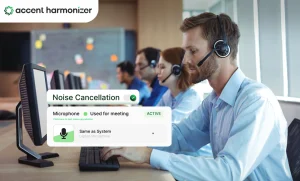

Enterprise contact centers process thousands of simultaneous SIP sessions across legacy Session Border Controllers (SBCs) and cloud telephony stacks. However, agent comprehension friction continually drives up Average Handle Time (AHT) and increases transfer rates.
Telephony engineering teams routinely block software upgrades that touch the voice path. In fact, altering SIP signaling or inserting inline media relays introduces packet loss, latency spikes, and troubleshooting blind spots.
Adding real-time audio transformation requires a strict architectural boundary. Specifically, engineering teams must deploy endpoint audio processing rather than modifying carrier-grade SIP routing infrastructure.
| SIP Signaling & Endpoint Audio Processing Architecture |
|---|
Layer 1: SIP Signaling Path (RTP Media Flow Intact) Agent Softphone <—> Session Border Controller <—> Carrier PSTN |
↓ Media Pipeline: RTP Packets Route Through Local Driver Layer ↓ |
Layer 2: Endpoint Audio Layer (Local DSP Processing) Microphone Input → Virtual Audio Device (Accent Harmonizer) → Softphone Client |
Why Voice Processing Projects Trigger Telephony Pushback?
Telephony infrastructure engineers operate under strict uptime SLAs. Consequently, any software layer modifying the Session Initiation Protocol (SIP) creates immediate operational resistance.
Telephony Risk vs. CX Demands
Operations teams require speech enhancement to reduce customer repetitions and lower AHT. Conversely, infrastructure architects prioritize call setup stability and raw network latency.
| Operations Demand vs Telephony Friction | |
|---|---|
| Operations Demand | Telephony Friction |
| Lower AHT and friction | Added SBC processing overhead |
| Clearer agent-customer audio | Transcoding & packet jitter |
| Reduced escalation volume | Complex failover scenarios |
Every inline proxy added to a SIP media path increases call setup failures. Furthermore, network-level audio inspection causes codec renegotiation issues across heterogeneous carrier networks.
The Architectural Decision That Determines Deployment Risk
Two primary architectural models exist for integrating real-time voice processing into contact center environments.
Network-Level Voice Processing (SBC & RTP Interception)
Network-level deployments force RTP audio streams through cloud media relays or inline proxies. Consequently, this design requires custom SIP routing rules and Session Border Controller reconfigurations.
- Operational Advantage: Centralized deployment across all endpoints without individual desktop installation.
- Engineering Friction: Introduces network hops, potential SIP trunking incompatibilities, and sub-optimal routing paths.
Local Audio Layer Processing (Virtual Audio Device)
Local endpoint processing intercepts raw audio at the operating system driver layer before SIP packetization.
- Operational Advantage: Zero modification to SIP signaling, SBC configurations, or RTP packet routes.
- Engineering Friction: Requires endpoint software distribution across agent workstations via enterprise software management tools.
Evaluating enterprise voice processing deployment considerations confirm endpoint processing completely insulates core SIP infrastructure from operational disruption.
How SIP Routing Handles Voice Traffic in Modern Contact Centers?
SIP functions strictly as a signaling protocol to initiate, maintain, and terminate real-time communications sessions. Specifically, SIP messages establish call parameters via the Session Description Protocol (SDP).
In contrast to signaling, the audio payload travels separately using the Real-time Transport Protocol (RTP). Consequently, inserting voice AI directly into the RTP stream introduces packet inspection delays and potential codec mismatches.
Standard architectures benefit when SIP signaling and RTP media flows remain completely untouched by external AI processing nodes.
SIP Routing vs. Voice Processing: Resolving Architectural Confusion
Buyers frequently conflate SIP routing changes with real-time audio manipulation. However, these two processes function at fundamentally separate layers of the OSI model.
SIP routing determines where call control packets travel across networks. In contrast, voice processing alters the PCM payload within the local workstation buffer before encoding.
Understanding this distinction allows teams to deploy advanced AI voice harmonizer software without submitting infrastructure change requests to carrier engineering teams.
Operational Impacts: AHT, Escalations, and Agent Productivity
Sub-optimal voice processing implementations generate immediate operational metrics degradation across frontline operations.
The Hidden Cost of Media Path Complexity
Inserting media relays into SIP paths causes packet jitter and audio clipping. Consequently, agents experience noticeable audio drops during peak trunk utilization hours.
| Telephony Issues vs. Downstream Operational Friction | |
|---|---|
| Telephony Issue | Downstream Operational Friction |
| 200ms RTP Jitter | Agent and customer cross-talk |
| Codec Transcoding Delays | Increased Average Handle Time (AHT) |
| SIP Re-INVITE Failures | Dropped calls during transfer sequences |
Executing AHT reduction strategies for contact center requires eliminating conversational friction without introducing packet transmission delays.
Furthermore, reducing agent repeat requests directly lowers transfer volume. Integrating dedicated speech clarity software for contact centers stabilizes handle times while maintaining frontline operational momentum.
Common Failure Points in SIP-based Voice Deployments
Inline RTP inspection introduces recurring failure modes into enterprise telephony environments:
- Transcoding Overhead: Converting G.711 to PCM and back to G.729 increases CPU load on network gateway servers.
- SBC Compatibility Failures: Firmware variations across Session Border Controllers often drop custom SIP headers during session establishment.
- Troubleshooting Blind Spots: Adding inline media proxies obfuscates native Quality of Service (QoS) telemetry metrics.
Specifically, deploying endpoint solutions bypasses network-level inspection points entirely. Teams maintain full visibility over native SIP metrics using existing monitoring platforms.
Why Alternative Voice Architectures Introduce Latency?
Real-time conversational processing requires sub-50ms latency to prevent double-talking and speech collisions. However, cloud-relay processing architectures struggle to maintain this threshold.
| Real-Time Accent Harmonizer |
|---|
Agent Mic Ingest Node → +35ms Cloud AI Server Accent Harmonizer → +40ms SBC Telephony Gate → +25ms Customer Earpiece Cumulative Latency Budget: 100ms total (Sub-150ms Threshold: Optimal) |
Network jitter on round-trip cloud transfers regularly pushes total latency above 120 milliseconds. Consequently, interactive conversation flows degrade into disjointed exchanges.
In contrast, local workstation processing executes harmonized audio streams in under 50 milliseconds without sending audio payloads over external routing hops.
Where Accent Harmonizer Fits Inside a SIP Environment?
Omind Accent Harmonizer operates directly on agent endpoints. Specifically, the system processes raw microphone audio locally before passing the payload to the softphone client.
| Technical Workflow Architecture: Agent Workstation Audio Pipeline |
|---|
Agent Workstation Layer Microphone Hardware Ingest → Accent Harmonizer Sub-50ms Stream → Virtual Audio Device System Driver → CCaaS Softphone ↓ SIP Signaling & Standard RTP Payload ↓ Telephony Infrastructure Layer Unmodified Session Border Controllers (SBCs), Voice Gateways & Carriers |
The system leverages native API hooks and a highly decoupled microservices architecture to execute real-time accent harmonization with sub-50ms latency. Because processing occurs at the audio driver layer, the platform requires:
- Zero SIP signaling modifications
- Zero SBC reconfigurations
- Zero changes to carrier trunking rules
- Zero additional network media hops
Reviewing telephony integration and voice harmonization details how endpoint drivers integrate seamlessly with WebRTC and SIP-based softphones alike.
Implementing a local real-time voice clarity solution resolves frontline comprehension friction while preserving enterprise telephony architecture integrity.
Vendor Evaluation Framework: Assessing Telephony Risk
Use this technical evaluation matrix when auditing real-time voice processing vendors:
| Safe vs. High-Risk Design Telephony Architecture | ||
|---|---|---|
| Architecture Question | Safe Design | High-Risk Design |
| Does it modify SIP INVITE headers? | No | Yes |
| Does it require SBC configuration? | No | Yes |
| Does it sit directly in the RTP path? | No | Yes |
| Does it require codec conversion? | No | Yes |
| Is total processing latency < 50ms? | Yes | No |
Choosing solutions that pass these critical operational checks eliminates deployment friction between IT and business stakeholders.
Evaluating Accent Neutralization vs Accent Harmonization demonstrates how real-time driver-level processing outperforms traditional cloud-relay models.
Technical Deployment Checklist for SIP Environments
Complete this pre-flight verification before initiating any voice AI deployment:
| Pre-Deployment Technical Checklist for Accent Harmonizer Integration | |
|---|---|
| Verification Step | Technical Scope & Requirements |
| SBC Configuration Audit | Confirm zero alterations to active Session Border Controller configurations to prevent routing conflicts. |
| Audio Driver Verification | Verify softphone compatibility with custom Virtual Audio Device drivers across all agent environments. |
| Latency Baseline Measurement | Measure baseline end-to-end audio buffer latency across agent workstations to ensure sub-150ms total delay. |
| Endpoint CPU Profiling | Review endpoint CPU utilization profiles under active call conditions to avoid local audio degradation. |
| Network Boundary Audit | Audit network firewall rules to ensure live audio streams stay strictly confined to authorized internal paths. |
Implementing this structured validation process supports long-term operational success while maintaining customer escalation reduction in BPO operations.
Ready to Upgrade Voice Clarity Without Touching Your SIP Architecture?
Telephony pushbacks shouldn’t stand between your contact center and lower Average Handle Time (AHT). Deploy real-time speech harmonization that integrates into your existing infrastructure stack in under 15 minutes.