
In this post, we explore how contact centers can reduce average handling time and customer frustration using modern audio technology. Discover how real-time speech intelligence eliminates repetitive explanations and improves call clarity without disrupting your current CCaaS platforms.
Rising average handling time (AHT), frequent repeat requests, and sudden escalations often signal deep communication challenges. Contact center leaders increasingly view these conversational inefficiencies as an operational problem rather than an agent performance issue. When background noise or accent barriers interrupt a call, metrics suffer. Fortunately, [AI-Powered Speech Transformation] offers a direct way to reduce conversational friction without disrupting your existing workflows.
Why Customers Ask Agents to Repeat Themselves in Contact Centers?
Every time a customer asks an agent to clarify a statement, your operational costs tick upward. Clarification requests and repeated explanations create dead air during live interactions, driving up customer impatience and turning standard inquiries into frustrating experiences.
Repetition is far more expensive, triggering domino effect across your entire operational matrix.
Financial & Metric Toll of Clarification Loops
Repetition directly damages your primary performance indicators. When agents struggle with vocal clarity or accent barriers, your core efficiency and satisfaction metrics suffer simultaneously:
| Accent Friction & Operational Efficiency Impact | ||
|---|---|---|
| Damaged KPI | The Root Cause of the Drop | Financial Consequence |
| Average Handle Time (AHT) | Long clarification loops and repeated sentences drag out the call duration. | Inflates Cost per Contact: Longer calls require more server capacity and agent minutes. |
| First Call Resolution (FCR) | Misunderstandings lead to incomplete resolutions, forcing customers to call back. | Creates Backlogs: Repeat callers spike inbound queue volumes unnecessarily. |
| Customer Satisfaction (CSAT/NPS) | Customers experience high cognitive effort and frustration just to understand the agent. | Drives Churn: Poor communication scores directly reduce lifetime customer loyalty. |
These seemingly minor individual delays accumulate across thousands of daily shifts. Repetitive friction degrades overall occupancy rates and forces operations to staff up just to handle the artificially inflated call volume. Mitigating phonetic drift requires software capable of executing an accent adaptation software framework without retraining agents during live interactions.
Why Do Retail Contact Centers Feel These Challenges More Acutely?
While clarity issues affect every industry, retail environments experience these challenges with distinct severity due to their business model:
- The Seasonal Volatility Trap: Retail relies heavily on rapid, massive seasonal workforce expansions. Bringing hundreds of temporary agents online quickly makes quality consistency nearly impossible to police manually.
- The Offshore Blindspot: Scaling rapidly often means deploying offshore support operations. Without immediate alignment tools, small communication or accent-matching breakdowns scale up instantly into major backlog bottlenecks.
- High-volume Amplification: During peak holiday or promotional windows, a 15-second clarity delay per call slows down agent. It cascades across the queue, driving up abandonment rates for the entire contact center.
Why Traditional Accent Neutralization Programs Struggle to Scale?
- Long Training and Coaching Cycles: Traditional voice coaching requires weeks of intensive, human-led training. Agents spend hours practicing pronunciation instead of handling live tickets. Because these programs move slowly, they cannot address immediate volume spikes.
- Inconsistent Outcomes Across Agents: Human skill development varies wildly by individual. While some agents adapt quickly to phonetic coaching, others require prolonged support. Consequently, your center suffers from highly unpredictable service quality.
- Time-to-Proficiency Challenges: Waiting for an entire cohort to master voice clarity delays your operational readiness. In fast-paced enterprise environments, you cannot afford months of onboarding before an agent hits standard KPIs.
- Seasonal Hiring Creates Additional Complexity: Hiring hundreds of temporary workers for Q4 makes deep voice coaching impossible. Because these workers leave after a few months, your training ROI drops significantly.
Why Can’t Coaching Alone Eliminate Conversational Friction?
Coaching cannot fix bad hardware, poor internet connections, or heavy background noise. Training focuses solely on the speaker, completely ignoring environmental variables.
What Is AI-powered Speech Transformation?
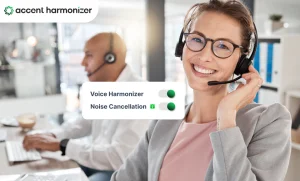
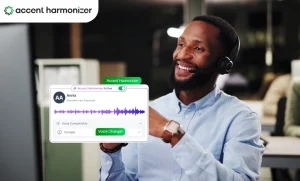
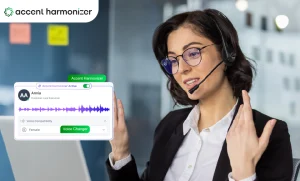
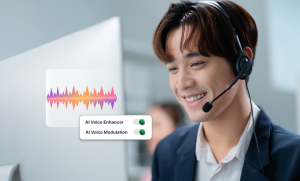
This technology modifies voice audio in real time to optimize comprehension between agents and customers. Unlike traditional training, the Omind’s Accent Harmonizer (powered by Sanas) intercepts the digital signal mid-call. The software adjusts audio output instantly during a live call. It sits directly within the digital audio path to unify phonetic clarity, eliminate environmental noise, and stabilize volume levels.
Building Real-Time Speech Intelligence
Older accent neutralization software often generates synthetic, robotic audio. Modern AI-powered speech transformation systems preserve the agent’s unique voice identity and emotional tone. Specifically, they modify only the linguistic elements that impede customer understanding.
AI-Powered Speech Transformation Improves Contact Center Conversations
- Real-Time Accent Harmonization: The software dynamically aligns spoken phonemes with the regional expectations of the listener. Because this happens instantly, it eliminates the cognitive load required to understand unfamiliar accents.
- Speech Enhancement and Voice Clarity: Poor audio signals are instantly reconstructed into high-definition sound. For instance, the system sharpens muffled consonants and normalizes volume spikes, ensuring words are easy to understand.
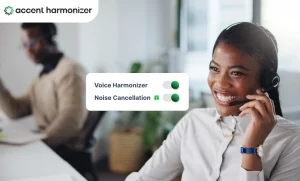
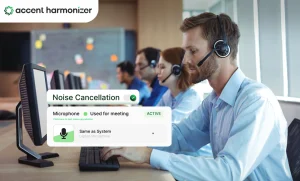
- Background Noise Elimination: Whether an agent works from a crowded central floor or a noisy home environment, ambient sound disappears. The system isolates the agent’s voice, removing barking dogs, traffic, and chatter.
- Preserving Natural Voice Identity and Emotional Tone: Empathy is critical for customer satisfaction. Therefore, the technology retains the agent’s natural inflections and emotional warmth while cleaning up the audio profile.
- Reducing Customer Effort During Voice Interactions: When customers understand answers on the first attempt, friction drops. Consequently, calls end faster, and customers walk away with a positive impression.
What Makes Real-time Speech Optimization Safe for Enterprise Contact Centers?
- Latency Matters in Customer Conversations: Audio lag destroys conversational flow, leading to awkward interruptions. Enterprise platforms must keep processing latency under 50 milliseconds to ensure natural, real-time banter.
- Understanding Virtual Audio Device (VAD) Architecture: The software installs as a virtual microphone layer on the local machine. Because it intercepts audio before it reaches the dialer, it requires no complex server infrastructure.
- Compatibility with Existing CCaaS Platforms: Enterprise systems must integrate with your existing technology stack. These modern audio layers work with major providers.
- Data Privacy and Security Considerations: Top-tier tools handle processing entirely on the local device endpoint. Because no audio data travels to external clouds, your operation remains compliant with PCI and GDPR standards.
What Enterprises Should Evaluate Before Choosing a Speech Transformation Platform?
| Enterprise Accent Solution Checklist | ||
|---|---|---|
| Evaluation Criteria | Key Requirements | Expected Operational Outcome |
| Processing Latency | Must remain below 50ms | Prevents unnatural conversation overlaps[cite: 5, 7]. |
| Data Privacy | Local on-device execution | Guarantees compliance with SOC2 and GDPR[cite: 9]. |
| Integration Method | Virtual Audio Device (VAD) | Requires no modifications to core CCaaS platforms. |
| Audio Authenticity | Zero robotic artificing | Preserves agent empathy and voice character. |
Retail Contact Center Use Cases for AI-powered Speech Transformation
- Supporting Peak-Season Service Operations: During holiday rushes, these tools stabilize service quality instantly. Temporary workers deliver immediate clarity without requiring weeks of language training.
- Scaling Offshore Customer Support Without Increasing Friction: Offshore teams become instantly more effective when communication barriers disappear. Consequently, brands can scale global operations while protecting customer satisfaction scores.
- Maintaining Consistent Brand Experiences Across Teams: Whether your agents operate from Manila, Austin, or Mumbai, your customers receive a uniform audio experience. This predictability strengthens brand loyalty.
- Improving Customer Understanding During High-Volume Interactions: Clear communication speeds up simple transactions like tracking orders or processing returns. Therefore, queues clear faster during critical high-volume periods.
- Accelerating New-Agent Readiness During Seasonal Hiring: By reducing the need for extensive speech coaching, you can compress your onboarding timelines. New hires begin generating positive ROI days ahead of schedule.
Conclusion
Communication challenges often show up as operational inefficiencies like high AHT and low FCR. However, reducing repetition and improving comprehension can positively influence your bottom line. Moving toward real-time speech intelligence allows enterprises to solve these issues instantly on scale.
Want to reduce AHT and eliminate conversational friction?
Book our technical architecture demo to see how our endpoint audio layer integrates with your existing CCaaS system.