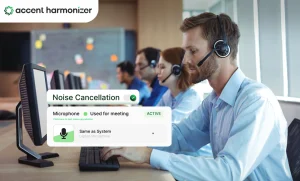

An offshore customer service representative opens a live voice call to assist a policyholder with an insurance claim. The representative provides the exact step-by-step resolution, yet the policyholder repeatedly asks them to repeat key details. The representative repeats the sentence slower, then rephrases it entirely. The interaction is eventually resolved, but a simple three-minute inquiry stretches past seven minutes.
Not every extended interaction stems from poor agent training, complex workflows, or difficult callers. Frequently, the underlying operational barrier is speech intelligibility friction—where the listener must dedicate excessive cognitive energy simply to decode pronunciation.
Real-time accent modification software processes voice audio directly within the live call path, adjusting specific acoustic properties to improve instant listener comprehension without forcing the agent to alter their natural speech patterns.
What Is Real-Time Accent Adjustment?
Real-time accent adjustment is live speech-to-speech processing that modifies targeted pronunciation and acoustic parameters to maximize listener comprehension while fully preserving the speaker’s vocal identity, emotional nuance, and conversational intent.
Vendors across the contact center ecosystem refer to related capabilities using overlapping terminology, including real-time accent conversion and accent neutralization vs. harmonization. For operational leaders, navigating the taxonomy is secondary to evaluating functional performance: what the underlying engine modifies, what it preserves, and whether it systematically reduces comprehension friction during live operations.
How Does Real-Time Accent Modification Work During a Call?
The technology operates entirely within the audio transmission layer between the agent’s microphone and the telephony transport.
| Accent Harmonizer Real-Time Voice Processing Pipeline |
|---|
Step 1 Agent Speech → Step 2 Live Stream Ingest → Step 3 Acoustic & Speech Analysis → Step 4 Targeted Modification → Step 5 Reconstructed Stream → Output Customer Receiver |
- Live Stream Ingest: The agent’s natural voice stream enters the local or cloud processing layer via a lightweight virtual audio driver.
- Acoustic & Speech Analysis: The engine evaluates incoming audio in real time, mapping phonetic structures and regional pronunciation signatures against target intelligibility models.
- Targeted Modification: Selected acoustic properties that generate comprehension friction are modified dynamically while maintaining original pitch dynamics, pacing, and inflection.
- Reconstructed Delivery: The adjusted audio stream is reconstructed and transmitted through the contact center softphone or CCaaS platform to the caller, operating with sub-200 millisecond latency to maintain natural, conversational turn-taking.
Is Accent Friction Actually the Problem?
Before deploying specialized voice technology, operations teams must isolate whether speech intelligibility is the actual root cause of extended call durations or customer friction. High Average Handle Time (AHT) alone is a lagging symptom that can point to multiple systemic issues.
| Operational Friction & Root Cause Diagnostic Matrix | ||
|---|---|---|
| Operational Observation | Root Cause Diagnosis | Primary Operational Intervention |
| Callers repeatedly request repetition of specific words, digits, or names | Regional pronunciation or cross-accent intelligibility friction | Real-time Accent Harmonizer software |
| Entire sentences are dropped, distorted, or cut off | Network jitter, packet loss, or poor VoIP bandwidth | Telephony infrastructure or QoS optimization |
| Callers frequently complain about background ambient noise | Floor noise, chatter, or inadequate headset hardware | Directional noise cancellation software or physical hardware upgrade |
| Agents repeatedly re-explain policies using varied phrasing | Complex product terms, rigid scripting, or knowledge gaps | Desktop co-pilot tools, script simplification, or automated coaching via AI QMS |
| Performance metrics drop across specific offshore-onshore geographic pairs | Cross-cultural communication friction and accent variation (e.g., Philippines/India to US) | Targeted Accent Harmonizer testing & deployment |
| Agent and caller do not share a common primary language | Complete language barrier | Real-time language translation (distinct from accent modification) or Voice AI agent routing |
What Should Change—and What Should Stay the Same?
Deploying real-time speech modification requires a precise balance between enhancing clarity and preserving the human element of voice interactions. Software that over-indexes on modification risks creating artificial audio, which damages caller trust.
- Expected System Improvements:
- Easier-to-follow pronunciation: Specific phonetic sounds are adjusted to match the target market’s familiar speech models.
- Natural conversational pacing: Audio processing preserves speech rhythms without introducing unnatural pauses or artificial gaps.
- Same meaning and intent: Words, domain terminology, and customer information remain completely unedited.
- Consistent intelligibility: Speech clarity remains uniform even during rapid explanations or multi-turn technical discussions.
- Operational Red Flags to Avoid:
- Robotic or synthetic sound: The output exhibits artificial metallic artifacts, robotic monotone, or flattened audio warmth.
- Voice replacement: The agent’s distinctive vocal characteristics are swapped for an entirely different, generic persona.
- Flattened emotional expression: Empathy, warmth, urgency, and tone modulation are stripped out of the delivery.
- Perceptible processing delay: High processing overhead creates audio latency above 200ms, causing agents and callers to talk over one another.
A successful system reduces the customer’s listening effort while ensuring the agent retains their authentic voice identity.
Where Does Comprehension Friction Show Up Operationally?
Operations leaders evaluating accent modification should track leading behavioral indicators before expecting movements in high-level business metrics.
Leading Behavioral Indicators
These signals occur directly within the conversation and provide immediate proof of clarity improvements:
- Repeat-request frequency: The number of times per call a customer asks, “What was that?” or “Can you repeat that?”
- Clarification loops: Instances where agents must state the same information three or more times using different phrasing.
- Dead air from confusion: Hesitation pauses while callers attempt to parse misheard terms.
- Mid-call escalation requests: Callers asking for a supervisor immediately following a repetition loop.
Lagging Business Metrics
Once conversational friction is reduced, improvements naturally propagate to core operational KPIs:
- Average Handle Time (AHT): Direct reduction of redundant explanations cuts overall call duration.
- First Contact Resolution (FCR): Accurate initial comprehension prevents miscommunication and follow-up calls.
- Transfer and Escalation Rates: Fewer calls are handed off to onshore supervisors due to communication barriers.
- Agent Attrition: Lowering the daily stress of handling repeated friction directly improves agent retention in voice roles.
When Is Real-Time Accent Adjustment Worth Testing?
Real-time accent software provides clear operational value under specific operational conditions. Contact centers should evaluate the technology when:
- Voice operations span distributed offshore or nearshore delivery centers supporting native English markets (e.g., US, UK, Australia).
- Speech analytics data confirms high repeat-request counts across specific geographic call routes.
- Highly proficient agents with strong product knowledge consistently receive low satisfaction scores tied to communication clarity.
- Complex billing, financial, or medical explanations require exact detail transmission where misinterpretation leads to compliance risk or repeat contacts.
Do not deploy accent technology simply because a workforce is geographically diverse. Deploy it when conversational data proves that intelligibility friction is actively driving up operational costs.
When Is Accent Modification the Wrong Fix?
Accent modification is not a universal solution for contact center performance issues. It is the wrong intervention when:
- Local network infrastructure suffers from high packet loss, high jitter, or unmanaged latency.
- Floor noise, open-office chatter, or HVAC hum is the primary cause of poor call audio.
- Agents struggle with product knowledge, workflow navigation, or basic language proficiency.
- Knowledge base articles or call scripts are convoluted and poorly structured.
Implementing accent modification over broken underlying processes or poor audio hardware adds unnecessary software overhead without fixing the root cause.
How Should a Contact Center Test Real-Time Accent Adjustment?
Enterprise evaluations require a controlled, methodology-driven pilot to isolate software impact from external operational variables.
| Controlled A/B Testing & Evaluation Protocol |
|---|
Step 1 Baseline Data (2–4 Weeks) → Step 2 Cohort Split (Control vs Treatment) → Step 3 Track Primary Metric → Step 4 Evaluate Secondary KPIs → Step 5 Enforce Guardrails |
- Establish a Clean Baseline: Gather 2–4 weeks of baseline data across target queues. Measure call handle times, repeat-request frequency via speech analytics, transfer rates, and baseline CSAT.
- Build Comparable Cohorts: Establish a Treatment Group (agents with real-time accent modification enabled) and a Control Group (agents operating normally). Match cohorts precisely by agent tenure, skill tier, shift pattern, queue type, and customer demographic.
- Select the Primary Diagnostic Metric: Focus on repeat-request frequency per call as the primary success metric. This metric sits closest to the intervention and isolates clarity from external call variables.
- Track Secondary Operational Outcomes: Monitor shifts in AHT, FCR, transfer rates, and post-call customer satisfaction scores over a 30-to-60-day trial period.
- Enforce Quality Guardrails: Continuously audit audio output to ensure voice naturalness, verify latency remains under 200ms, and gather direct agent feedback regarding ease of use.
What Should Buyers Evaluate in Real-Time Accent Modification Software?
When comparing enterprise software vendors, operations and IT procurement teams should focus on five core criteria:
- Voice Identity Preservation: Does the software adjust targeted pronunciation while preserving the agent’s unique vocal identity, emotion, and tone?
- Telephony Architecture & Latency: Does processing occur with sub-200ms latency across live CCaaS, VoIP, and softphone environments without causing voice overlap?
- Geographic & Accent Coverage: Has the underlying model been trained and validated on the specific agent-to-customer geographic routes present in your network?
- Security & Deployment Model: Does the software process audio in memory without storing raw voice files, complying with SOC 2 Type II, ISO 27001, HIPAA, or PCI-DSS requirements?
- Pilot Proof Support: Will the vendor support a structured, controlled pilot framework using your live call queues to prove measurable ROI before full deployment?
Accent Harmonizer in Practice
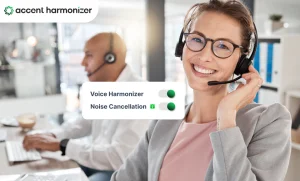
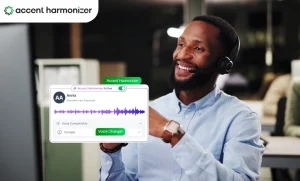
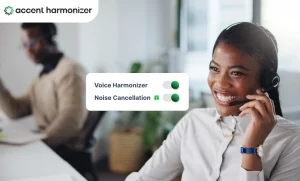
In live enterprise operations, Omind’s Accent Harmonizer—built on Sanas technology—deploys as a lightweight virtual audio layer directly within existing CCaaS and softphone environments. Operating with sub-200 millisecond latency, the platform combines omni-directional noise cancellation with real-time speech harmonization. By processing audio entirely in memory without retaining call recordings, it maintains strict SOC 2 Type II and HIPAA compliance while preserving the agent’s natural vocal identity, tone, and emotional expression.
Better Understanding, Not Voice Standardization
Real-time accent modification software delivers operational value when it removes measurable comprehension friction without attempting to strip away an agent’s authentic identity. The strategic goal of contact center leadership is to remove the unnecessary conversational loops. It helps them prevent customers and agents from resolving issues efficiently on the first attempt.