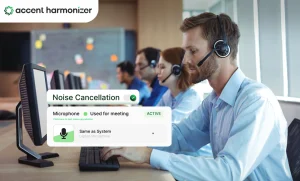

Customers don’t complain about bad experiences — they abandon them. And in voice support, the biggest friction isn’t always speed or availability. AI voice modulation shifts customer experience to real-time clarity. It fixes conversations as they happen, not after they fail.
What is AI Voice Modulation in Customer Experience?
AI voice modulation refers to the real-time modification of voice attributes — tone, clarity, accent, and pacing — during a live conversation. It works at the acoustic layer, enhancing how voices are transmitted and received before misunderstanding even has a chance to take hold.
This is where a lot of confusion creeps in. Voice modulation, conversational AI, and Voice of the Customer (VoC) analytics are frequently bundled together under “AI for CX” — but they operate at entirely different layers of the stack:
- Voice modulation — real-time clarity enhancement during a live call
- Conversational AI — automated interaction handling (bots, virtual agents)
- VoC analytics — post-call insight extraction from recorded interactions
Why Customer Experience Breaks Down in Voice Channels?
Voice support fails for reasons that go beyond slow response times. The root causes are often invisible — accent mismatch, poor audio clarity, cognitive overload from dense information, or repetition loops where agents re-explain the same thing three times in one call.
Each of these has a direct cost. Repetition extends Average Handle Time (AHT). Misunderstanding tanks First Contact Resolution (FCR). Both erode CSAT. And none of them shows up in a dashboard until after the damage is done.
The industry has spent years optimizing speed. What most CX stacks still don’t address is clarity — and clarity is what determines whether a customer feels helped.
How does AI Voice Modulation Works?
The AI voice modulation for customer experience pipeline runs in real time, typically with under 200ms latency. Here’s what happens between a customer speaking and an agent hearing them clearly:
- Voice capture — audio input from either end of the call
- Signal processing — noise reduction, background filtering
- Phoneme and acoustic analysis — detecting clarity gaps, accent patterns, pacing anomalies
- Real-time modulation — tone smoothing, clarity enhancement, accent normalization (not conversion)
- Output reconstruction — the modified audio delivered in near-real-time
The underlying technologies — ASR (automatic speech recognition), NLP, and neural voice modeling — work in concert to make this possible. The key engineering challenge is balancing latency against naturalness. Aggressive modulation can sound robotic. The best systems are imperceptible.
Voice modulation vs conversational AI vs VoC — A Clear Comparison
| Technology Capabilities Comparison | |||
|---|---|---|---|
| Capability | Voice Modulation | Conversational AI | VoC Analytics |
| Real-time clarity | Yes | No | No |
| Automation | No | Yes | No |
| Post-call insights | No | Partial | Yes |
| When it acts | Live conversation | Interaction handling | Post-analysis |
Real Use Cases Across Industries
The applications vary, but the underlying problem is consistent:
- Global contact centers — cross-accent support where neither party’s “native” sound is the other’s default
- BPO operations — offshore teams handling onshore customers, or vice versa
- Technical support — high-complexity instructions that require precise comprehension
- BFSI and healthcare — high-stakes conversations where a misunderstood instruction carries real consequences
- Sales calls — clarity in persuasion, were stumbling in communication break momentum
The Missing Layer: Real-Time Vs Post-Call Optimization
Most CX technology — analytics platforms, quality assurance tools, coaching systems — operates after the interaction ends. But it means every insight you generate is advice for the next call, not a fix for the current one.
Most CX tech optimizes after the interaction. However, voice modulation optimizes during it — when there’s still something to change. The shift to AI voice modulation fills the gap analytics was never designed to address.
How To Evaluate Voice Modulation Software?
When assessing cross-accent communication AI solutions, use this as a decision framework:
- Latency under 200ms — anything higher creates a noticeable, disruptive lag
- Voice naturalness — no robotic artifacts; modulation should be transparent
- Accent adaptability, not conversion — the goal is clarity, not standardization
- Integration depth — CCaaS, telephony, and QA tool compatibility
- Scalability for high call volumes without quality degradation
- Compliance and data security certifications for your industry
What Comes Next?
The near-term roadmap for AI voice modulation for customer experience points toward emotion-aware systems. The real-time voice modulation AI systems that detect not just acoustic clarity but affective tone, adjusting delivery to reduce escalation risk. Multilingual real-time adaptation is also emerging not translation, but simultaneous clarity optimization across languages on a single call. As these capabilities mature, voice modulation will move from a point solution to a foundational layer in every serious CX stack.
The best way to evaluate this is to hear it in context. If you’re running a global support team and clarity is costing you on AHT or CSAT, it’s worth a live demonstration with your own call scenarios.
See How It Performs on Your Actual Call Types
Book a demo and we’ll run voice modulation against your environment to see real results.