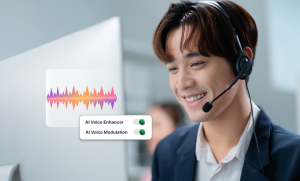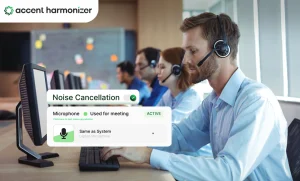

Most contact centers assume customers struggle to understand agents because of regional pronunciations. However, that assumption only covers part of the story. In live customer conversations, misunderstandings typically stem from three distinct sources. First, accent comprehension gaps strain the listener. Second, background noise interference disrupts the audio signal. Third, conversational latency breaks the natural flow of dialogue.
Consequently, the breakdown manifests in predictable ways. Managers see repeat requests, longer handling times, and frequent escalations. Customer frustration spikes quickly. Therefore, many organizations searching for a real time accent changer eventually discover they need something broader. They need a mechanical way to reduce communication friction across every single conversation.
Why Do Customers Say, “Can You Repeat That?” More Often?
When a customer struggles to understand an agent, pronunciation is rarely the lone culprit. Dialects introduce unique pacing and syllable stress. Because human brains require time to adapt to unfamiliar speech patterns, small differences slow down comprehension.
Background noise creates a second layer of misunderstanding
A call center floor hums with activity. Chatter from neighboring desks blends with computer fan whirrs. When these sounds bleed into the microphone, they mask the consonant sounds of speech. For instance, words like “fast” and “past” become indistinguishable.
Cognitive listening effort slows conversations
When audio is muddy, customers must exert intense mental energy just to decode the words. This cognitive load causes exhaustion. Consequently, buyers lose track of the actual resolution steps because their brains are working too hard on basic listening.
What Do Buyers Actually Mean When They Search for a Real-Time Accent Changer?
When buyers type real time accent changer, they rarely want a gimmick. They are looking for an enterprise remedy for low customer satisfaction scores. The search query is a proxy for a deeper business need.
The difference between sounding different and being easier to understand
Altering a vowel sound does not automatically guarantee clarity. If the underlying audio stream remains muffled, the customer still struggles. True clarity requires sharpening the spoken words, not just shifting the pitch or regional tone.
How does the category evolve from voice transformation to speech clarity?
Early voice modification tools served the gaming and entertainment spaces. However, the market has shifted toward cross-accent communication AI tech. The goal has evolved from changing individual identities to maximizing mutual understanding.
Why Most Real-Time Accent Changers Were Never Built for Enterprise Conversations?
Many voice alteration applications began as consumer plugins for streamers. Developers built them to modify voices for entertainment. Because they were engineered for fun, they lack the data security and stability required by corporate networks.
What changes when every second affects customer experience?
In an enterprise contact center, milliseconds equal dollars. Delayed audio stretches call durations across thousands of agents daily. Furthermore, glitchy voice harmonization tools frustrate customers who are already anxious about their technical issues.
The Three Hidden Causes of Misunderstood Conversations
#1: Accent Comprehension Gaps
- Regional pronunciation differences: Distinct vowel sounds confuse untrained ears.
- Cross-accent communication challenges: Global teams face hurdles when handling customers across different continents.
- Speech pattern interpretation: Varied sentence structures and local idioms slow down real-time comprehension.
#2: Audio Quality Problems
- Background office noise: Nearby agent conversations bleed through microphones.
- Remote work environments: Home call centers introduce unexpected noises like barking dogs or traffic.
- Customer-side noise interference: Wind, sirens, or crowds on the customer’s end disrupt the agent’s ability to listen.
#3: Conversation Latency
- Processing delays: Slow software processing lags voice delivery.
- Interruptions: Lag causes both parties to speak simultaneously.
- Natural conversation breakdowns: Awkward pauses erode customer trust and rapport.
Why Are Enterprises Moving Beyond Basic Accent Changers?
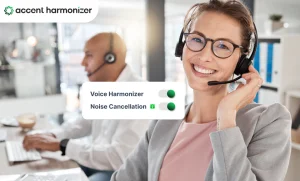
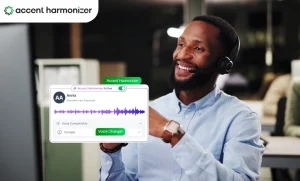
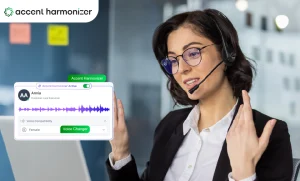
Basic modification replaces native speech patterns with a rigid, synthetic profile. Accent harmonization works differently. It softens heavy regional differences while preserving the agent’s natural voice, cadence, and human warmth.
Real-time speech clarity without changing identity
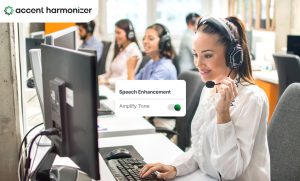
Customers value authenticity. They want to speak with real people, not machines. Advanced systems enhance speech clarity without erasing the agent’s personal identity. Specifically, technology improves articulation while keeping the voice recognizable.
Bi-directional noise cancellation and comprehension
Communication is a two-way street. Agents also struggle to understand customers calling from noisy environments. Modern platforms provide bi-directional noise cancellation. Therefore, both parties enjoy a quiet, distraction-free audio environment.
Real-Time Accent Changer vs Conversation Clarity Platform
| Basic Accent Changer vs Conversation Clarity Platform | ||
|---|---|---|
| Evaluation Area | Basic Accent Changer | Conversation Clarity Platform |
| Accent adjustment | Yes | Yes |
| Noise cancellation | Limited | Yes |
| Speech intelligibility focus | Partial | Primary objective |
| Identity preservation | Varies | Designed for it |
| Enterprise deployment | Limited | Built for scale |
| Telephony compatibility | Limited | Enterprise-ready |
| Operational outcomes | Indirect | Directly tied to conversation quality |
Why CTOs and Contact Center Leaders Evaluate Speech Technologies Differently?
Operations executives want lower handling times and higher CSAT scores. They view technology through the lens of agent performance and customer retention metrics.
- IT leaders focus on deployment risk: Information technology teams care about CPU utilization, memory footprint, and desktop stability. They reject any software that slows down local workstations or thin clients.
- Security teams focus on data handling: Because contact centers handle sensitive payment data, security teams guard data closely. They require on-device processing or certified cloud environments to prevent data leakage.
Why does architecture matter as much as AI?
An AI model is only as good as its deployment method. On-premises or local edge processing ensures data security while maintaining the ultra-low latency required for live voice applications.
Conclusion
A real-time accent changer can improve speech comprehension, but accent conversion alone does not eliminate communication friction. Customers struggle to understand each other due to poor audio processing.
As contact centers expand globally, these misunderstanding become operational problems. Repeated explanations increase average handle time and increase escalations. Customer effort rises even when agents have the right skills and knowledge to resolve issues.
That is why enterprise leaders are beginning to evaluate conversation quality as a system rather than a single feature. They want to reduce communication friction at scale to improve operational efficiency. An accent translation software can help address speech comprehension challenges. Platforms like Accent Harmonizer by Omind make conversations easier to hear, understand, and navigate from start to finish.
Is Communication Friction Affecting Your Contact Center Performance?
If rising handle times, repeat requests, or customer effort complaints are becoming common, it may be time to evaluate how accent comprehension, background noise, and conversational latency are impacting your operations.
Book a demo of Accent Harmonizer to see how real-time accent harmonization and bi-directional noise cancellation can help improve conversation clarity without changing agent identity or disrupting your existing telephony infrastructure.