
Global contact centers are built around distributed talent. An agent in India, the Philippines, Latin America, or another delivery market may support customers thousands of miles away without any problem with language, product knowledge, or process.
Yet understanding can still break down.
Customers ask agents to repeat a sentence. Agents rephrase information they already explained correctly. Verification takes longer. Complex instructions require another attempt. Individually, these moments look minor. Across thousands of calls, they create a hidden comprehension tax.
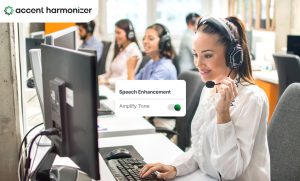
Cross-accent communication AI is designed to reduce this friction during live conversations by making speech easier for listeners to understand while preserving the agent’s natural voice and identity.
For contact centers, the business question is therefore not whether an accent is “good” or “bad.” It is whether differences in speech patterns are quietly increasing customer effort and operational cost.
What Is Cross-accent Communication AI?
Cross-accent communication AI is real-time speech technology designed to improve understanding between speakers and listeners who use different accent patterns. Rather than translating one language into another, the technology works within the same language. It analyzes speech as the conversation happens and adjusts clarity-related characteristics that may make certain words or sounds harder for the listener to process.
The objective is not to erase an agent’s identity or make every speaker sound identical. The goal is simpler: reduce the listening effort required for the customer to understand what is being said. In a contact center, that distinction matters. Small improvements in comprehension can potentially reduce repetitions, rephrasing, clarification loops, and other moments that quietly extend conversations.
The Hidden Comprehension Tax in Global Contact Centers
Most customers will never tell a contact center:
“I experienced cross-accent comprehension friction.”
Instead, they say:
- “Could you repeat that?”
- “Sorry, what was the last number?”
- “Can you explain that again?”
- “What did you say the next step was?”
The call continues, the issue may still be resolved, and the interaction appears successful in a traditional QA review.
But the operational cost remains.
A 10-second repetition multiplied across thousands of calls becomes additional talk time. A misunderstood instruction may become a repeat contact. On the other hand, a customer who has to concentrate harder throughout the call may leave a lower satisfaction score even when the agent followed the process correctly.
This is why cross-accent friction often hides inside conventional contact-center metrics. By inspecting the operational flow, leaders can see how real-time accent modification works in live call paths to remove comprehension barriers.
Where Comprehension Friction Appears in Operations Data
| Conversation Signals vs. Operational Data Metrics | |
|---|---|
| Conversation Signal | What May Appear in Operations Data |
| Customer asks the agent to repeat information | Higher average handle time (AHT) |
| Agent rephrases an already-correct explanation | Longer talk time |
| Customer misunderstands the next step | Repeat contact / Lower FCR |
| Complex interaction moves to a supervisor | Higher transfer or escalation rate |
| QA score is strong but customer outcome is weak | QA–CSAT mismatch |
| Agent deliberately slows or repeatedly self-corrects | Higher cognitive load / Silence & delay spikes |
| Verification details require multiple attempts | Increased customer effort (CES drop) |
These metrics do not proves that accent differences caused the problem. That is exactly why operations teams need to investigate patterns rather than rely on assumptions. If repetition language, talk time, escalation, or customer effort consistently changes across certain customer-agent pairings, there may be a comprehension issue hiding underneath the headline metric.
Why Traditional Accent Training Hits a Scaling Ceiling
Accent and communication training remain useful tools. Agents can learn pacing, pronunciation, vocabulary, listening techniques, and conversational control. Coaching also improves confidence and helps agents communicate complex information more effectively.
But training has an important limitation:
it happens before the comprehension problem occurs.
The agent must remember, apply, and maintain those techniques while simultaneously navigating systems, following scripts, listening to the customer, solving the issue, documenting the interaction, and meeting compliance requirements.
As BPO operations scale, that becomes increasingly difficult to standardize. Hiring hundreds of new agents can create wide variation in speech patterns and coaching requirements. Different customer markets introduce different listener expectations. Even a highly trained agent may encounter a customer who simply processes certain pronunciation patterns differently.
Training improves the speaker, but cannot control how every listener interprets the speech.
From Accent Training to Comprehension Engineering
This creates a useful distinction for contact-center leaders.
| Accent Training vs. Comprehension Engineering | ||
|---|---|---|
| Approach Paradigm | Core Operational Question | Execution Focus & Mechanism |
| Accent Training | How can we change the way the agent speaks? | Focuses on human behavioral modification through multi-week phonetic training to manually adjust pronunciation and inflection. |
| Comprehension Engineering | Where does understanding break down during the conversation, and can that friction be reduced in real time? | Leverages real-time AI technology (such as Accent Harmonizer) to systematically identify acoustic breakdown points and bridge accent distance instantly. |
The second question shifts the focus away from “correcting” accents. Instead, it treats comprehension as an operational variable.
Addressing multi-dialect contact center friction requires isolating whether communication breakdowns stem from customer misinterpretation or incoming customer speech conversion challenges. The agent can remain the same person, speaking naturally, while technology works in the voice path to make the conversation easier for the listener to process. It changes the objective from speech conformity to conversational clarity.
For global BPOs, this is important because the value of a distributed workforce depends on the ability to connect customers with qualified agents regardless of where those agents are located.
How Cross-accent Communication AI Works During Live Calls
| Real-time Accent Harmonization Processing Workflow |
|---|
Step 1 Agent Speech → Step 2 Real-time Speech Analysis → Step 3 Clarity Adjustment → Step 4 Natural Voice Preserved → Outcome Customer Hears Optimized Speech |
The processing happens during the live conversation rather than after the call.
The technology identifies speech characteristics that can contribute to cross-accent comprehension difficulty and modifies selected elements of the audio before it reaches the listener.
The important operational requirement is that this must happen with minimal delay. Voice conversations are highly sensitive to latency. If speech processing introduces noticeable pauses or disrupts conversational timing, any clarity benefit can be offset by a poorer interaction experience.
For that reason, contact centers evaluating cross-accent communication AI should consider not only speech quality but also latency, voice naturalness, telephony compatibility, deployment requirements, and consistency across different agent-customer pairings.
Cross-accent Communication AI vs Traditional Approaches
There is no single solution to every speech-clarity problem. Different approaches solve different parts of the issue.
| Accent & Communication Improvement Approaches – Enterprise Comparison | ||||
|---|---|---|---|---|
| Approach | Works During Live Calls? | Requires Agent Behavior Change? | Enterprise Scalability | Main Limitation |
| Accent training | No | Yes | Moderate | Improvement depends on continued coaching |
| Speech coaching | No | Yes | Moderate | Results develop over time |
| Hiring for accent similarity | N/A | No | Low | Restricts the available talent pool |
| Script simplification | Partly | Yes | High | Does not address listener-specific speech friction |
| Cross-accent communication AI | Yes | No | High | Requires reliable real-time voice integration |
Where Cross-accent Communication AI Creates the Most Value
The technology becomes most relevant where understanding directly affects operational outcomes.
- Offshore Customer Service: High-volume offshore operations may connect agents and customers with significantly different speech patterns every day. Even small amounts of repetition can compound at scale.
- Technical Support: Technical conversations include product names, error messages, codes, commands, and unfamiliar terminology. Misunderstanding one word can extend troubleshooting significantly.
- Financial Services and Collections: Names, numbers, dates, balances, payment information, and verification details must be communicated accurately. Repetition can increase both handle time and customer frustration.
- Travel and Hospitality: These environments frequently involve customers and agents from multiple regions, creating accent variability on both sides of the conversation.
- Rapidly Scaling BPO Programs: Large hiring ramps can increase the training burden placed on L&D teams. Real-time communication technology can provide another layer of support without requiring every clarity improvement to come through additional coaching hours.
Does Your Contact Center Have a Cross-accent Comprehension Problem?
Before purchasing another voice technology, look at your own interaction data. Useful questions include:
- Are customers frequently asking agents to repeat themselves?
- Does AHT vary significantly by agent location or customer market?
- Do QA comments repeatedly mention clarity or pronunciation?
- Is FCR lower despite agents providing technically correct information?
- Are complex conversations escalated more often by certain delivery teams?
- Are new hires spending significant training time on accent modification?
- Does CSAT differ between teams with otherwise similar QA and performance scores?
- Do transcripts show repeated phrases such as “say that again,” “sorry?” or “what did you say?”
One indicator alone proves very little. Patterns across several metrics are more meaningful.
For example, if one delivery group shows strong QA compliance but consistently higher AHT, more repetition language, and lower CSAT, the operation has a clearer reason to investigate speech comprehension.
How to Measure the Business Impact
Cross-accent communication AI should ultimately be evaluated against measurable operational outcomes.
Before deployment, establish a baseline for:
- average handle time;
- first-call resolution;
- repeat-contact rate;
- transfer and escalation rate;
- CSAT;
- repetition frequency;
- agent ramp-up time.
Then compare those metrics during a controlled pilot.
Reducing Communication Friction Without Changing Agent Identity
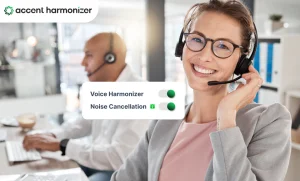
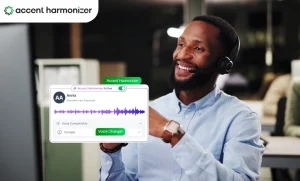
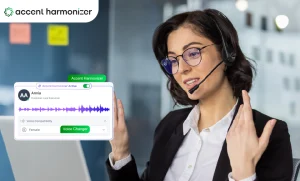
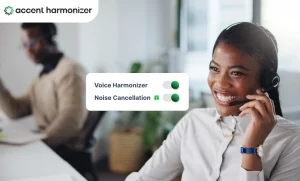
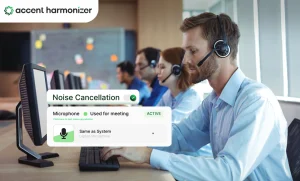
Accent Harmonizer is designed around this principle. It applies real-time AI voice processing to help make agent speech clearer for the listener while preserving the agent’s voice and conversational identity. It distinction matters because effective cross-accent communication should not require agents to abandon the way they naturally speak.
The objective is not to standardize people. It is to reduce unnecessary friction between speakers and listeners so that customer conversations can focus on the issue being solved.
For contact centers operating across regions, that can make speech clarity less dependent on geography and more manageable as part of the underlying voice infrastructure.
Turn Cross-accent Friction Into a Measurable Operational Question
Cross-accent comprehension rarely appears as its own KPI. It shows up indirectly through repetition, longer conversations, transfers, repeat contacts, customer effort, and inconsistent satisfaction scores.
That is why contact centers should avoid treating accent clarity purely as a training issue. The more useful approach is to measure where understanding breaks down, determine whether those patterns have operational consequences, and then evaluate whether real-time technology can reduce the friction.
Cross-accent communication AI gives contact centers another way to address that problem during the conversation—not after it.
Want to hear the difference?
Compare the same agent before and after Accent Harmonizer and evaluate whether real-time voice clarity could reduce comprehension friction across your customer conversations.