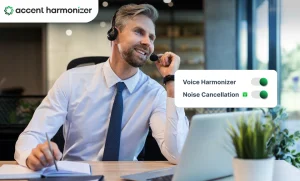

Most BPO leaders treat accent as the problem. However, the problem is real-time comprehension failure and it’s costing you every single call.
A voice communication barrier in BPO is a complex intersection of environmental noise, linguistic gaps, and cognitive fatigue. When these factors collide, they create a “clarity tax” that shows up in your AHT and CSAT scores. If you want to improve call outcomes, you must move beyond the 20-year-old toolkit of scripts and coaching. You need to address the moment of misunderstanding as it happens.
What Is a Voice Communication Barrier? A Clear Framework
The phrase gets used loosely — and that vagueness is the first problem. Without a precise definition, BPOs misdiagnose the issue, deploy the wrong intervention, and measure the wrong outcome. Here’s the working definition: a voice communication barrier is any condition that causes a failure of real-time comprehension between speaker and listener.
There are four distinct barrier types, and most operations are dealing with at least two simultaneously:
| Communication Barriers in Global Voice Operations | |
|---|---|
ACCENT BARRIER Phoneme Mismatch The listener’s auditory system fails to correctly decode unfamiliar sound patterns. This is a pattern-recognition failure at the phoneme level, not a language gap. | LANGUAGE BARRIER Lexical or Structural Gap Words or grammar structures are unfamiliar to the listener. This is a distinct class of problem requiring lexical intervention rather than phonetic adjustment. |
NOISE BARRIER Signal Degradation Environmental interference or poor codec quality degrades the signal before processing. This is an infrastructure-layer problem that masks the speaker’s voice. | COGNITIVE BARRIER Processing Fatigue The most underdiagnosed type. Unfamiliar speech patterns create a sustained “cognitive tax,” causing comprehension to degrade as the call progresses. |
The critical insight: these barriers overlap and compound. A noise barrier reduces the listener’s tolerance for accent variation. Cognitive load from accent processing depletes the buffer for handling ambiguous phrasing. Most BPOs address one layer without mapping the full interaction.
Where Communication Breaks in BPO Calls?
Clarity failures aren’t evenly distributed across a call. They cluster at predictable stages — and the cost of each failure scales with how late in the call it occurs.
| Anatomy of a Failed Call: The Compounding Cost of Accent Friction | ||
|---|---|---|
| Call Phase | Linguistic Friction Points | Operational Penalty |
| OPENING 0–60 Seconds | Authentication & Intent Capture:
| +45–90s AHT |
| MID-CALL 1–8 Minutes | Information Transfer & Resolution:
| +18–31% RCR |
| CLOSING 8+ Minutes | Commitment & Confirmation:
| −12–20% Sales |
A failure in the first 60 seconds sets a skeptical tone, but accent clarity is especially critical for decision delays in the closing stages of a sales or support call.
“If it’s not real-time, it’s not a solution. You can’t fix misunderstanding after the call has already ended.”
Why Do Traditional Solutions Fail at Scale?
The BPO industry has been trying to solve communication barriers with the same toolkit for 20 years. The tools haven’t changed. The scale has. Here’s why each conventional approach breaks down:
| Competitive Analysis: Enterprise Accent & Voice Solutions | |||
|---|---|---|---|
| Solution | Value Proposition | Scalability Barriers (BPO Context) | Verdict |
| Accent Training | Manual phoneme adjustment over time. |
| SLOW |
| Multilingual Hiring | Matching agent dialect to customer base. | Exponential cost increases at scale. High geographic hiring constraints and turnover risks. | EXPENSIVE |
| Script Standardization | Reducing linguistic and lexical variability. | Destroys brand authenticity and agent rapport. System breaks immediately when customers deviate from the “happy path.” | BRITTLE |
| Noise Cancellation | Environmental signal quality improvement. | Only addresses the background layer. Does nothing for phonetic misunderstanding. Widely used but insufficient as a standalone clarity solution. | INCOMPLETE |
| NLP / Transcription AI | Post-call analysis and QA automated scoring. | Operates after the damage is done. Provides no real-time intervention for active customer frustration. | POST-CALL |
“Training programs work beautifully in pilots. At 500 agents, you’re fighting attrition, retraining cycles, and regression simultaneously. It becomes a treadmill.”
BPO Operations VP
The Missing Layer: Real-Time Voice Clarity
Every solution above shares the same structural flaw: it operates outside the moment of misunderstanding. Here training happens before and analysis happens after, however the live conversation goes unaddressed.
For a call center voice clarity solution to work, it must operate with ultra-low latency voice processing (under 200ms) to maintain the natural rhythm of speech. Below 200ms, audio processing is imperceptible to human cognition. Above 400ms, the rhythm of natural speech breaks down, and customers register something is wrong even if they can’t name it.
The implication for vendor evaluation: any solution that can’t demonstrate sustained sub-200ms processing under live call load conditions is not a real-time solution by definition — regardless of marketing language.
How Accent Harmonizer Solves Communication Barriers?
Accent Harmonizer operates at the phoneme level. The individual sound units that make up speech. It doesn’t change what the agent says. It doesn’t replace their voice, instead it adjusts how specific sounds are produced and received in real time. The ai accent solutions for BPO is optimized for the listener’s comprehension rather than standardized against any accent target.
The key architectural distinction: Accent Harmonizer is listener-focused, not speaker-standardized. Instead of “standardizing” an agent, AI accent modification improves intelligibility without changing identity.
What Changes Vs What Stays
| Accent Harmonizer: Modification vs. Preservation Logic | ||
|---|---|---|
| Voice Component | Modified? | Functional Rationale |
| Phoneme Articulation | Yes (Selective) | Adjusts specific sounds most likely to cause comprehension failure or listener cognitive fatigue. |
| Consonant Clusters | Yes (Precision) | Ensures Names, Numbers, and Product Terms receive high-priority treatment for data accuracy. |
| Voice Identity & Timbre | No | The agent remains recognizable as themselves. Technology avoids creating “standardized” or robotic voices. |
| Emotional Tone & Warmth | No | Critical soft skills like empathy, urgency, and rapport are fully preserved to maintain customer trust. |
| Speech Rhythm & Prosody | No | Natural pace and intonation remain intact to prevent the conversation from feeling artificial or laggy. |
Why Offshore BPOs Face the Highest Communication Risk?
Why Offshore BPOs Face the Highest Communication Risk Offshore scaling creates a “retraining deficit.” Whether it is the vowel transfers in South India or the prosody patterns in Eastern Europe, accent harmonization technology expands talent pools by making regional diversity an asset rather than a barrier.
When to Invest in a Voice Clarity Solution?
The signals are specific. If you’re seeing these patterns, your operation has outgrown conventional approaches, and you need a real-time accent harmonizer
Deploy now — these signals indicate systemic barrier failure
- AHT rising despite 2+ training investment cycles without corresponding volume or complexity increase. Training isn’t the level.
- Repeat call rate above 25% with “misunderstood instructions” as a closure code. This is clarity attributable.
- Measurable conversion gap between offshore and onshore teams running identical scripts and processes. Geography is a variable worth isolating.
- CSAT scores diverge by call center location with similar product quality and process compliance. Communication friction is the remaining variable.
- Agent tenure doesn’t predict clarity performance. If 2-year agents perform similarly to 3-month hires on comprehension metrics, training isn’t compounding.
Consider waiting — these signals suggest premature deployment
- Sub-100 agent operations where targeted coaching still produces consistent, measurable improvement cycle-over-cycle.
- AHT and FCR are within industry benchmark with no offshore-to-onshore gap. Don’t introduce infrastructure complexity for marginal gains.
- No call-stage barrier mapping has been completed yet. Deploying AI without understanding your specific problem type is expensive trial-and-error.
Does It Affect Agent Identity?
Agents often worry about sounding robotic. However, real-time harmonization strengthens agent confidence and reduces cognitive load because they no longer have to brace for the “Could you repeat that?” loop.
In practice: agents report sounding like a more intelligible version of themselves, not like a different person. The outcome is increased confidence, not identity loss. When customers understand you the first time, you stop bracing for the repeat-request loop.
The Real Problem Isn’t Accent. It’s Understanding.
Communication barriers are comprehension failures — and comprehension failures are a revenue problem, an operations problem, and a customer trust problem all running simultaneously.
“The best BPOs won’t eliminate accents — they’ll eliminate misunderstanding. Those are not the same objective, and the operations that confuse them will keep solving the wrong problem.”
The infrastructure to fix this exists. The question is whether your deployment is targeted at the right level, at the right call stage, with the right measurement framework behind it.