
Evaluating accent harmonization software via curated vendor demos creates significant operational risk. A speech model that sounds pristine during a pre-recorded presentation often encounters severe friction under live contact center conditions.
Two platforms can deliver identical acoustic clarity in a controlled test, yet diverge sharply during high-volume production. Operational failures typically surface across latency boundaries, voice identity retention, regional phoneme coverage, overlapping talkover, acoustic noise suppression, telephony integration, data privacy controls, and performance under peak call concurrency.
This accent harmonization software comparison focuses on the core architectural and operational factors that determine whether a platform can perform in production—not just whether sample audio sounds impressive.
Accent Harmonization Software Comparison Checklist
To evaluate solutions effectively during initial vendor comparisons, assess each candidate against operational requirements rather than superficial audio quality:
| Real-Time Voice Processing Benchmarks & Production Verification | ||
|---|---|---|
| Evaluation Dimension | Strong Implementation Benchmark | Production Verification Target |
| Speech Intelligibility | Measurable improvement in critical alphanumeric data capture | Reduced clarification requests and repeat phrases on live calls |
| End-to-End Latency | Sub-200ms processing within the full voice transmission path | Preserved conversational cadence with zero talkover delay |
| Voice Preservation | Original speaker identity, pitch, and emotional cadence remain intact | Zero robotic flattening or synthetic pitch distortion |
| Accent Coverage | Verified performance across specific agent/customer accent pairings | Consistent phoneme conversion across diverse regional dialects |
| Noise Handling | Environmental noise suppression without stripping speech detail | Uncompromised consonant clarity during high ambient noise |
| Integration Fit | Virtual audio layer compatible with existing SIP/CCaaS stacks | Direct software deployment without infrastructure overhauls |
| Security & Privacy | Local or zero-retention processing with strict compliance posture | Full alignment with HIPAA, SOC 2 Type II, and PCI-DSS standards |
| Scalability & Impact | Stable real-time execution across high concurrent call loads | Statistically validated reductions in Average Handle Time (AHT) |
8 Factors to Compare in Accent Harmonization Software
Evaluating software requires moving beyond high-level vendor spec sheets. Each factor must be tested against operational failure modes.
1. Real-World Speech Intelligibility
Acoustic cleanliness is not speech intelligibility. A speech model can eliminate background static while failing to convey complex alphanumeric sequences.
When evaluating platforms, test comprehension using actual customer interactions containing street addresses, policy numbers, technical jargon, and rapid speech. A superior implementation improves first-time listener comprehension without introducing voice artifacting or slurring fast-spoken consonants.
2. End-to-End Latency
Advertised model latency is misleading if it excludes the total audio transport pipeline. The critical metric is the total round-trip delay:
| Total Latency Equation for Real-Time Voice | ||||||||
|---|---|---|---|---|---|---|---|---|
Total Latency = Agent Mic + Local/Cloud Processing + Telephony Stack + Earpiece Playback | ||||||||
If total latency exceeds 200–250 milliseconds, natural conversational rhythm breaks down. Benchmarking real-time speech AI requires testing audio latency on the agent outbound path as well as evaluating agent-side vs customer-side processing capabilities across live caller queues. Agents and customers begin talking over one another, creating awkward pauses, mutual interruptions, and increased call duration. Measure latency strictly inside your active telephony path under peak call volume.
3. Voice Identity and Naturalness
Early iteration software often stripped accents by flattening vocal dynamics, turning human agents into monotone, synthetic-sounding bots.
Compare whether a platform preserves pitch inflection, cadence, natural pauses, and emotional tone. The operational goal is Speech-to-Speech Accent Modification, enhancing clarity and retaining the human speaker’s authentic identity.
4. Accent and Phoneme Coverage
Generic claims like “supports multi-regional accents” are insufficient for enterprise operations.
Map vendor capability directly against your exact delivery footprint and customer markets (e.g., offshore agents in Manila or Cebu speaking to callers in North America or Australia). Test specific phoneme shifts—such as the differentiation between /v/ and /b/, or /p/ and /f/ sounds—where comprehension friction concentrated in your call transcripts usually occurs.
5. Integrated Noise Suppression
Acoustic environment noise and accent friction occur simultaneously in open-plan BPO facilities or remote agent settings.
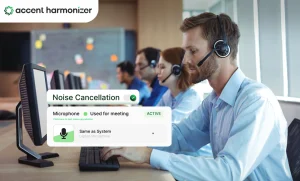
Determine whether background noise suppression is integrated natively into the voice transformation layer or requires third-party add-ons. Test whether environmental suppression strips out subtle speech frequencies. Inferior suppression algorithms often mute the tail ends of words, destroying word-ending clarity.
6. Contact Center Integration
Assess what deployment requires through your existing architecture.
| Integration Model | Operational Mechanics | Stack Impact |
|---|---|---|
| Virtual Audio Device | Deploys as a local audio driver directly on the agent endpoint. | Operates transparently with any softphone or CCaaS platform. |
| SIP Gateway / Media Proxy | Intercepts call streams at the network Session Border Controller (SBC) or telephony level. | Provides centralized control, but requires explicit SIP infrastructure changes. |
| API / Cloud Routing | Routes call audio out to external cloud servers for processing before delivery. | High bandwidth usage; introduces external network latency risk. |
The core buying criterion is minimal stack disruption: choose solutions that install seamlessly without forcing a rip-and-replace of your core contact center platform.
7. Security and Audio Processing
Voice data handling requires rigorous procurement scrutiny. Ask vendor technical teams:
- Is call audio processed locally at the endpoint or streamed to a cloud server?
- Is any customer or agent audio recorded, cached, or retained on processing servers?
- Is live customer voice data used to train public or shared AI models?
In regulated environments like BFSI or healthcare, insist on zero-data-retention architectures that comply with HIPAA, SOC 2 Type II, and GDPR requirements.
8. Measurement and Scalability
Determine if the vendor can demonstrate real-time processing stability at enterprise scale (e.g., 5,000+ concurrent calls during peak volume spikes).
Furthermore, evaluate how operational impact is proven. Strong solutions provide transparent telemetry to track clarification rates, repeat queries, and AHT metrics before and after deployment. Ensure these metrics are validated using an independent call center agent scoring automation process rather than vendor-supplied self-evaluations.
How Accent Harmonization Platforms Differ in Practice?
Architectural choices dictate how solutions perform under daily operational stress.
| Real-Time Voice Infrastructure Trade-Offs | |||
|---|---|---|---|
| Functional Area | Approach A: Endpoint / Local Layer | Approach B: Centralized Cloud / SIP | Buyer Trade-off |
| Processing Site | Local endpoint CPU/GPU processing | Centralized cloud or media gateway | Local endpoint control vs. centralized IT management |
| Noise Handling | Native, single-pass voice/noise filter | Separate noise suppression tool | Unified lightweight stack vs. managing multi-vendor software |
| Speech Modification | Real-time phoneme-level mapping | Full vocal synthesis / accent conversion | Voice naturalness vs. aggressive accent replacement |
| Integration | Virtual audio device on agent desktop | Direct SIP trunk / API integration | Fast enterprise rollout vs. deep telephony dependency |
| Data Privacy | On-device processing; zero data transfer | Cloud stream routing; external transit | Direct data sovereignty vs. vendor cloud compliance risk |
Accent Harmonization vs. Neutralization vs. Translation
Avoid evaluating misaligned software categories. Selecting the wrong voice technology creates severe customer friction.
| Accent Harmonization vs. Neutralization vs. Translation | ||
|---|---|---|
| Category | Primary Objective | Typical Contact Center Application |
| Accent Harmonization | Elevates intelligibility while preserving natural human voice, tone, and identity. | Live cross-accent customer support and BPO sales calls. |
| Accent Neutralization | Filters regional speech variations to produce standardized phonemes. | Speech training programs and legacy voice processing. |
| Accent Translation | Synthesizes agent speech into a completely different target voice profile. | Asynchronous voiceovers or fully automated speech translation. |
| Noise Suppression | Isolates vocal frequencies from background environmental noise. | Removing ambient office noise, traffic, and room echo. |
7 Questions to Ask Before Choosing Accent Harmonization Software
Incorporate these direct technical prompts into your vendor RFP process:
- What is the true end-to-end latency measured inside our specific telephony stack? Demand live network testing, not standalone model benchmarks.
- Do agents retain their authentic voice identity, or does the output sound synthetic? Request raw vs. processed side-by-side audio samples recorded from actual operational environments.
- How does the system handle overlapping speech and interjections? Verify that rapid back-and-forth communication does not produce clipping or audio drops.
- Which specific agent-customer accent pairings have been benchmarked on the scale? Reject generic language coverage lists in favor of validated regional matrices.
- Is environmental noise cancellation natively integrated into the speech processing pass? Ensure background noise filtering does not degrade consonant definition.
- What specific software or driver modifications are required on agent endpoints? Determine total IT deployment effort across remote and on-premise teams.
- How do we isolate the operational impact of this software during a pilot? Define control groups to evaluate key operational indicators like AHT and FCR accurately.
Build Your Own Accent Harmonization Software Scorecard
Use this matrix to rate competing solutions during proof-of-concept testing:
| Real-Time Accent Harmonization & Voice Tech Vendor Evaluation Checklist | |||
|---|---|---|---|
| Evaluation Criterion | Operational Importance | Vendor Option A | Vendor Option B |
| Speech Intelligibility | Critical | ||
| Voice Preservation | High | ||
| End-to-End Latency | Critical | ||
| Deployment & Stack Fit | High | ||
| Accent Matrix Coverage | High | ||
| Data Security & Privacy | Critical | ||
| Integrated Noise Handling | High | ||
| Operational Telemetry | Medium | ||
Assign weightings based on operational realities. A regulated financial services team might prioritize zero-retention security and latency, whereas a global BPO operating in challenging acoustic environments may weigh noise suppression and specific regional phoneme coverage higher.
When Accent Harmonization Is Not the Right First Solution?
Accent harmonization addresses real-time speech intelligibility across regional accent differences. It is not a cure-all for upstream technical or structural problems.
| Operational Friction | Primary Remediation Path |
|---|---|
| Constant background chatter / fan noise | Dedicated acoustic noise suppression or directional noise-canceling headsets |
| Packet loss, jitters, or audio dropouts | Network infrastructure remediation, QoS routing, or bandwidth allocation |
| Different primary spoken languages | Real-time language translation engines or bilingual routing |
| Cross-accent comprehension challenges | Accent Harmonization Software |
| Muffled audio from low-quality hardware | Standardized enterprise headset deployment and audio driver configuration |
| Gaps in product knowledge or SOP adherence | Targeted agent coaching, workflow automation, and agent co-pilot tooling |
Compare Accent Harmonizer in Your Contact Center
An effective software comparison relies on empirical data gathered from your operational environment. Omind Accent Harmonizer uses active agents, existing telephony infrastructure, and real customer traffic to evaluate end-to-end latency, voice naturalness, speech intelligibility, and deployment fit.
Benchmark Accent Harmonization on Your Live Telephony Stack
Avoid evaluating voice AI solely on pre-recorded vendor demos. Test real-time speech intelligibility and natural voice retention using your actual contact center traffic.
- Deploy in Minutes: Virtual audio layer integrates seamlessly into existing CCaaS and softphone setups without infrastructure changes.
- Empirical ROI: Measure real reductions in Average Handle Time (AHT) and clarification requests across live calls.
Schedule a live comparison to analyze performance against your operational metrics.