
Most contact centers measure agent performance obsessively, yet very few measure the hidden cognitive strain caused by communication friction. Here’s what that’s costing you.
Every time an agent repeats a sentence, slows down unnaturally, or worries about being misunderstood, mental bandwidth gets redirected away from empathy, problem-solving, and customer experience. The communication friction is invisible on most dashboards. However, its costs accumulate across every call, every shift, every quarter.
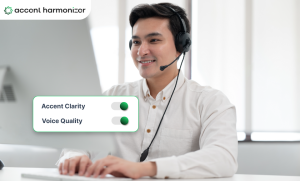
Accent Harmonizer changes this dynamic. Instead of requiring agents to manually modify their speech patterns under pressure, real-time AI voice clarity technology reduces comprehension barriers during live conversations, helping agents sound clearer, feel more confident, and perform more naturally under pressure.
Why Agent Confidence Is a CX Infrastructure Problem?
Agent confidence is typically treated as a training issue or an HR concern. In practice, it functions as a core piece of operational infrastructure—one that directly determines call quality, handle time, and customer perception.
When agents worry about being understood, they enter a self-monitoring loop: consciously adjusting pronunciation, pre-empting misunderstandings, or repeating themselves proactively. That loop consumes the same cognitive resources required for empathy, active listening, and effective problem resolution.
Global and offshore contact center teams bear a disproportionate share of this burden. Shifting to an enterprise AI speech clarity framework for offshore operations fundamentally changes how frontline teams handle compliance and metrics.
Agents with non-native accents often report heightened awareness of how they sound—a state researchers describe as “accent anxiety.” The result is not reduced intelligence or capability. It’s depleted working memory during the moments that matter most.
Hidden Cognitive Load Agents Carry on Every Call
Consider everything an agent manages simultaneously during a live customer interaction: real-time comprehension, emotional tone calibration, CRM navigation, compliance adherence, issue diagnosis, and resolution guidance. Each of these draws from a shared pool of working memory.
When accent friction enters that stack, the allocation shifts. Pronunciation management competes with empathy. Self-correction cycles interrupt solution-finding. The agent is still present—but operating at a measurably reduced cognitive capacity.
| “ Communication fatigue is not a language issue. It’s a cognitive infrastructure issue — and it shows up directly in your AHT, FCR, and attrition numbers. ” |
What Happens When Cognitive Overload Hits?
The downstream effects are consistent across contact center environments. Agents experiencing communication-related cognitive overload produce longer call durations, more dead air, reduced empathy quality, and higher escalation transfer rates. QA scores decline not because the agent lacks skill, but because available attention is unevenly distributed.
Over time, this produces compounding damage: burnout, attrition, and the expensive cycle of recruiting and training replacements—often for roles where the underlying problem was never addressed.
How Accent Harmonizer Works in Real Time?
Real-time accent harmonization is distinct from accent neutralization, voice cloning, and noise cancellation. Where neutralization attempts to replace an accent entirely, harmonization refines phonetic clarity while preserving the agent’s natural vocal identity, emotional tone, and cultural character.
The processing pipeline operates with sub-30ms latency, fast enough that neither agent nor customer notices any artificial delay. At that latency threshold, conversations remain natural. Above it, they begin to feel processed.
- Captures agent speech and streams the AI processing layer
- Acoustic analysis identifies phoneme patterns likely to cause listener decoding friction
- Phoneme refinement optimizes clarity at the syllable level without altering voice character
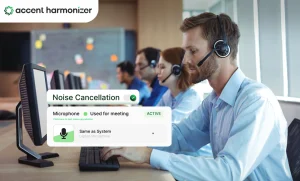
- Filteres ambient noise in parallel
- Normalizes speech pacing to reduce listener cognitive load
- Delivers better audio to the customer within conversational latency thresholds
The result is bidirectional: customers hear the agent more clearly, and agents—aware that comprehension barriers have been reduced—shift mental resources back toward the conversation itself.
Measuring what most contact centers ignore
Traditional QA frameworks evaluate content accuracy and compliance, yet they rarely capture the texture of conversational flow. Tracking voice intelligibility metrics alongside standard KPIs reveals hidden data leaks. They rarely capture the texture of conversational flow under communication stress.
A more complete picture of agent performance requires tracking of Agent Confidence Indicators reveal friction before it reaches CSAT. These include interruption frequency, repeat-request rate, hesitation pause duration, silence distribution across call stages, speech pacing consistency, and sentiment volatility scores.
AI-powered conversation analytics, combined with accent harmonization deployment, makes it possible to close that gap systematically. The accent improvement software:
- Identifyes friction points
- Measures improvement over time
- Builds coaching frameworks around real behavioral data
Business Impact Across the Metrics That Matter
The operational case for Accent Harmonizer integrates across every tier of CX leadership—from workforce managers focused on AHT and FCR to CX directors tracking CSAT and NPS to operations leaders managing attrition and cost-per-contact.
- Average handle time decreases as system fixes clarification loops
- First-call resolution improves as agents engage more fully with problem diagnosis
- Escalation transfer rates fall as agents maintain control during complex interactions
- CSAT and NPS scores reflect higher conversation quality and perceived empathy
- Agent attrition drops as platform addresses burnout at the source
- Offshore and global teams onboard faster without accent-based performance gaps
For contact centers operating at scale, these improvements compound. A 10-second reduction in average handle time across 50,000 daily calls represents a material operational impact. A sustained improvement in agent retention reduces the recruitment and training costs that erode margins in high-volume BPO environments.
What to Evaluate Before Deployment?
Enterprises considering accent harmonization technology should evaluate vendor capabilities across several dimensions that directly determine operational fit. Latency consistency matters more than peak performance. A system that occasionally spikes above conversational thresholds creates its own form of friction. Multilingual support breadth, telephony compatibility, and security architecture for voice data processing are non-negotiable for enterprise deployment.
Equally important is measurability. Any vendor that cannot connect harmonization deployment to observable improvements in operational KPIs is asking for trust without accountability. The right technology will integrate with existing QA infrastructure, generate observable performance data, and support iterative coaching frameworks built around real behavioral signals.
Empower Agents to Speak Clearly
Reduce communication friction, improve agent confidence, and deliver smoother customer conversations with real-time Accent Harmonizer technology.