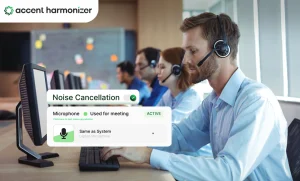

Most contact centers do not report a speech clarity problem. Instead, leadership teams regularly look at operational symptoms that point to a deeper issue. Specifically, these operations leaders flag rising Average Handle Time (AHT) and unexpected escalation increases. They also notice inconsistent First Contact Resolution (FCR), complaints about customer effort, and wide performance variation across teams.
The core challenge is that communication breakdowns often appear as operational inefficiencies. Because of this, leaders review metrics long before they recognize them as conversation quality issues. Therefore, we must redefine the core metric. Call center speech clarity is not simply about how clearly agents speak.
Instead, it is about how consistently customers understand what agents are saying. This understanding must happen across different teams, regions, environments, and interaction types.
Speech Clarity As an Operations Problem Rather Than a Training Problem
When performance drops, leaders usually investigate standard operational levers. For instance, they review coaching logs, staffing models, scripting adjustments, and schedule adherence. However, communication friction is rarely investigated first during these performance reviews. Leaders assume that if an agent passes language screening, communication is clear.
Why Similar Teams Often Produce Different Results?
Consider two teams within the same enterprise operation. They share the same training, follow the exact same processes, and utilize an identical technology stack.
Yet, these teams deliver wildly different results. One team maintains a low AHT, while the other faces spiking escalation rates and high customer effort scores.
The missing variable is often conversation quality. Specifically, speech clarity is not a standalone KPI.
Because it underpins every spoken interaction, it influences multiple operational KPIs simultaneously. To understand why identical agents produce different CSAT outcomes, QA leaders should run an objective speech clarity evaluation process across clean audio calls.
Where Call Center Speech Clarity Appears in Your Metrics?
When tracking performance across decentralized teams, enterprise buyers realize that understanding gaps impact contact center economics far worse than jitter. Here are some call center speech clarity metrics that appear on the dashboard:
- Rising Average Handle Time: When customers fail to grasp information the first time, agents must repeat themselves. This repetition loop creates a compounding effect on your talk time. Therefore, poor call center speech clarity directly inflates call duration.
- Escalation Patterns: Misunderstanding creates unnecessary escalation events. For example, a customer might ask for a supervisor simply because they lack confidence in the conversation they are having.
- First Contact Resolution Variance: Customers sometimes leave conversations without fully understanding next steps. Because they feel confused, they call back within 48 hours, which severely degrades your FCR metrics.
- Customer Effort Scores: There is a direct relationship between conversation effort and customer perception. If a customer must strain to hear, they will rate the interaction as high effort.
- QA and Customer Experience Misalignment: This is a common operational blind spot. A conversation can pass every checkbox on a compliant QA scorecard, yet still generate poor customer satisfaction outcomes because the customer struggled to comprehend the agent.
Why Traditional Reporting Misses Speech Clarity Issues?
Operational reports rarely measure understanding directly. Instead, they measure lagging outcomes like handle times and satisfaction scores. To bridge this gap, operations leaders need an audit framework that connects operational signals to communication barriers.
| Accent & Comprehension Barriers | |
|---|---|
| Operational Signal | What It May Indicate |
| Repeat explanations | Comprehension friction |
| High AHT despite coaching | Communication barriers |
| Escalations after correct process execution | Understanding gaps |
| Strong QA scores but weak CSAT | Customer comprehension issues |
| Team-to-team performance variance | Inconsistent conversation quality |
The objective here is not to prove a speech clarity issue exists. Rather, the objective is to determine whether communication friction contributes to performance variation.
Diagnosing the Root Causes of Communication Friction
- Accent Comprehension Challenges: Understanding varies across customers even when agents follow strict communication standards. For instance, regional accents on either side of the call can require extra cognitive processing time from the listener.
- Background Noise Interference: Both agent-side and customer-side noise impact the interaction. Specifically, open office environments or remote work settings introduce unpredictable audio competition.
- Audio Quality Limitations: Call quality degradation occurs across telephony networks. This hardware and software limitation introduces conversational disruption that agents cannot fix on their own.
- Delivery and Communication Consistency: Human communication factors naturally fluctuate throughout a shift. For example, fatigue changes an agent’s pacing, volume, and articulation over an eight-hour period.
Why Coaching Alone Often Produces Inconsistent Results?
Coaching is highly effective for specific operational skills. Specifically, it improves communication habits, active listening techniques, and overall call control.
However, coaching cannot fix structural or environmental barriers. For instance, a supervisor cannot coach away accent comprehension barriers, environmental noise, or systemic audio disruptions.
| “ Operations leaders often treat audio and comprehension friction as behavioral issues. When you try to coach your way out of a technology or environmental issue, you burn out agents without fixing the metric. ” — Enterprise Operations Director |
To see this clearly, we can compare the two operational layers:
| Coaching Layer vs Infrastructure Layer | |
|---|---|
| Coaching Layer | Infrastructure Layer |
| Listening skills | Noise cancellation |
| Communication skills | Accent harmonization |
| Call control | Speech enhancement |
| Empathy | Audio optimization |
Evaluating Technology Designed to Improve Conversation Clarity
Here is a list of questions enterprises must ask while evaluating technology like AI accent translation software to improve conversation clarity:
- Does It Improve Understanding Rather Than Simply Modify Speech?
When reviewing speech software, look at real-world utility. The tool must measurably improve customer understanding rather than just filtering background audio.
- Can It Address Multiple Sources of Communication Friction?
An effective tool cannot just solve one issue. It must address noise, audio degradation, and comprehension challenges simultaneously.
- Does It Preserve Voice Identity?
Human connection matters in enterprise support. Therefore, technology must maintain the agent’s unique voice identity while removing the friction surrounding it.
- Does It Maintain Real-Time Conversation Flow?
Low latency is non-negotiable. If a software solution introduces lag, it creates conversational overlap and drives up AHT.
- Can It Integrate Without Telephony Disruption?
Enterprise environments are complex. Consequently, new tools must integrate into existing SIP lines and contact center platforms without requiring a total overhaul.
The strongest software choices focus on reducing communication friction across multiple dimensions rather than addressing a single source of misunderstanding.
Conclusion
Instead of asking how to improve speech clarity, shift your perspective. Ask what forms of communication friction are creating performance variation across your operation.
That specific question moves the discussion from basic training tactics to operational diagnosis. Consequently, it creates a clearer path toward improving customer understanding on a scale.
Reduce Communication Friction in Your Contact Center
Are hidden audio and comprehension barriers driving up your handle times? Talk to our operations specialists today to receive a customized communication friction audit for your enterprise teams.