
Contact centers treat employee speech as a personal capability issue. This is an operational mistake. In live enterprise environments, accent variation is rarely an accent problem in isolation—it becomes a structural performance bottleneck the second a customer fails to comprehend an agent on the first attempt.
Questions like “Could you repeat that?” adds only 4 to 8 seconds to an interaction. Multiply those seconds across 50,000 daily calls across global seats, and those micro-delays aggregate into inflated Average Handle Time (AHT), elevated customer effort scores, unnecessary supervisor escalations, and massive erosion of productive agent capacity.
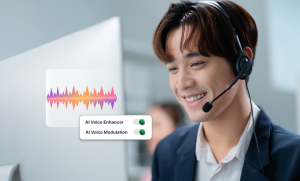
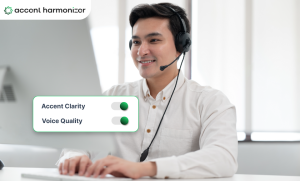
AI-powered accent clarity addresses this operational friction at the signal level, optimizing speech in real time while preserving the agent’s natural identity, emotional intelligence, and voice tone.
Where does Accent-Related Friction Degrades Contact Center ROI?
Accent-based comprehension gaps rarely show up as a discrete line item on an executive dashboard. Instead, they leak capital across secondary metrics:
- Clarification Loops: An agent states a complex policy or account number; the customer misses a syllable and asks for repetition.
- Articulated Pacing: Agents deliberately slow down their speech to compensate for customer unfamiliarity, artificially lengthening every call segment.
- Friction-driven Escalations: Customers become frustrated after multiple repetition requests and demand a supervisor, turning a routine query into a high-cost interaction.
- Repeat Contacts: Customers mishear instructions regarding billing dates, troubleshooting steps, or shipping details, driving unnecessary follow-up calls.
Accent clarity is a core lever for operational throughput and financial efficiency.
Clarifying the Architecture: Accent Harmonization vs. Audio Processing
Enterprise voice platforms bundle several audio-layer technologies. It is critical to differentiate accent harmonization from adjacent contact center speech technology.
| Core Voice & Audio Processing Technologies Comparison | ||
|---|---|---|
| Technology | Core Function | Operational Impact |
| Noise Cancellation | Filters environmental audio (chatter, HVAC, keyboards) | Delivers a clean signal but does not alter speech patterns. |
| Automatic Speech Recognition (ASR) | Converts live voice streams into text | Powers analytics but does not change real-time customer audio experience. |
| Accent Harmonization | Adjusts specific phonetic structures in real time | Improves intelligibility while preserving natural voice characteristics. |
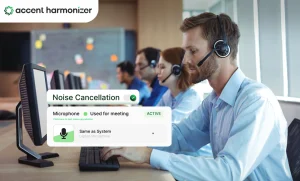
While noise cancellation ensures the customer hears the audio clearly, accent harmonization ensures the customer understands the agent on the first pass.
Key Technical vs. Operational Evaluation Metrics
Deploying voice processing requires balancing audio engineering validation against actual operational metrics.
Technical Performance Metrics
- End-to-End Latency: Total processing time must stay below 200ms to avoid audio overlapping or awkward conversational pauses.
- Signal Naturalness: Preserving fundamental pitch, emotional variation, and prosody.
- Endpoint Stability: Low CPU consumption on local virtual desktop infrastructure (VDI) or agent hardware.
Operational Business Metrics
- Repetition Frequency: Percentage drop in customer clarification requests per call.
- AHT Reduction: Net savings in average handle duration across target call queues.
- First Contact Resolution (FCR): Reduction in secondary callbacks caused by miscommunicated information.
- Agent Fatigue: Qualitative and quantitative reductions in agent stress and post-call burnout.
Real-world Deployment: Testing Beyond Demo Environments
Voice processing models that perform flawlessly in synthetic tests often fail under live enterprise conditions. Contact center environments introduce complex operational variables:
| Real-World Speech Signal Pipeline |
|---|
Input Factor 1 Background Chatter + Input Factor 2 Varied Headset Hardware + Input Factor 3 Industry Terminology → Resulting Output Real-World Speech Signal |
A enterprise pilot must test processing models against:
- Alphanumeric data transfer (parsing account numbers, codes, and names).
- Heavy crosstalk and emotional customer interruptions.
- Endpoints operating over constrained network bandwidth or low-spec VDI instances.
How Accent Harmonizer Optimizes Real-Time Voice Processing?
Accent Harmonizer by Omind AI, powered by Sanas technology, integrates into existing contact center environments as a virtual audio device at the endpoint.
- Sub-200ms Latency: Processes live voice streams instantly, keeping conversation within human perceptual real-time limits.
- Zero Infrastructure Overhaul: Operates at the agent desktop level without requiring complex SIP rerouting or underlying platform overhauls on contact center architectures.
- Identity-Preserving Engine: Adjusts specific target pronunciations while retaining the agent’s core voice signature, pitch dynamics, and warmth.
- Zero Agent Cognitive Load: Operates continuously in the background, removing the need for agents to manually alter their natural speech patterns.
Governance: Operational Optimization, Not Accent Scoring
Accent harmonization should be deployed strictly as an operational productivity tool, never as an employee evaluation metric.
Creating “accent scores” or using speech modification as a HR performance metric damages workforce morale and misinterprets the technology’s objective. Conversation fluency ensures friction-free communication while respecting the agent’s natural identity.
Enterprise Deployment Framework for Voice Clarity Pilots
To evaluate real-world ROI, execute a controlled production pilot:
- Select Target Queues: Choose high-volume, alphanumeric-dense, or complex inquiry queues.
- Establish Baseline: Measure current AHT, repetition rates, and escalation frequency over a 30-day pre-pilot window.
- Deploy to Representative Groups: Include a diverse cross-section of agent tenures, hardware configurations, and shift patterns.
- Isolate Control vs. Treatment: Run parallel cohorts handling identical call types to measure true variance.
- Validate End-User Experience: Track agent sentiment around delay, voice authenticity, and overall ease of interaction alongside hard operational metrics.
Evaluating real-time accent clarity on live call queues provides the empirical proof needed to justify enterprise-wide rollout.
Stop Treating Speech Friction as an Agent Capability Issue
Micro-delays from repeat requests drain thousands of productive agent hours every month. Accent Harmonizer integrates directly at the desktop level to eliminate clarification loops, protect agent identity, and reclaim lost capacity.
Launch a Controlled Production Pilot
Measure the direct ROI in your highest-volume queues and eliminate comprehension friction in real time.