
Collections teams track payments and productivity closely but rarely track whether customers understood the call. Debt collection accent translation targets that blind spot directly, cutting repetition, callbacks, and compliance risk in real time.
The debt collection accent translation has become a real search term for operations leaders. They aren’t hunting for a literal translator. They’re hunting for a fix to a quiet problem that eats into recovery outcomes call after call.
Why Aren’t Collection Calls Like Other Calls?
Most customer service calls can absorb a small misunderstanding. Collections call usually cannot.
Collectors must explain balances, payment schedules, settlement terms, due dates, and legal disclosures. If a customer mishears any of that, the fallout isn’t just annoyance. It can mean a missed payment, a dispute, or a compliance headache.
Why Failed Calls Get Misdiagnosed?
When a call ends without a payment commitment, teams usually blame the obvious: refusal to pay, financial hardship, or plain resistance.
Those reasons are real. However, according to debt collections outsourcing support teams point out, quieter cause often gets ignored.
Signs of a Communication Breakdown
Watch for these patterns during QA review:
- Customers mishearing repayment terms
- Confusion around settlement offers
- Missed disclosures
- Repeated “can you say that again?” requests
- A customer who sounds unsure by the end of the call
Most platforms measure whether the call ended in payment. Few measures whether the customer understood the terms along the way.
The Hidden Cost of Repetition in High-stakes Collection Conversations
Every time a collector repeats an explanation, it costs the business more than a few seconds.
- Longer Handle Times: Collectors burn extra minutes re-explaining instead of moving the conversation forward.
- Lower Occupancy: More time per call means fewer calls per shift. That directly limits capacity.
- More Callbacks: Customers who hang up unsure often need a second or third contact attempt to close the loop.
- Slower Recovery: Because friction slows the path from conversation to commitment, recovery-per-hour quietly drops, even when nothing else in the process changes.
Where does Communication Friction Turns Into Compliance Risk?
Collections operate under tight compliance rules. Companies pour money into scripts, monitoring, and agent training. But delivering a disclosure and a customer understanding that disclosure are two different things.
This distinction matters most around:
- Payment plan terms
- Settlement agreements
- Consumer rights notifications
- Recorded compliance statements
Consequently, the real operational question isn’t “was the disclosure read?” It’s “was the disclosure understood?”
Why “Accent Translation” Is the Search Term, Not the Real Ask?
The terminology in this space is still settling. Teams search for accent translation software, accent neutralization software, or voice accent translation tools.
Because most aren’t after literal translation. They’re after fewer repetition loops, fewer misunderstandings, and shorter calls. The words point to accents. The actual problem is clarity.
What Teams Try Before Accent Translation?
Most operations leaders test other fixes first.
- Accent Training: Helps overtime but needs constant reinforcement and months to show results.
- Script Optimization: Standardizes language but doesn’t touch how clearly, it’s heard.
- QA Coaching: Catches problems after the call, not during it.
- Noise Cancellation: Cleans up background sound but doesn’t address the accent itself.
Each approach solves a slice of the problem. None of them address live speech clarity in the moment, which is why a separate category has emerged.
How Real-Time Accent Harmonization Works in Practice?
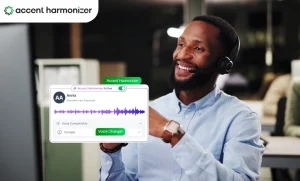
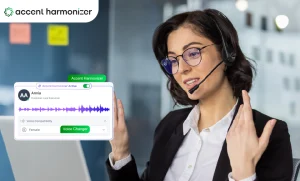
Real-time accent harmonization adjusts speech clarity while the call is happening, without translating language or altering content.
In collections specifically, this can help with:
- Fewer repetition loops: Customers ask “what?” less often
- Clearer payment terms: Numbers and dates land the first time
- Cleaner compliance delivery: Disclosures stay intelligible start to finish
- Natural pacing: Conversations flow without constant re-explaining
- Consistency across regions: Distributed teams sound uniformly clear to the customer
| Accent, QA, and Audio Processing Capabilities | ||||
|---|---|---|---|---|
| Capability | Accent Training | QA Coaching | Noise Cancellation | Speech Clarity AI |
| Improves audio quality | No | No | Yes | Partial |
| Addresses cross-accent gaps | Limited | Limited | No | Yes |
| Works during live calls | No | No | Yes | Yes |
| Needs long retraining | Yes | Yes | No | No |
| Targets intelligibility directly | Partial | Partial | Limited | Yes |
Questions to Ask Before Deployment
Before signing with any vendor, technology leaders should push on the infrastructure details.
- What latency does the processing add?
- Does it require telephony or SIP changes?
- How does it interact with the current dialer?
- What happens to call recordings during processing?
- Is audio stored or discarded after the call?
These architecture questions often matter more than the marketing deck.
Metrics Worth Tracking After Rollout
Once a clarity initiative goes live, most first party debt recovery support teams watch:
- Right Party Contact and Promise-to-Pay rates
- Average Handle Time
- Callback volume
- Collector occupancy
- Recovery per hour
- Escalation frequency
These numbers show whether speech clarity software moved the needle, not just the software is installed cleanly.
Conclusion
Collections teams have spent years refining scripts, training, and QA. But most still have no clear view of whether the customer understood the call.
As collections work spreads across more regions and delivery centers, that blind spot gets bigger, not smaller. That’s the real story behind debt collection accent translation: it’s not a niche audio feature. It’s becoming a core operational metric alongside RPC and recovery rate.
See the clarity gap in your own call data.
Run a 15-minute audit of your current handle times, callback rates, and repeat-explanation frequency against a live accent harmonization sample call. Book a technical walkthrough with our collections solutions team to see the architecture, latency, and compliance fit before you commit to anything.