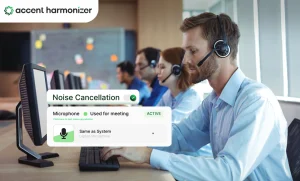

Many enterprise leaders invest heavily in modern telephony upgrades to fix customer friction. Consequently, they deploy aggressive noise reduction tools and launch intensive agent coaching programs. These executives naturally expect customer understanding to improve when they upgrade their infrastructure. However, operational metrics frequently tell a completely different story.
Leaders regularly see repeat requests and raise average handle times (AHT) even after upgrading their hardware. Because of this trend, teams quickly realize that crisp sound bites do not automatically resolve complex customer issues. Speech clarity for contact centers must serve a larger goal than simple acoustic precision. If your audio is clear but the customer still struggles to comprehend the agent, your technology investment fails.
How Speech Clarity Became a Contact Center Priority?
To understand this friction, we must look at how communication metrics evolved. Contact centers historically measured success by engineering metrics rather than human comprehension.
The Evolution of Communication Quality Metrics
The journey toward modern conversation tracking happened in four distinct historical phases:
- Phase 1 (Call Connectivity): Teams measured success by signal stability and basic uptime.
- Phase 2 (Audio Quality): Companies adopted wideband audio to expand the acoustic frequency range.
- Phase 3 (Speech Clarity): Systems began focusing on specific syllable distinction and packet loss concealment.
- Phase 4 (Conversation Understanding): Modern operations now track real-time cognitive processing speed.
| Voice Communication Maturity Timeline |
|---|
Phase 1 Hardware Stability Can the call connect? → Phase 2 Audio Cleanliness Can customers hear clearly? → Phase 3 Speech Clarity Can customers understand the words? → Phase 4 Human Comprehension Can customers understand the meaning? |
Why Speech Clarity Became a Strategic Focus?
Distributed operations changed how enterprises manage customer support teams. Specifically, the rapid rise of remote work forced agents out of controlled environments into unpredictable home offices. Furthermore, brands rely on offshore support and global talent pools to scale their coverage. Therefore, tools like an AI speech enhancement call center application became necessary operational infrastructure.
The Gap Between Hearing and Understanding
Modern contact center strategies treat speech friction as a structural bottleneck, using AI-powered accent clarity to eliminate operational friction during live calls. Most technology providers design systems that stop at basic audibility. Standard audio cleanup fixes environment sound but ignores customer understanding issues.
When addressable audio artifacts are removed, an AI voice clarity solution ensures that phonetic and pronunciation gaps no longer inflate call handling times. Reducing contact center repetition with real-time speech intelligence is required to save operational minutes. However, human communication requires cognitive processing that goes far deeper than picking up sound waves.
Customers Can Hear Every Word and Still Miss the Message
A customer can hear an agent perfectly but still fails to gather the meaning. For instance, cross-accent communication introduces subtle phonetic differences that force the brain to work harder. This cognitive load slows down processing time during live conversations. As a result, the customer spends energy deciphering pronunciations instead of focusing on the actual answers.
Why Identical QA Scores Can Produce Different Customer Experiences?
Traditional quality assurance scorecards present a dangerous operational blind spot for managers. An agent might earn a perfect quality score for pronunciation and compliance scripts. Nevertheless, the customer may still feel confused by the rhythm or pacing of the interaction. If the interaction lacks phonetic familiarity, the customer often leaves the call dissatisfied.
The Hidden Cost of Conversation Rework
When comprehension fails, financial metrics suffer across the entire enterprise. Customers constantly ask agents to repeat complex technical instructions. Consequently, this conversational rework drives up AHT and triggers avoidable transfers to Tier 2 support.
Why Traditional Speech Clarity Initiatives Reach a Ceiling?
Organizations spend millions on isolated fixes to solve these communication gaps. Unfortunately, these standalone initiatives hit a performance ceiling because they treat symptoms rather than the root cause.
- Initiative 1 (Agent Coaching): Coaching improves delivery and script pacing. However, it cannot eliminate the immediate cognitive friction caused by deep regional accent variations.
- Initiative 2 (Noise Suppression): Software removes background dogs or keyboards. It improves audibility, but it does not clarify the spoken words.
- Initiative 3 (Accent Neutralization): Training forces agents to alter their natural speech. It creates unnatural pauses and lowers agent confidence.
- Initiative 4 (Telephony Upgrades): HD voice systems deliver pristine transmission. Even so, clean data streams cannot fix underlying conversation dynamics.
| “ Most corporate initiatives improve exactly one layer of communication. ” |
The New Conversation Stack for Modern Contact Centers
To build a defensible operation, enterprise buyers must move beyond basic audio metrics. You need a structured framework that connects acoustic input directly to business outcomes.
| The Layers of Voice Communication Quality | ||
|---|---|---|
| Layer | Primary Question | Business Impact |
| 1. Transmission Quality | Can the call connect? | Service availability |
| 2. Audio Cleanliness | Can customers hear? | Call quality ratings |
| 3. Speech Clarity | Can customers distinguish speech? | Reduced syllable repetition |
| 4. Conversation Understanding | Can customers process meaning? | Faster resolution times |
What Enterprise Buyers Should Evaluate Beyond Speech Clarity?
Procurement teams must change how they score communication technology vendors. Specifically, look past the marketing brochures and test deep real-time adaptation capabilities.
Intelligibility Improvement and Noise Reduction
Your platform must isolate human speech while actively flattening environmental distractions. Therefore, integrating enterprise-grade noise cancelling software for call centers is a baseline requirement.
Cross-accent Communication Support
Modern buyers now evaluate advanced cross-accent communication AI to bridge regional gaps. These voice harmonization tools contact center deployments adjust phonetic outputs in real time. This ensures customers process information instantly without changing the agent’s natural voice identity.
| “ Running real-time voice harmonization at sub-200ms latency requires a carefully engineered stack: edge-based processing, low-latency neural inference, zero-copy audio pipelines, etc. You cannot afford dropped packets or jitter when modifying live audio streams. The architecture must be purpose-built for telco-grade reliability. ” — Enterprise IT Director, Global BPO Provider |
Latency Impact and Deployment Risk
Every security layer you add introduces potential latency into the audio stream. Enterprise systems must process these voice alterations in under 200 milliseconds to prevent agents from talking over customers. Furthermore, architecture teams favor simple voice application deployment (VAD) models. Your software should install directly without complex SIP interception or routing changes on platforms like AIQMS.
Why Speech Clarity Is Becoming a Workforce Strategy Issue?
Communication technology now directly dictates your global talent strategy. Because cross-accent friction limits where you can source talent, it creates artificial hiring constraints. If your technology handles phonetic translation, you can hire skilled agents anywhere in the world. Consequently, speech clarity transforms from a simple IT metric into a massive competitive advantage for talent acquisition.
Conclusion
The future of speech clarity for contact centers is about faster human understanding. Organizations that treat clarity as an isolated IT project leave significant friction points completely untouched. The next phase of global contact center performance requires making conversations easier to comprehend, not just louder.
Ready to bridge the gap between hearing and understanding?
Book our Enterprise Conversation Stack Demo to see how real-time voice harmonization can reduce your contact center’s AHT and improve global FCR.