
Discover how real-time accent translation software removes hidden friction from global contact centers by eliminating repetitive communication loops. Learn how to lower average handling times and boost agent productivity without expensive, slow-moving training programs.
Most retail contact centers do not discover communication problems through explicit accent complaints. Instead, they discover them through clear operational signals. For instance, rising Average Handling Time (AHT) and growing repeat contact volumes often point to underlying friction. Consequently, supervisor escalations spike and onboarding periods stretch longer for new agents.
These factors lead to highly inconsistent customer experiences across support teams. For organizations operating offshore or distributed support models, communication inefficiencies quickly become a major hidden operational cost. Real-time accent translation for call centers is emerging as a practical approach to reducing these bottlenecks while maintaining natural, human conversations.
Why Retail Contact Centers Struggle with Communication Consistency at Scale?
During holiday rushes, interaction volumes skyrocket. Because of this spike, small misunderstandings scale into massive backlogs. Temporary workers must hit the ground running immediately. Under this immense pressure, subtle communication gaps create major bottlenecks.
Complexity of Offshore Customer Support Operations
Managing teams across multiple continents introduces distinct operational variables. Specifically, regional dialects and cultural phrasing differences can stall conversation flow. Therefore, maintaining a uniform quality standard across distributed zones becomes a constant management challenge.
Why Customers Ask Agents to Repeat Themselves?
A customer often asks an agent to repeat a sentence due to phoneme pronunciation variances. Because vowels or consonants are shaped differently across world regions, the human ear requires extra processing time. When this happens, the natural rhythm of the service call breaks down.
When an agent repeats a resolution step three times, the caller becomes frustrated. Consequently, the emotional tone of the interaction degrades rapidly. The friction slows down queues and hurts overall team morale.
Customers value fast, clear answers above almost everything else. If a buyer struggles to understand a support agent, they lose trust in the brand. Therefore, clear communication directly protects customer lifetime value. Eliminating structural barriers requires AI call clarity solution to target conversational outcomes like reduced repetition and faster compliance routing.
The Hidden Cost of Repetition in Call Centers
- Longer Average Handling Times: Every time an agent repeats a billing policy, the call clock keeps ticking. These extra seconds compound across thousands of weekly interactions. Ultimately, this repetition inflates your total staffing requirements.
- Escalation Inflation and Supervisor Dependency: When a caller grows tired of clarifying their issue, they demand a manager. Because supervisors spend hours handling these avoidable transfers, they cannot coach their primary teams. This dynamic creates a costly operational loop.
- Repeat Contacts and Resolution Delays: Misunderstandings during the initial call prevent first-contact resolution. For instance, a customer might apply an incorrect troubleshooting step because they misheard the instruction. Consequently, they must call back, doubling the support load.
- Increased Customer Effort: High customer effort scores correlate perfectly with brand churn. If securing a simple refund requires extreme concentration, the customer experience fails. Minimizing this mental strain is critical for modern operations.
- Inconsistent Customer Experiences Across Teams: When some agents communicate clearly while others struggle, your brand experience fractures. Customers then begin to gamble every time they dial your number. This variance destroys predictability in service delivery.
Call Centers Invest in Accent Training Despite Limited Scalability
Here are some reasons why call centers invest in accent training despite limited scalability:
- Coaching Requires Ongoing Operational Resources: Traditional voice coaching is not a one-time event. Because language habits are deeply ingrained, agents require continuous monitoring and feedback. This constant feedback loop consumes vast amounts of quality assurance hours.
- Outcomes Depend on Individual Agent Performance: Human training yields highly variable results. Some agents adapt quickly, while others show minimal change after weeks of classes. This unpredictability makes it difficult to project uniform service improvements.
- Training Does Not Eliminate Seasonal Hiring Challenges: When you scale up for peak seasons, you only have days to onboard workers. Because comprehensive speech training takes weeks, it cannot be deployed effectively for temporary staff. As a result, seasonal teams often underperform.
- Communication Variability Returns Through Attrition: Contact centers face notoriously high turnover rates. When a trained agent leaves, your training investment walks out the door with them. The replacement agent requires the exact same costly training cycle.
- Time-to-Proficiency Limits Workforce Flexibility: Long training timelines prevent swift operational pivots. If you need to scale up a new offshore team immediately, speech training acts as a severe bottleneck. This limitation reduces your agility in a volatile market.
Why Enterprises Are Exploring Real-Time Alternatives?
Because manual training is slow, tech leaders want immediate, deterministic tools. Eliminating customer retry loops requires an enterprise-grade accent translation AI platform that integrates seamlessly into existing CCaaS stacks. Real-time software offers a predictable way to standardize communication instantly. This shift removes human variability from the operational equation.
What Is Accent Translation for Call Centers?
This technology refers to software that modifies spoken audio in real time during a live call. It alters specific phonetic traits, so the listener hears a familiar accent, yet it retains the speaker’s original pacing and wording.
| Competitive Landscape: Accent Modification Architectures | |||
|---|---|---|---|
| Feature | Accent Translation | Accent Neutralization | Traditional Accent Training |
| Delivery Method | Real-time software layer | Filtering or masking audio | Human classroom coaching |
| Time to Value | Instantaneous | Days or weeks of tuning | Months of practice |
| Scalability | Unlimited across seats | Limited by software rules | Poor due to agent turnover |
How Accent Translation Technology Works in Contact Center Environments?
- Real-Time Speech Analysis: The software captures the agent’s voice audio stream instantly at the millstone level. It analyzes incoming phonemes, pitch, and linguistic patterns before the audio leaves the agent’s workstation.
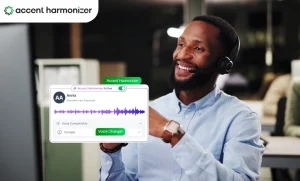
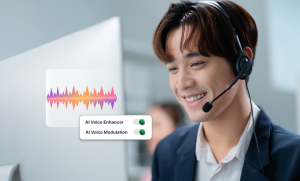
- Accent Harmonization and Speech Adaptation: Next, the engine maps the detected phonemes to target accent models. It alters the acoustic properties of the vowels and consonants to match the target geography. Because this happens instantly, the conversation flows without lag.
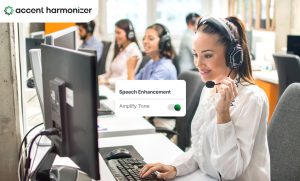
- Speech Enhancement and Voice Clarity: Beyond altering accents, the system polishes the overall audio quality. It sharpens muffled words and standardizes volume levels. Consequently, the customer receives a crisp, highly intelligible audio stream.
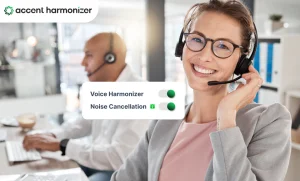
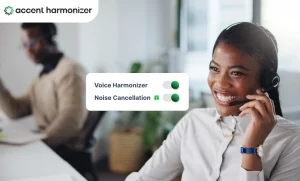
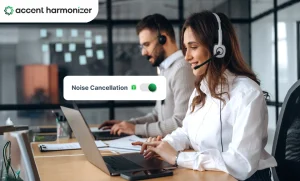
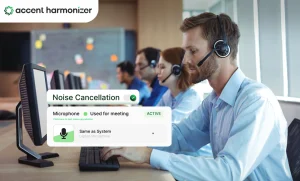
- Background Noise Reduction: Offshore delivery centers can be loud environments filled with floor chatter. The software strips out background voices, keyboard clicks, and air conditioning hums. This isolation ensures the customer focuses solely on the agent’s words.
Conclusion
Communication challenges in the enterprise contact center rarely present themselves as simple accent complaints. Instead, they show up as bloated handling times, inflated supervisor escalation rates, and high repeat contact volumes that drain operational budgets. Traditional accent training requires significant, ongoing management resources and fails to scale effectively during high-turnover or seasonal hiring spikes.
Adopting real-time accent translation for call centers marks a practical transition from training-dependent programs toward software-driven communication optimization. The accent translation technology for BPO into your existing infrastructure, your organization can eliminate conversational friction, optimize labor capacity, and deliver a reliable brand experience across your entire global support footprint.
Ready to optimize your global support team’s operational efficiency?
Stop losing valuable labor capacity to constant call repetition and rising supervisor escalations. Contact our enterprise technology team to schedule a low-latency demonstration of our virtual audio platform.