
Most contact centers assume accent-related issues are training problems. When call times increase or customer satisfaction declines, managers naturally schedule coaching sessions. They invest heavily in accent neutralization programs or increase QA oversight. However, these traditional interventions often address symptoms rather than operational friction itself.
The real issue for contact centers is conversational friction. It means the extra mental effort customers expend to understand information during a live interaction. Friction appears in predictable, small moments. For instance, you see it in frequent clarification requests, repeated explanations, and conversational restarts. Customers pause longer, which leads to supervisor escalations. Individually, these moments seem insignificant.
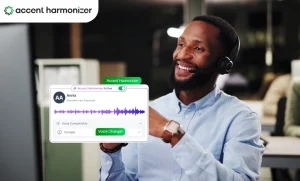
Fortunately, voice accent translation emerged as a response to this precise challenge. Technology helps organizations improve comprehension during live conversations. Most importantly, it achieves this goal without retraining entire agent populations or altering their identity.
Why Do Many Contact Centers Misdiagnose Accent-related Problems?
When Average Handle Time (AHT) rises, leadership typically responds with traditional operational levers. BPOs can protect first-contact resolution metrics by introducing AI voice accent translation to bridge regional speech gaps without retraining agents. They authorize increased hiring, approve overtime pressure, or make workforce management adjustments. Specifically, teams look at staffing capacity instead of investigating what expands conversations in the first place.
Why are Escalations and CSAT Lagging Indicators?
Most organizations notice communication issues only after customer frustration becomes visible. Consequently, metrics like Customer Satisfaction (CSAT) drop long after the friction occurs. By then, operational damage has already impacted on your bottom line.
Conversational friction introduces repetition, clarification requests, and sudden conversational restarts. It also creates extended silences during critical dialogue. Operations leaders must position these issues as measurable operational events rather than vague communication problems.
What Voice Accent Translation Actually Does During a Live Conversation?
It is vital to clarify category confusion. Language translation changes words from one language to another, such as turning Spanish into English. Conversely, accent translation software modifies speech delivery while keeping the exact words identical.
Voice Accent Translation vs Accent Neutralization
Traditional neutralization attempts to change how agents speak through human behavior modification. In contrast, accent translation AI dynamically alters the sound waves during live conversations.
| Accent Neutralization Software vs. Voice Accent Translation | |
|---|---|
| Accent Neutralization Software | Voice Accent Translation |
| Requires active agent coaching | Works automatically in real time |
| Changes human speaking habits | Modifies digital audio output |
| Takes months to show results | Delivers immediate clarity |
Voice Accent Translation vs Voice Changers
Enterprise real-time accent translation is entirely different from consumer voice changers. Consumer tools alter pitch or mimic specific characters for entertainment. Enterprise software preserves the agent’s unique voice identity, gender, and tone while adjusting specific phonetic markers.
Why Voice Clarity Matters More Than Accent Neutralization?
The operational goal of a contact center is fast, accurate problem resolution. Therefore, removing an accent entirely is unnecessary. While text-based translation shifts meaning, true speech accent translation reduces conversational friction by dynamically aligning phonemes without changing words. Organizations should focus on clarity rather than complete accent erasure.
Chasing perfect pronunciation wastes valuable training resources. Because speech patterns vary globally, attempting to standardize speech perfectly across hundreds of agents is mathematically impractical.
How Voice Clarity Impacts Customer Effort?
When you implement AI voice clarity software, customer effort drops immediately. Customers process information faster because the audio matches their familiar phonetic expectations.
Clear speech paths allow conversations to flow logically. Consequently, agents handle objections more effectively, control the call pace, and reduce total talk time.
Why Traditional Approaches Struggle to Scale?
- Economics of Accent Training Programs: Human coaching requires massive upfront and ongoing investments. Classrooms, trainers, and QA monitoring hours quickly drain operational budgets.
- Attrition Recreates the Same Training Investment: Contact centers face notoriously high attrition rates. Because trained agents eventually leave your training investment leaves with them, forcing you to restart the cycle.
- Coaching Outcomes Vary Across Teams and Locations: Human learning is inherently inconsistent. Consequently, coaching outcomes vary wildly between different teams, managers, and regional locations.
- Why Time-to-Proficiency Remains a Challenge: New agents often spend weeks in specialized communication academies. This delay extends your time-to-proficiency metric, which slows down overall floor deployment.
Voice Accent Translation Delivers the Greatest Operational Impact
- High-Volume Customer Support Operations: In high-volume environments, saving fifteen seconds per call preserves massive capacity. Therefore, accent changer software delivers immediate returns here.
- Outsourced BPO Environments: Business Process Outsourcing (BPO) firms compete on margin and SLA performance. Technology protects those margins from attrition-driven coaching costs.
- Technical Support Teams: Technical support requires absolute precision. Because troubleshooting steps are complex, clear communication prevents dangerous user errors.
- Collections and Revenue Recovery Operations: Financial conversations require high trust and low friction. Clear audio ensures compliance and reduces customer defensiveness.
- Sales Teams Serving Native-English Markets: Sales conversions rely heavily on immediate rapport. Clear articulation helps agents build trust before the prospect disengages.
Conclusion
Most organizations view accent-related issues through the lens of training. Yet longer calls, higher escalations, staffing pressure, and inconsistent customer experience originate from conversational friction.
Voice accent translation improves understanding during conversations. AI accent modification system while preserving operational efficiency, agent productivity, and customer experience. The more useful question for contact center leaders is not whether accents exist. It is how much conversational friction is costing the operation every day—and how that cost should be measured.
Ready to eliminate conversational friction in your contact center?
Don’t waste months on expensive accent retraining programs that disappear with agent attrition. Schedule a technical brief with our operations experts to see how our real-time voice accent translation software integrates with your existing CCaaS platform to lower AHT and improve clarity instantly.