
In high-volume BPO, speech clarity and customer comprehension directly dictate performance outcomes. Every enterprise contact center track Average Handle Time (AHT), First Contact Resolution (FCR), and Customer satisfaction (CSAT). A drop in these metrics naturally launches diagnostic investigations.
The standard playbook is familiar: audit agent knowledge bases, overhaul coaching programs, or retrain teams on process compliance. In many operations, however, these interventions produce marginal gains. The root cause lies outside agent competency or product mastery.
Every instance of “Could you repeat that?” or “I didn’t catch that last step” introduces non-value-added time into the workflow. Across millions of annual interactions, this silent comprehension gap inflates operating costs, degrades customer sentiment, and depresses workforce productivity.
What Is Speech Clarity in BPO Environments?
BPO speech clarity is the degree to which a customer instantly understands an agent’s spoken communication without requiring repetition, re-explanation, or supervisor escalation.
Unlike traditional communication metrics, speech clarity is an operational property of the live audio channel rather than an assessment of agent effort. It represents the intersection of several distinct technical, environmental, and acoustic variables:
- Pronunciation and Phonetic Precision: Accuracy in word formation and enunciation.
- Speech Intelligibility and Pacing: Cadence and acoustic structure that enable effortless human auditory processing.
- Acoustic Signal Quality: Microphones, bandwidth, and telecommunications codec performance.
- Background Noise: Ambient office noise or residential sound artifacts on either side of the call.
- Listener Cognitive Load: The effort required by the customer to parse foreign accents, unfamiliar regional dialects, or complex technical instructions.
| Speech Clarity Formula |
|---|
Speech Clarity = Intelligibility + Signal Precision − Cognitive Friction |
Why Speech Clarity Has Become an Operational KPI?
For decades, contact centers treated speech dynamics as a soft skill managed exclusively within learning and development (L&D) departments. In modern enterprise BPO operations, speech clarity functions directly as an upstream operational key performance indicator (KPI).
| Operational Cascade of Low Speech Clarity | |
|---|---|
| 1 | Low Speech Clarity |
| 2 | Customer Requests Clarification (“What was that?”) |
| 3 | Agents Restate Information & Scripts |
| 4 | Average Handle Time (AHT) Increases |
| 5 | Agent Occupancy & Capacity Drop |
| 6 | Required Full-Time Equivalent (FTE) Staffing Increases |
| 7 | Total Cost to Serve Rises |
A customer who struggles to understand an offshore or near-shore agent does not immediately demand a supervisor. First, they ask the agent to repeat account numbers, verification prompts, or technical troubleshooting steps.
Repeating a 15-second verification script twice adds 30 seconds of pure waste to a call. Across a 500-agent deployment handling 10,000 calls daily, 30 seconds of repeated audio per call burn roughly 83 hours of productive capacity every day.
Operations teams religiously monitor AHT, occupancy, and headcount requirements. Yet, without diagnosing customer comprehension friction, they miss the root cause inflating those metrics.
How to Tell if Speech Clarity Is Actually the Problem?
Is longer handle time driven by complex workflows, poor agent training, or a customer comprehension barrier? Because traditional contact center QA metrics focus on agent compliance rather than customer cognitive load.
Contact center executives should look for these operational indicators:
- Stable QA Scores Alongside Rising AHT: Agents follow the script, hit every compliance check, and demonstrate correct product knowledge, yet handle times continue to trend upward.
- High Repeat Rate on Standard Scripts: Verification, disclosures, and legal disclaimers take twice as long to complete in specific offshore delivery locations compared to domestic tiers.
- Frequent Interruption and Repetition Patterns: Conversation analytics show high density of phrases like “Say that again,” “Excuse me,” or “What did you just say?”
- Escalations Driven by Misunderstanding: Escalation logs show customers transfer to tier-2 support or domestic supervisors not because of policy exceptions, but because they lost confidence during the initial disclosure.
- Extended Dead Air During Complex Steps: Long pauses after an agent provides instructions often indicate the customer is processing what was said rather than executing the step.
Measuring Speech Clarity in a Contact Center
Because speech clarity operates at the intersection of human perception and acoustics, enterprise operations cannot evaluate it using a single direct metric. Instead, operations teams infer speech clarity by aggregating conversational patterns through speech analytics.
| Speech Clarity & CX Performance Metrics | ||
|---|---|---|
| Metric | Measurement Focus | Operational Significance |
| Clarification Request Rate (CRR) | Frequency of customer-initiated repeat requests per call. | Directly quantifies real-time customer cognitive friction. |
| Script Duration Variance | Actual vs. baseline time required to complete fixed compliance scripts. | Measures non-value-added talk time on standardized disclosures. |
| Customer Interruption Index | Rate at which customers talk over the agent during explanations. | Indicates the customer is attempting to halt or clarify an ongoing explanation. |
| Post-Explanation Silence | Micro-pauses immediately following agent instructional blocks. | Captures customer cognitive processing time before taking action. |
| Phonetic Escalation Triggering | Transfer rates correlated to specific delivery geographies or voice profiles. | Pinpoints regional intelligibility friction across customer segments. |
Root Cause or Symptom? Understanding the Metrics
When scaling international teams, BPO leaders deploy desktop-level processing to address accent-related friction and lower AHT without changing core telephony infrastructure. Operations leaders misdiagnose speech clarity problems as agent performance issues, they deploy the wrong remedies. The table below illustrates how common contact center symptoms are misattributed and what the underlying root cause often is:
| Operational Symptoms vs. Audio Friction Root Causes | ||
|---|---|---|
| Operational Symptom | Common Misinterpretation | Actual Root Cause |
| High Average Handle Time (AHT) | Slow system navigation or low agent proficiency. | Speech clarity friction causing systematic repetition of instructions. |
| Low CSAT / High Effort Scores | Poor agent empathy or inadequate soft skills. | Customer frustration driven by cognitive effort required to process audio. |
| High Transfer Rates | Knowledge gaps or improper tier-1 triage. | Breakdown in customer trust stemming from initial communication friction. |
| Excessive Coaching Hours | Ineffective onboarding or weak agent talent pool. | Structural limitation of pre-call training trying to solve live audio dynamics. |
| Supervisor Interventions | Strict compliance policy or difficult customers. | Preventable escalations caused by minor misunderstandings early in the call. |
Treating a speech clarity failure with additional product training will not shorten handle times. It simply creates better-informed agents who still must repeat themselves three times per call.
Why Traditional Voice and Accent Training Doesn’t Solve Every Conversation?
Traditional voice and accent coaching builds essential baseline communication skills, but it cannot solve every live conversation issue due to structural limits:
- Pre-call preparation vs. live variables: Coaching prepares agents beforehand, but live calls introduce unpredictable challenges like poor phone line quality, customer regional accents, background noise, and varied listener hearing or cognitive abilities.
- Human phonetic limits: Under fatigue, pressure, or high call volume, an agent’s native phonetic patterns naturally persist. Relying strictly on human muscle memory across large global teams is statistically unrealistic.
- Adaptive solution: Rather than replacing voice training, modern contact centers pair human coaching with real-time speech processing technology. This dynamically harmonizes the live audio stream to deliver a consistently clear acoustic experience.
What Actually Improves Speech Clarity During Live Calls
Achieving low-friction speech clarity requires:
- Hardware & Signal Isolation: Noise-canceling hardware and digital suppression eliminate ambient background noise and crosstalk.
- Pacing & Cadence Control: Managed speech speed helps customers digest complex information without cognitive fatigue.
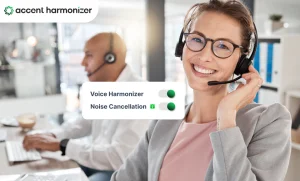
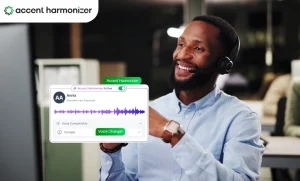
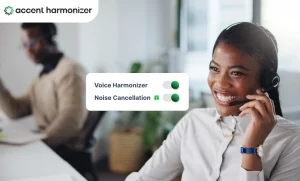
- Real-time Accent Harmonization: Sub-second audio processing adjusts phonetics for clearer customer comprehension while preserving the agent’s natural tone and emotion.
Why Real-Time Speech Processing Changes Contact Center Economics?
Shifting speech clarity management from pre-call training to live call processing changes the underlying cost structure of BPO operations.
| Training vs. Real-Time Technology Economics |
|---|
Traditional Training Economics (Linear & Lossy) More Agents → More Trainers → Longer Onboarding → Post-Call Decay Real-Time Technology Economics (Scalable & Instant) System-Wide Deployment → Zero Onboarding Lag → Consistent Quality Across All Shifts |
- Compressed Time-to-Green: New hires reach target AHT and CSAT benchmarks faster because customer comprehension barriers are mitigated from day one.
- Expanded Talent Acquisition: BPOs can recruit agents based on domain expertise, problem-solving ability, and empathy—rather than filtering out qualified candidates purely on regional accent characteristics.
- Stabilized Global Delivery Quality: Delivery quality across offshore, nearshore, and onshore facilities becomes standardized, giving enterprise buyers consistent operational performance regardless of routing location.
What Enterprise Buyers Should Evaluate in Speech Clarity Software?
When evaluating speech clarity software for enterprise contact center environments, IT and operations leaders must look past basic feature lists. Enterprise deployment requires strict adherence to performance, security, and architectural standards:
1. Latency and Processing Overhead
To maintain natural, conversational turn-taking, end-to-end audio processing must occur in under 200 milliseconds. Higher latency introduces conversational overlaps and awkward pauses that frustrate customers.
2. Voice Preservation and Naturalness
Systems must preserve the agent’s unique voice and emotional tone. Synthetic voice overlays or robotic conversions erode customer trust and degrade rapport.
3. Architecture and Telephony Compatibility
The solution should operate as a lightweight virtual audio device at the OS level or integrate into existing CCaaS and SIP infrastructures.
4. Security, Compliance, and Data Privacy
Enterprise architecture demands zero local audio retention and full compliance with HIPAA, PCI-DSS, and GDPR standards. Live processing must occur locally on the endpoint without transmitting sensitive data to unverified platforms.
5. Operational Resilience and Governance
Platforms must offer failover mechanisms, immediate administrative rollback capabilities, and full compatibility with existing call recording and workforce management systems.
How Accent Harmonizer Supports BPO Speech Clarity?
Omind’s Accent Harmonizer provides a real-time operational layer designed specifically for high-volume BPO and enterprise contact center environments.
Instead of replacing human agents or relying on post-call coaching feedback loops, Accent Harmonizer processes live voice streams to eliminate comprehension barriers during the interaction.
- Sub-200ms Latency: Delivers instantaneous processing, ensuring conversational dynamics remain natural and fluid.
- Virtual Audio Device Architecture: Installs easily at the endpoint level with zero code changes, requiring no modifications to underlying SIP routing or CCaaS platform setups.
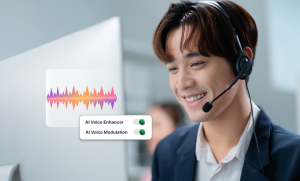
- Voice Preservation Engine: Maintains the agent’s authentic tone, pitch, and emotional cadence, smoothing out hard-to-understand phonetic variations while avoiding synthetic, artificial sounds.
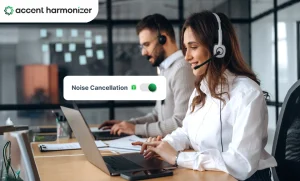
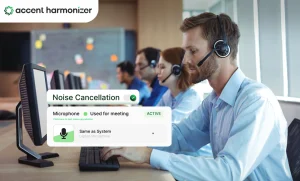
- Built-in Noise Suppression: Filters out background workstation noise and acoustic distractions alongside speech harmonization.
- Enterprise CCaaS Compatibility: Integrates seamlessly with existing workforce optimization toolstacks, recording solutions, and modern contact center platforms.
By deploying real-time voice harmonization, BPOs reduce customer comprehension friction, compress handle times, and elevate satisfaction scores without disrupting operational workflows.
Redefining Speech Clarity as an Operational Strategy
For decades, contact centers treated BPO speech clarity as an intangible human factor managed through endless coaching sessions. In modern multi-region enterprises, that model is no longer cost-effective or scalable.
Speech clarity is a direct driver of operational efficiency, affecting Average Handle Time, customer effort, staffing capacity, and service consistency.
By measuring customer comprehension friction, distinguishing underlying root causes from superficial symptoms, and deploying real-time speech processing technologies, operations leaders can permanently strip non-value-added time out of every call—improving business margins and customer experience simultaneously.
Fix Silent Comprehension Gaps Across Your Global BPO
Stop letting misheard scripts, repeated disclaimers, and cognitive friction inflate your Average Handle Time and burn productive capacity.
Discover how Accent Harmonizer delivers ultra-low latency, real-time speech processing to standardize voice clarity, empower offshore agents, and protect operating margins—without changing your existing telephony stack.
Schedule a Real-Time Voice Clarity Assessment