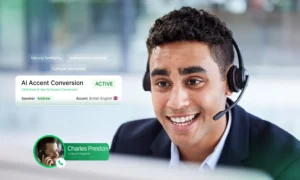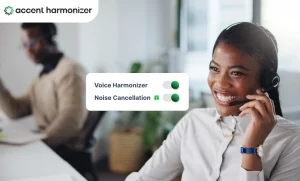

Unlike workforce management systems or CCaaS platforms, speech modification is not a mature software category. Most buyers looking for an enterprise accent harmonizer vendor are not trying to replace an existing tool. Instead, they are trying to diagnose operational issues that appear elsewhere in the contact center. Specifically, these issues show up as rising Average Handle Time (AHT), customer frustration, and long onboarding cycles. Consequently, buyers must compare completely different operational approaches before they ever evaluate software features.
This guide covers why enterprises evaluate accent harmonization. We will examine the alternatives that operations teams consider first. Furthermore, we will analyze the vendor landscape, technical risks, and evaluation frameworks.
Why Enterprises Push for Accent Harmonization?
- Customer Repetition Becomes a Hidden Cost Center: When customers struggle to understand an agent, they ask for repeated explanations. These repetitions create significant conversational drag, spiking AHT and increasing staffing pressure.
- QA Scores Remain Stable While Customer Experience Declines: Traditional quality assurance forms rarely measure real-time comprehension friction. Because of this, their QA score remains high while the customer struggles to understand the accent.
- Supervisor Escalations Increase for the Wrong Reasons: Many customers request supervisor escalations simply to reinforce trust. They seek conversational clarification rather than a policy change. As a result, expensive supervisor resources spend time validating basic information.
- Agent Training Programs Produce Uneven Results: Traditional accent neutralization training requires significant time. However, coaching variability and high attrition often wipe out these investments. Consequently, operations teams find it difficult to scale consistent performance.
What Enterprise Accent Harmonizer Vendor Technology Does?
Organizations must understand the mechanical differences between speech tools. The table below outlines how these technologies function in real-world environments.
| Accent & Voice Processing Technologies Comparison | ||
|---|---|---|
| Technology Type | Primary Mechanism | Operational Impact |
| Accent Reduction | Human coaching and training software | Long-term behavior modification with high attrition risk. |
| Accent Translation | Speech-to-text turned into text-to-speech | Introduces massive audio latency and neutralizes conversational flow. |
| Accent Harmonization | Real-time phoneme adjustment | Preserves agent voice identity while matching customer phone profiles. |
How Real-Time Speech Adaptation Works?
The software captures the agent’s digital audio signal instantly. Then, it modifies specific vowels and consonant sounds to match the customer’s region. This entire mechanical process occurs within milliseconds during the live conversation.
Why Voice Identity Preservation Matters?
Customer trust depends on authentic human connection. If an enterprise accent harmonizer vendor uses a robotic voice replacement, customers notice immediately. Therefore, the software must preserve the agent’s unique vocal inflection, tone, and emotion.
Enterprise Accent Harmonizer Vendor Landscape: Four Emerging Approaches
- Platform Vendors: Pure-play providers focus exclusively on real-time speech harmonization architecture. For example, Sanas builds dedicated infrastructure to process real-time voice alterations. These vendors typically sell directly to large global enterprises and major BPOs.
- Embedded Technology Providers: Some organizations deploy this capability through existing implementation partners. For instance, the Omind AI Accent Harmonizer is powered by Sanas technology. This deployment model simplifies procurement because it utilizes established enterprise software agreements.
- CX Service Providers: Large business process outsourcing companies now embed speech tools into their delivery models. For example, Fusion CX delivers harmonization within broader customer experience engagements. Thus, clients receive the technology as part of their managed staffing contracts.
- Industry-specific Implementations: Certain platforms tailor their models to vertically call profiles. For instance, ServeRetail focuses on retail-specific vocabulary and transactional compliance terms. Consequently, their models require less training for specific retail environments.
How Procurement Teams Evaluate Accent Harmonizer Vendor Options?
Before signing a contract, teams must run a technical evaluation of AI accent conversion software for call centers.
| Enterprise Evaluation & Procurement Checklist for Accent Harmonizer Vendors | ||
|---|---|---|
| Evaluation Pillar | Core Technical Threat | Procurement Action Items & Criteria |
| 1. Audio Authenticity | Artificial/Mechanical Voice Distortion |
|
| 2. Processing Latency | Conversational Overlap (>150ms) |
|
| 3. Telephony Footprint | Intrusive Network Routing Risk |
|
| 4. CCaaS Integration | Desktop Fragmentation & Friction |
|
| 5. Data Privacy & Security | Unauthorized Voice Data Retention |
|
| 6. Use Case Suitability | Misallocated Tech Budget |
|
Beyond audio quality, enterprise RFP evaluation requires a deep dive into accent translation security due diligence across your telephony stack. While speech clarity and emotional resonance drive upfront buyer interest, checking how deep the application touches the SIP trunk or telephony layer determines the actual engineering resources required for rollout. Before finalizing your RFP, review our detailed accent harmonization software comparison to benchmark vendors across real-world latency, noise handling, and integration fit.
Conclusion
The most important insight for buyers is that speech harmonization is an operational efficiency decision. The strongest vendors are not necessarily those that modify speech most aggressively. Instead, they are the ones that help organizations reduce conversational friction without introducing latency, infrastructure complexity, or deployment risk.
Ready to reduce conversational friction in your global contact center?
Book Speech Harmonization demo to learn how to test latency, verify CCaaS integration, and audit data security parameters before your next vendor pilot.