Many global contact centers struggle with low customer satisfaction scores despite high compliance rates. Discover how deploying real-time live call accent harmonizers can eliminate conversational friction and bridge the customer understanding gap.
The agent followed the internal process exactly. They delivered every mandatory compliance statement clearly. The agent provided the correct resolution. Consequently, the QA score exceeded company expectations. Yet, the customer satisfaction score dropped. The customer complained to leadership. An avoidable escalation occurred anyway.
Most contact centers measure process quality. However, few measure customer understanding. That massive blind spot creates hidden communication friction during customer interactions. This friction damages the customer experience, lowers operational efficiency, and hurts agent performance. Deploying a live call accent harmonizer solves this issue by correcting phonetic misalignment instantly.
What Is the Customer Understanding Gap?
To fix this hidden problem, contact center leaders must look at a new operational framework:
| The Customer Understanding Gap |
|---|
Agent Delivery – Customer Comprehension = Customer Understanding Gap |
Specifically, this metric represents the difference between what an agent says and what a customer understands.
Why Do Customers Rarely Complain About Accents Directly?
Customers usually report issues regarding how they felt during the conversation. For instance, they might state, “The call took too long.” They might complain that they had to repeat themselves constantly. Frequently, they note that they were not confident in the information given. Therefore, the root issue often appears as high customer effort rather than an accent issue.
Why This Gap Becomes More Visible in Global Contact Centers?
This customer understanding gap widens within offshore operations and distributed teams. Because global teams serve diverse customer demographics, the increasing complexity of customer interactions makes clarity vital. Without speech clarity software, subtle phonetic variations lead to severe conversational drag. Once operations managers define the core customer comprehension variance, they can use AI voice harmonization framework across offshore locations.
Why Traditional Contact Center Metrics Miss Communication Friction
Traditional QA evaluates whether information was delivered. Conversely, customers evaluate whether information was understood. Because an agent can check every box without achieving true comprehension, high QA scores often hide broken customer interactions.
AHT Measures Duration, Not Clarity
Longer calls are often symptoms of communication friction, not root causes. When agents repeat instructions multiple times, call durations spike. Supervisors often mistake this clarity problem for a training issue.
CSAT Reveals the Damage After It Happens
Customer satisfaction metrics identify negative outcomes. However, they rarely isolate the underlying causes. A low CSAT score tells you the customer was unhappy, but it cannot pinpoint the exact moment miscommunication occurred.
| “ Traditional contact center sampling isolates a mere 1% to 5% of your customer interactions. Relying on delayed reports days or weeks after a call ignores the critical reality that accent friction creates business risk in real time—driving up AHT by 15% to 30% and inducing severe listener cognitive fatigue. ” |
Why Communication Friction Becomes Operationally Invisible?
Organizations struggle to isolate clarity-related issues because standard analytics platforms do not track syllable comprehension. Because these details are unrecorded, the real reason for extended handle times remains completely invisible.
Four Signals Your Contact Center Has a Customer Understanding Problem
- Rising Repeat Requests: Frequent phrases like “Can you repeat that?” or “I didn’t catch that” reveal immediate audio misalignment.
- High QA Scores but Declining CSAT: This classic warning sign proves that your internal metrics are detached from actual customer perception.
- Escalations Without Process Failures: Customers request supervisors despite agents following technical procedures correctly.
- Unexplained AHT Growth Across Offshore Teams: Productivity issues persist despite constant managerial coaching and extra process training.
The Hidden Cost of Communication Friction During Live Calls
Every Clarification Request Extends Call Duration
When an agent repeats phrases, seconds tick away. These small delays accumulate across thousands of calls daily. Consequently, your average handling time increases significantly, inflating total labor costs.
Cognitive Load Increases Customer Effort
Repetition damages the Customer Effort Score (CES). If a caller must focus intensely just to decode basic pronunciation, frustration builds rapidly. High effort directly correlates with lower brand loyalty.
Misunderstandings Create Avoidable Repeat Contacts
When details get lost in translation, the resolution fails. Customers call back because they misunderstood the original instructions. This means communication friction quietly destroys your First Call Resolution rate.
Accent Training and QA Coaching Often Fail to Solve Live Call Communication Problems
Traditional accent neutralization software and training programs operate before the agent speaks to a customer. However, conversational friction happens live in the air. Training cannot account for background noise, phone line static, or customer panic.
Coaching Improves Behavior but Cannot Modify Live Speech Clarity
Post-call feedback helps agents notice their pronunciation habits. However, coaching cannot modify live speech clarity during an active conversation. It cannot help the frustrated customer on the line right now.
Hiring for “Neutral Accents” Creates New Workforce Challenges
Restricting your hiring pool to agents with a specific accent profile is unsustainable. This strategy creates severe talent shortages. Consequently, it increases recruiting costs and reduces overall workforce flexibility.
What a Live Call Accent Harmonizer Changes in the Moment of Conversation
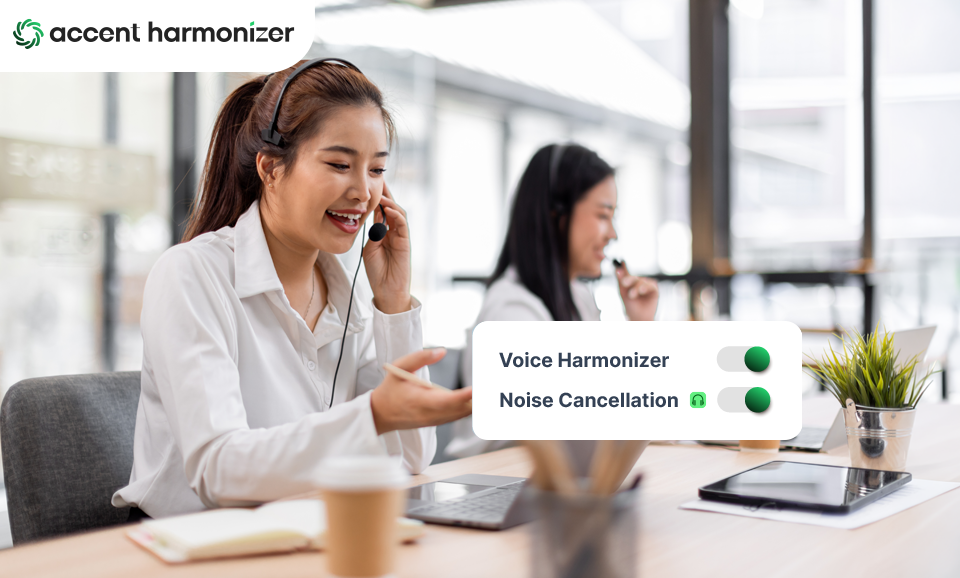
Deploying a live call accent harmonizer transforms how your offshore teams interact with customers. The real-time accent translating platform acts as an active filter during live agent conversations.
| Retrospective Coaching vs Live Call Accent Harmonizer | ||
|---|---|---|
| Metric | Retrospective Coaching | Live Call Accent Harmonizer |
| Execution Timing | Days after the call | Real-time (under 50ms) |
| Customer Impact | Zero impact on current caller | Eliminates active friction |
| Operational Goal | Long-term behavior change | Immediate comprehension |
Real-Time Accent Harmonization vs. Post-Call Analysis
Post-call analysis helps you study past failures. Conversely, cross-accent communication AI corrects pronunciation errors as they occur. This immediacy prevents customer frustration from building in the first place.
Improving Intelligibility Without Replacing the Speaker’s Voice
This technology does not rely on voice cloning or synthetic speech generators. It does not perform total accent removal either. Instead, the software modifies only the specific syllables that cause customer misunderstanding.
Contact Centers See Measurable Impact from Live Call Accent Harmonization
- Reduced Repeat Request Rates: Customers understand the information the first time it is spoken.
- Faster Average Handling Times: Eliminating clarification naturally shortens the conversation length.
- Higher Customer Satisfaction Scores: Clearer audio makes buyers trust the instructions they receive.
- Improved First Call Resolution: Minimizes callbacks caused by misheard numbers or misspelled names.
- Lower Escalation Rates: Documented reductions in supervisor transfer requests.
- More Consistent QA Outcomes: Standardizes audio quality across multiple global locations.
Communication Clarity Is Becoming a Contact Center Performance Metric
The customer experience industry spent years measuring process metrics like QA, AHT, FCR, and CSAT. However, the next major operational metric is customer understanding.
Traditional training and coaching methods have clear structural limits. Fortunately, modern technology offers a better path forward. Organizations that utilize a live call accent harmonizer to reduce communication friction gain immediate advantages in customer experience, efficiency, compliance, and workforce performance.
Find the Communication Friction Your Current Metrics Miss
Most contact centers can measure outcomes. However, few can identify the specific communication barriers driving them. Contact our enterprise team for a live demonstration of our real-time accent harmonizer. See how we help global teams improve customer understanding without changing your existing infrastructure.