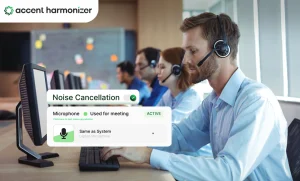

When customers complain that a call “sounds bad,” the obvious response is to investigate the network, headset, carrier, or CCaaS platform.
Sometimes that is exactly where the problem sits. But call center voice quality issues are not one failure class.
A customer may experience:
- robotic or distorted speech;
- choppy audio;
- noticeable delay;
- echo;
- background noise;
- low volume;
- or perfectly audible speech that still must be repeated.
Those symptoms can originate from completely different layers of the voice stack. Treating all of them as generic “audio quality problems” leads operations and IT teams toward the wrong fix.
A better diagnostic question is: Is the customer struggling to receive the audio signal, hear the audio clearly, or understand the speech being delivered?
That distinction matters because packet loss, acoustic noise, and speech comprehension problems require different interventions.
This guide breaks down the major causes of call center voice quality issues, shows how to diagnose each one, and explains when infrastructure fixes stop being enough.
What Are the Most Common Call Center Voice Quality Issues?
Most contact center voice problems fall into five categories.
| Contact Center Voice Quality Diagnostic Guide | ||
|---|---|---|
| Customer Symptom | Likely Failure Layer | What to Check First |
| Robotic, garbled, or distorted speech | Network or codec | Packet loss, codec behavior, connection quality |
| Audio cuts in and out | Network | Jitter, packet loss, bandwidth |
| Noticeable delay or people speaking over one another | Network or processing | Latency and round-trip delay |
| Background chatter, fan noise, keyboard noise, static | Acoustic or endpoint | Headset, microphone, agent environment, noise suppression |
| Audio sounds clean, but customers repeatedly ask agents to repeat themselves | Speech comprehension | Repetition patterns, intelligibility, call reviews, accent-related friction |
Audio Quality vs Speech Comprehension
Contact centers often combine several layers of voice performance under the label “call quality.” That hides the actual failure mechanism.
| Technical Audio Quality vs. Human Speech Comprehension | |
|---|---|
| Technical Audio Quality | Human Speech Comprehension |
| Packet delivery | Speech intelligibility |
| Jitter | Pronunciation processing |
| Network latency | Listener familiarity with speech patterns |
| Audio fidelity | Immediate understanding |
| Endpoint quality | Need for repetition |
| Noise suppression | Conversational effort |
Technical audio systems answer: “Did the voice signal arrive cleanly?”
Speech-comprehension analysis answers: “Did the customer understand what was said without requiring conversational repair?”
The Four Layers of Call Center Voice Quality
A more useful way to diagnose voice performance is to separate it into four layers.
| The Four Layers of Call & Audio Quality Architecture | ||
|---|---|---|
| Architecture Layer | Core Components & Parameters | Failure Mode / Operational Risk |
| Layer 1: Signal Quality Transmission Foundation |
| Audio becomes distorted, delayed, packet-dropped, or incomplete. |
| Layer 2: Acoustic Quality Microphone & Input Capture |
| Background chatter, keyboard clack, and ambient noise override primary audio. |
| Layer 3: Speech Clarity Phonetic Intelligibility |
| Message requires immediate listener effort to decipher, creating cognitive fatigue. |
| Layer 4: Customer Understanding Operational First-Time Success |
| Requires repetition, paraphrasing, manual spelling, unnecessary escalations, or transfers. |
Why Call Center Voice Quality Issues Increase AHT
Not every additional second of Average Handle Time comes from slow systems or weak agent knowledge. Some of it comes from conversational repair.
A common sequence looks like this:
| Customer-Agent Repetition Loop |
|---|
Step 1 Agent gives information → Step 2 Customer asks for repetition → Step 3 Agent repeats → Step 4 Customer confirms part → Step 5 Agent restates missing info → Step 6 Customer verifies again → Outcome Conversation continues |
The original information may have taken five seconds to deliver. The repair loop can consume considerably longer. Multiply that pattern across a high-volume contact center and a small comprehension problem becomes a capacity problem.
The economic chain is straightforward:
| Accent Friction Operational Impact Chain |
|---|
Trigger Comprehension Friction → Behavioral Reaction More Conversational Repair → Metric Impact Higher AHT → Efficiency Loss Fewer Completed Interactions / Paid Hr → Cost Penalty Additional Staffing Pressure |
This is why call-center leaders should not evaluate voice quality exclusively through technical network dashboards.
How to Diagnose Call Center Voice Quality Issues Without Guessing
The fastest way to waste money is to start with the product. Start with the symptoms instead.
- If the customer hears robotic or garbled speech, check:
- packet loss;
- codec configuration;
- endpoint connectivity;
- and VoIP network conditions.
- If audio repeatedly drops or cuts out, check:
- jitter;
- packet loss;
- unstable Wi-Fi;
- bandwidth;
- and endpoint resources.
- If conversations have pauses or constant talk-over, check:
- end-to-end latency;
- processing delays;
- CCaaS performance;
- network route;
- and endpoint performance.
- If customers complain about noise, check:
- headset quality;
- microphone positioning;
- office acoustics;
- home-work conditions;
- and noise cancellation.
Treat this as an acoustic problem.
- If the call sounds clean but customers keep requesting repetition, review:
- recorded calls;
- repeat-request frequency;
- phrases most frequently repeated;
- customer regions;
- agent groups;
- transfer patterns;
- supervisor escalations;
- and AHT changes.
If the technical voice path is healthy but comprehension problems remain, the organization may be dealing with a speech-intelligibility problem rather than a conventional audio-quality issue.
Five Signs the Problem Has Moved Beyond Traditional Audio Quality
Contact-center leaders should investigate speech comprehension when several of the following are true:
- Internal QA reviewers report that calls sound technically clean.
- Customers still ask agents to repeat specific information.
- Network and endpoint improvements do not materially reduce repetition.
- Calls involving offshore or cross-accent conversations show longer clarification loops.
- Supervisor escalations occur even when the agent’s information is technically correct.
None of those signals prove that accent-related friction is the root cause. They tell you that it is worth investigating. A credible diagnosis should rule out infrastructure faults before introducing a speech-layer solution.
Why Do Better Headsets Not Fix Every Voice-Quality Problem?
| Capabilities and Limitations of Premium Headsets in Contact Centers | |
|---|---|
| What Premium Headsets Improve | What Premium Headsets Cannot Fix |
|
|
The same applies to noise cancellation. A cleaner input signal is valuable. But a cleaner signal does not guarantee immediate understanding. It repeatedly upgrades endpoints can reach diminishing returns. If the customer already receives a clean signal, another headset upgrade is unlikely to solve a speech-intelligibility problem.
Where Accent Harmonization Fits in the Equation?
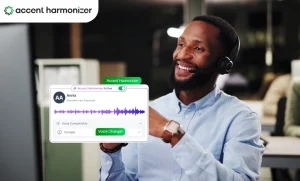
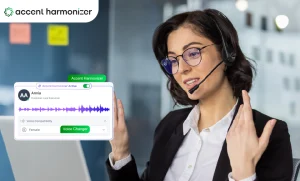
Accent Harmonizer by Omind AI, powered by Sanas, is designed for situations where the audio path is functioning, but speech comprehension still creates unnecessary repetition.
The software acts as a real-time voice-processing layer that adjusts speech patterns while preserving the agent’s individual voice characteristics, tone, and emotional delivery.
The intended use case is not: “Fix every bad call.”
It is to reduce comprehension friction on technically healthy calls where cross-accent speech patterns contribute to repeated explanations and longer interactions.
How Accent Harmonizer Fits Into the Contact Center Voice Stack
The architecture can be thought of as:
| Real-Time Audio Routing |
|---|
Source Agent Voice → Processing Virtual Audio Device → Routing Existing CCaaS Platform → Destination Customer |
Accent Harmonizer operates as a virtual audio layer rather than requiring the contact center to redesign its core telephone routing. For contact center platforms, the objective is to preserve the existing voice workflow while processing the agent’s speech before it enters the normal call path. That distinction matters to enterprise IT teams because a voice-quality intervention should not create a larger telephony problem than the one it is trying to solve.
What Enterprise Teams Should Evaluate Before Deploying Speech-Level Voice Processing?
When the diagnosis points toward speech comprehension rather than network quality, technical and operations teams should evaluate the following areas.
1. Latency
Any additional voice-processing layer introduces an obvious question: Will it make live conversations feel delayed?
Evaluate processing performance under real contact-center conditions rather than relying only on a headline latency figure.
Test:
- normal calls;
- rapid turn-taking;
- double-talk;
- different endpoint hardware;
- and production-scale agent environments.
2. Deployment Architecture
Determine exactly where the telephony integration for voice harmonization deployment sits.
Ask:
- Does it require SIP changes?
- Does it alter routing?
- Does it require new hardware?
- Does it run at the endpoint?
- What happens if the software is disabled?
- What is the rollback process?
3. CCaaS Compatibility
Confirm compatibility with the contact center’s existing environment. Enterprise deployments should not require teams to rebuild mature platforms or other CCaaS configurations simply to test speech processing.
4. Privacy and Data Handling
Voice-processing products should be evaluated like any other enterprise system touching live customer interactions.
Security teams should be established:
- what data is processed;
- where processing occurs;
- whether audio is retained;
- whether PII is retained;
- what diagnostic logs exist;
- and which systems receive processed audio.
Do not accept generic “enterprise secure” language as an architecture answer.
5. Measurement
The pilot should define success before deployment. Possible operational measures include:
- repetition requests per call;
- AHT;
- transfer rate;
- supervisor escalation rate;
- customer effort indicators;
- and call-level comprehension observations.
How to Measure Whether Speech Clarity Is Actually the Problem?
Before purchasing anything, take a sample of calls and tag the moments where the interaction slows down.
Classify each delay as:
- network/audio failure;
- background noise;
- system navigation;
- hold time;
- agent knowledge issue;
- customer verification;
- repetition;
- clarification;
- or escalation.
Then look specifically at the repetition and clarification events.
Ask:
- What information had to be repeated?
- Was the original signal technically clean?
- Did the customer misunderstand the content or fail to hear it?
- Are specific teams, regions, or call types affected more often?
- Does the same pattern appear across multiple agents?
This gives operations leaders something far more useful than a vague complaint about “call quality.” It identifies the actual failure layer.
Stop Treating Every Voice Complaint as the Same Problem
“Poor call quality” is an incomplete diagnosis. A contact center can have excellent network performance and poor speech comprehension. It can have excellent agent speech and terrible packet delivery. The system can have clean network transport and unusable background noise.
For global contact centers where technically, clean calls still produce repeated explanations, Accent Harmonizer addresses that final category: the comprehension friction that remains after traditional voice-quality problems have already been fixed.
Stop Guessing Which Layer Is Breaking Your Voice Channel
Clean audio signals don’t matter if your customers are still asking agents to repeat themselves. See how Accent Harmonizer removes comprehension friction in real time without altering your existing CCaaS routing or agent identity.